


Joint Replacement & Revision Overview
Joint Replacement & Revision Overview
A joint replacement is one of the most successful operations in medicine — and it is also a machine placed inside a living body. Machines have lifespans, and they have known failure modes. Most hip and knee replacements last for decades and are never operated on again; a minority come back for revision, an operation to replace some or all of the components. This guide treats that prospect as what it is: a predictable, plannable branch of joint surgery rather than a catastrophe. It follows one idea throughout — new pain in a joint that had been quiet always deserves assessment, because the cause is usually one of five things, and each of the five has a different answer.
-
10 years
About 95 in 100 hip replacements still in place (national registry data)
-
48 hours
Written second-opinion report after complete records arrive
-
30+
International insurers working with us on direct billing
-
124+
Countries and regions our international patients come from
What joint replacement is, and what revision means
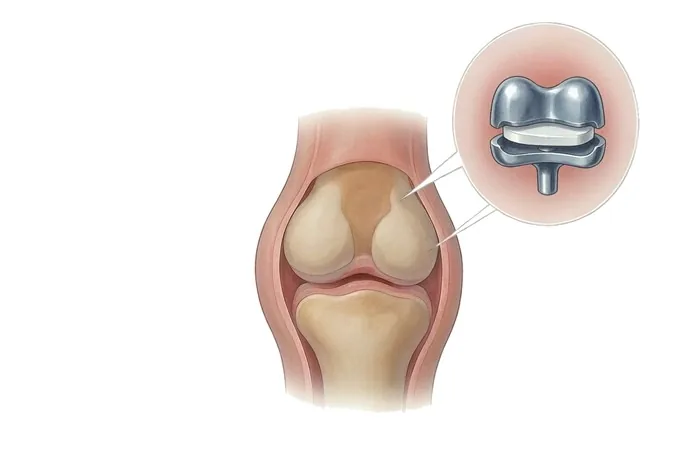
A joint replacement — an arthroplasty — removes the damaged surfaces of a joint and replaces them with an implant: a metal or ceramic ball that rides in a socket, or shaped metal components that resurface the ends of the thigh and shin bones at the knee. The implant is fixed to bone either with acrylic cement or by a surface the bone grows onto, and between the moving parts sits a bearing surface — today most often ceramic or a highly cross-linked plastic designed to shed as little wear as possible over decades of use.
Revision is the operation that replaces some or all of those components later in the implant's life. Part of a component may be exchanged, a whole component may be lifted out and replaced, or in complex cases the bone around the implant must be rebuilt before new components can be seated. Revision is often described as the most demanding work in joint surgery, and that is true — but it is also planned work with a known playbook. The failure modes are few and well understood, the assessment follows a fixed sequence, and the operations have names, steps and expected recoveries.
One idea belongs at the centre of this guide, because patients arrive carrying the opposite belief: needing a revision does not mean the first operation failed. Implants age because they are used. Bearing surfaces shed microscopic particles with every step; the bone around an implant remodels over the years; bodies fall, gain weight, live longer than their implants were designed to last. A revision at year fifteen of a comfortable hip is usually the operation working as designed over a long life, not a verdict on anyone's surgeon.
This cluster is the deep guide to the implant itself: how long replacements last, how they fail, how a painful replacement is assessed, and what each revision operation involves. The diseases that lead to replacement have their own guides — hip and knee osteoarthritis, the commonest reason for the operation, and avascular necrosis of the femoral head, which brings younger patients to surgery earlier — and the stiff or injured joint that has not yet reached replacement has its own as well.
Why replaced joints come back: the five reasons
When a replaced joint becomes painful or unreliable, the answer is almost always one of five things. The order below is roughly the order of frequency reported by national joint registries, which track every replacement in a population and are the reason this field's numbers can be stated with unusual confidence.
| Reason | What it feels like | What it means |
|---|---|---|
| Instability / dislocation | The joint gives way, feels unreliable, or fully dislocates — commonest in the first months after a hip replacement | Sometimes settled with physiotherapy and activity change; sometimes needs a procedure, from a liner change to revision of the components |
| Aseptic loosening | Start-up pain that returns each time activity begins, slowly worsening over months to years | The implant's bond to bone has loosened without infection, driven by the bone's reaction to wear particles — the classic late failure, and the reason wear-resistant bearings were developed |
| Infection | Pain at rest or at night, warmth, swelling; sometimes fever or fluid from an old scar | The most serious of the five; treatment is staged — clear the infection first, then rebuild — and the assessment is deliberately strict before it is declared |
| Periprosthetic fracture | Sudden pain after a fall or twist, and inability to bear weight | The bone around an implant breaks while the implant itself may be sound; treatment depends on whether the implant is still fixed |
| Pain that is not the implant | Aching that never quite matches the patterns above — referred from the spine, from bursae around the joint, or from tendons | The reason assessment comes before any decision: a proportion of painful replacements are revised, or spared revision, on the strength of this distinction |
Two further notes complete the picture. First, wear is not itself a symptom: modern bearing surfaces wear so slowly that wear matters mainly through the bone reaction it can eventually cause (loosening) or through the failure of an older bearing design. Second, the profile of these five has changed over time. Registries show dislocation rates falling as technique and implant design improved, and the early-generation metal-on-metal bearings that revised at unacceptably high rates have been withdrawn from primary practice — history that shapes which implants are used today.
Reading a replaced joint: implant status and symptom pattern
A painful replacement is read along two axes that are kept separate and then combined. The first is structural: what state is the implant in? The second is functional and temporal: what is the pain doing, and how fast? The two usually point at the same row of the table below — a slow build of start-up pain over months matches a slowly loosening implant; night pain over weeks raises infection; acute pain after a fall matches a fracture. Where they do not match, the assessment digs deeper before it concludes anything.
| Implant status | What imaging and tests show | What it means for treatment |
|---|---|---|
| Well fixed, functioning | No change against previous films; inflammation markers normal | Routine follow-up; the pain, if any, is looked for elsewhere — soft tissue, spine, referred pain |
| Suspected loosening | Thin lines around a component that widen across successive films; start-up pain | Serial comparison rather than a single film; surgery is discussed when the trend is confirmed, not on suspicion alone |
| Confirmed aseptic loosening | Migration or clear progressive lucency of a component; markers normal, aspiration sterile | Elective one-stage revision, timed for the patient rather than rushed — a loosening implant fails over months, not hours |
| Periprosthetic infection | Raised markers, positive aspiration or a consistent picture across several tests | Staged treatment: washout or two-stage revision depending on how established the infection is |
| Periprosthetic fracture | A break in the bone around the component, with the implant fixed or loose | Urgent: fixation alone when the implant is solid, revision when it is not — the fracture's position decides |
Against this structural axis sits the question every patient actually asks: how long does a replacement last? The most reliable answer comes from national registries, which record nearly every hip and knee replacement in a population. In Australian registry data — the largest continuous series of its kind — about 95 in 100 hip replacements are still in place at ten years, roughly 91–92 in 100 at fifteen years and about 87–88 in 100 at twenty years. Modern knee replacements show the same shape: more than nine in ten are still in place at ten years. Expressed as the patients experience it: for the majority — particularly those operated on later in life — the implant outlasts the need for it. Age at surgery is the strongest single influence on the odds of ever needing a revision, not because implants fail faster in younger patients but because younger patients live more years against a finite implant lifespan.
How a painful replacement is assessed
The sequence matters more here than in almost any other orthopaedic assessment, because the first test chosen determines whether the five reasons can even be told apart.
| Step | The question it answers | What it cannot do |
|---|---|---|
| Radiographs + previous films | Is any component changed, migrated or surrounded by new lucent lines? Comparison over time is the single most informative test in this field | A single film without comparison under-reads loosening; normal films do not exclude infection |
| Blood markers (CRP, ESR) | Is there systemic inflammation? Both are read together; both raised makes infection a live question, both normal makes it unlikely | They cannot distinguish infection from other inflammation, and they rise after recent surgery for other reasons |
| Joint aspiration | Does fluid drawn from the joint grow an organism? Taken before antibiotics so the answer is not destroyed by them | A single negative aspiration does not fully exclude infection when suspicion is high — it is repeated rather than treated as final |
| CT | How much bone remains around each component, and is it fixed? The planning map for any revision | It adds little to the infection question; metal limits some sequences |
| MRI (metal-reduction sequences) | Soft tissue and bone around the implant: collections, muscle, the bone-metal interface | Not a first-line test; used where the question is soft tissue rather than fixation |
An assessment is not complete until its report answers four things: which component (or whether the pain is from somewhere else at all), whether that component is fixed or loose, whether the picture is infected or aseptic, and how much bone stock remains. A report that says only "painful right hip replacement" leaves every one of those questions — and therefore the operation — unchosen. The same report also protects the patient from the opposite error: operating on an implant that is fine, for pain that came from the back.
Why patients travel to China for joint revision
Primary joint replacement is standardised the world over; revision is where planning capability separates providers. A revision is performed against bone that previous surgery has altered, with fewer standard options and a wider range of implants that must be available on the day. The centres that do this well are the ones that plan hardest before the skin is cut.
Records reviewed by a joint specialist receive a written opinion within about 48 hours of complete records arriving, and for a replaced joint that opinion needs the series, not just the latest film: the operative notes of the original surgery, the implant identification if known, and every available previous radiograph — because in this field the comparison is the diagnosis. Our centres use robotic-assisted planning for knee and hip replacement, which turns implant position into a plan made before surgery rather than an estimate made in theatre, and 3D-printed planning models and patient-specific augments — developed with the orthopaedic 3D printing centre established with the Shanghai Ninth People's Hospital team — are used in complex and revision cases where bone loss must be reconstructed rather than simply bypassed.
Recovery is managed on an enhanced-recovery pathway: regional anaesthesia where suitable, standing on the day of surgery where the operation allows, and structured rehabilitation with nine standardised rehabilitation stages, discharged against a milestone list rather than a calendar. For staged infection treatment, the two operations and the interval between them are planned as one episode of care, with the interim months coordinated rather than left to chance. Complete treatment in China typically runs at 30–50% of comparable care in Europe or the United States. We work with more than 30 commercial insurers for direct billing and have received patients from 124 countries and regions.










