
2026-09-11
On the morning of August 27, a warm farewell unfolded in a ward at Foshan Fosun Chancheng Hospital, a leading private hospital in China. Specialists from the Departments of Otolaryngology, Vascular Surgery and Neurosurgery visited Mr. Zakir, a patient from Bangladesh, to assess his postoperative recovery, give him detailed discharge and rehabilitation instructions, and take a group photo with him before his journey home.
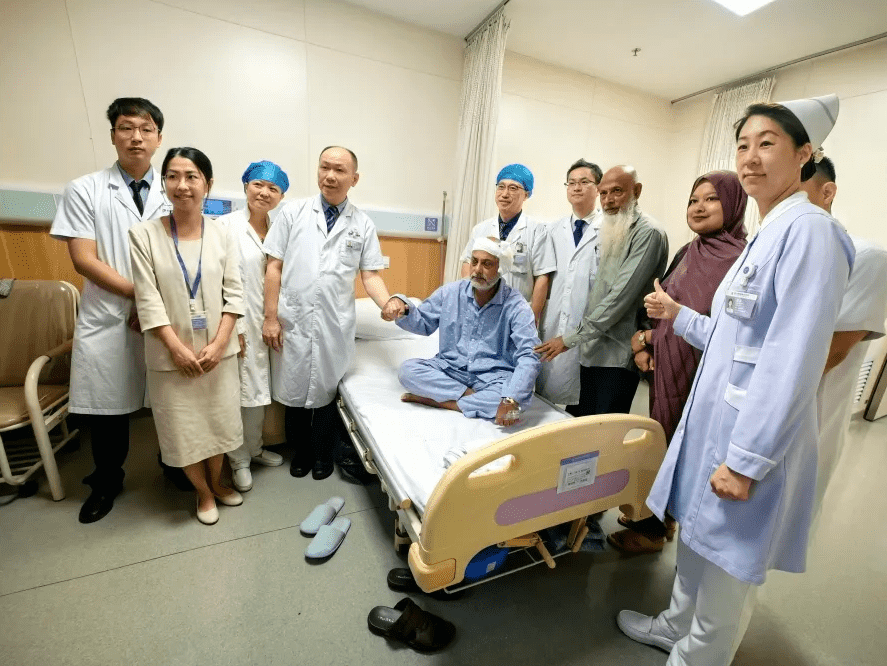
Three weeks earlier, the same team had performed a highly complex operation lasting nearly 20 hours, successfully removing an aggressive glomus jugulare tumor extending across the skull base, temporal bone and upper neck. Remarkably, no blood transfusion was required throughout the procedure.
Now recovering well and ready for discharge, Mr. Zakir gave the Chinese medical team a thumbs-up and repeatedly expressed his gratitude: “Thank you, China.”
Seeking Care Across Borders
The story began about a year ago, when Mr. Zakir was diagnosed in Bangladesh with a left-sided glomus jugulare tumor. These tumors are highly vascular and can be locally aggressive, potentially extending toward the skull base, intracranial structures and the upper cervical region. Doctors in Bangladesh told him that the risks of surgery would be difficult to manage locally, and recommended seeking treatment abroad.
Mr. Zakir and his family initially considered destinations closer to home, including Thailand, Singapore and India. “They told me they would first examine me and then decide what could be done,” he recalled. The uncertainty made him hesitate. He later learned that Foshan Fosun Chancheng Hospital had an experienced team capable of managing complex skull-base tumors. “They told me there were experienced doctors here and that this type of surgery could be performed,” he said.
Having never visited China before, Mr. Zakir naturally had concerns about undergoing a major, potentially life-threatening operation in an unfamiliar country and healthcare system. After several rounds of communication with the medical team, his confidence gradually grew. Once he arrived in Foshan, the professionalism and attentiveness of the doctors and nurses further reassured him. “The doctors and nurses were very careful, responsible and kind. Every step of the process made me feel safe,” Mr. Zakir said. “From that moment, I felt that maybe everything was going to be all right.”
A 20-Hour Multidisciplinary Challenge
Glomus jugulare tumors arise in the region of the jugular foramen near the ear, and are widely regarded as among the most technically challenging tumors in otolaryngology and skull-base surgery. In Mr. Zakir’s case, the tumor was particularly extensive: it involved three anatomical regions — the skull base, temporal bone and upper neck — and had already extended into the dura mater.
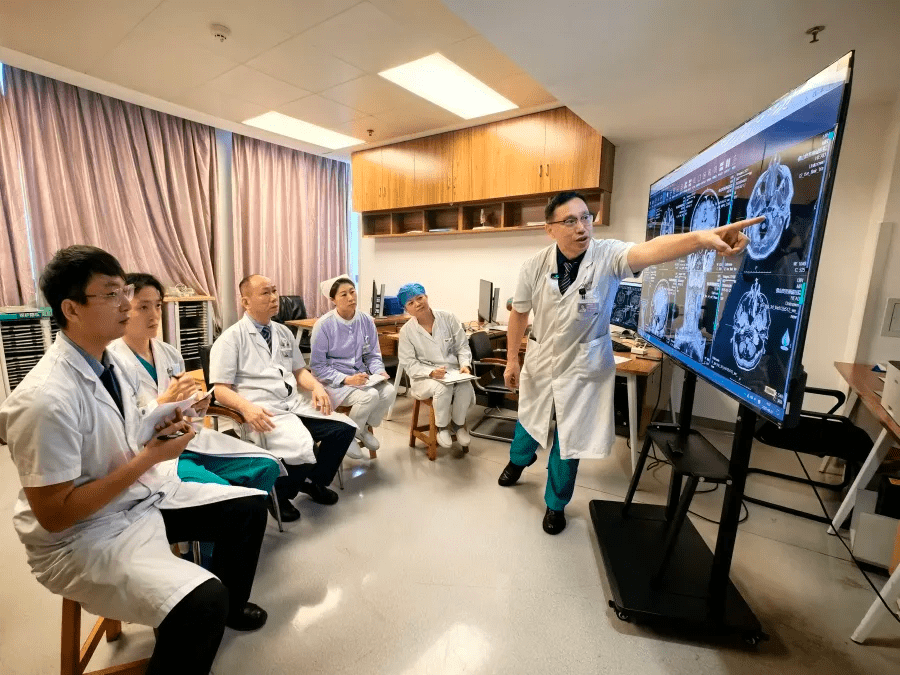
MDT at Foshan Fosun Chancheng Hospital
“The biggest challenge with this disease is that the tumor is extremely vascular and locally invasive,” explained Dr. Mei Xiaofeng, Director of the Department of Otolaryngology at Foshan Fosun Chancheng Hospital. “The tumor was located very close to the internal carotid artery. The facial nerve passed through the affected area, and the auditory nerve was also nearby. Any mistake during surgery could have resulted in massive bleeding, facial paralysis, hearing loss or even a life-threatening complication.”
Such a complex operation could not be managed by a single specialty alone. Before surgery, the hospital convened a multidisciplinary team (MDT) involving specialists from Otolaryngology, Vascular Surgery, Neurosurgery, Radiology and Anesthesiology. The team carefully reviewed the potential risks and developed detailed contingency plans for each stage of the operation.
Following comprehensive preoperative assessment and planning, the surgery began at 10:00 a.m. on August 6. The operating team included four chief physicians: Dr. Mei Xiaofeng, Director of Otolaryngology; Dr. Du Guoneng, Director of Vascular Surgery; Dr. Chen Baozhong, Director of Neurosurgery; and Dr. Zheng Ligang, Chief Physician and Executive Deputy Director of Otolaryngology.
The team adopted a four-stage surgical strategy — Protection, Dissection, Resection, Reconstruction. They first identified and protected critical nerves and blood vessels, then carefully separated the tumor from surrounding healthy tissue. A total temporal bone resection was subsequently performed to achieve complete tumor removal, followed by dural repair and reconstruction. At approximately 5:00 a.m. on August 7, after nearly 20 hours in the operating room, the procedure was successfully completed.
Throughout the operation, specialists from different disciplines worked across several complex anatomical regions, coordinating closely at each stage. Through meticulous dissection and precise intraoperative hemostasis, the team kept blood loss to a very low level — no blood transfusion was required during the entire procedure.
“This surgery was particularly difficult because the tumor extended across several completely different anatomical regions, including the neck, intracranial area and middle ear,” Dr. Mei explained. “We had to manage major high-risk blood vessels and prevent catastrophic bleeding, while also protecting critical structures such as the facial nerve.
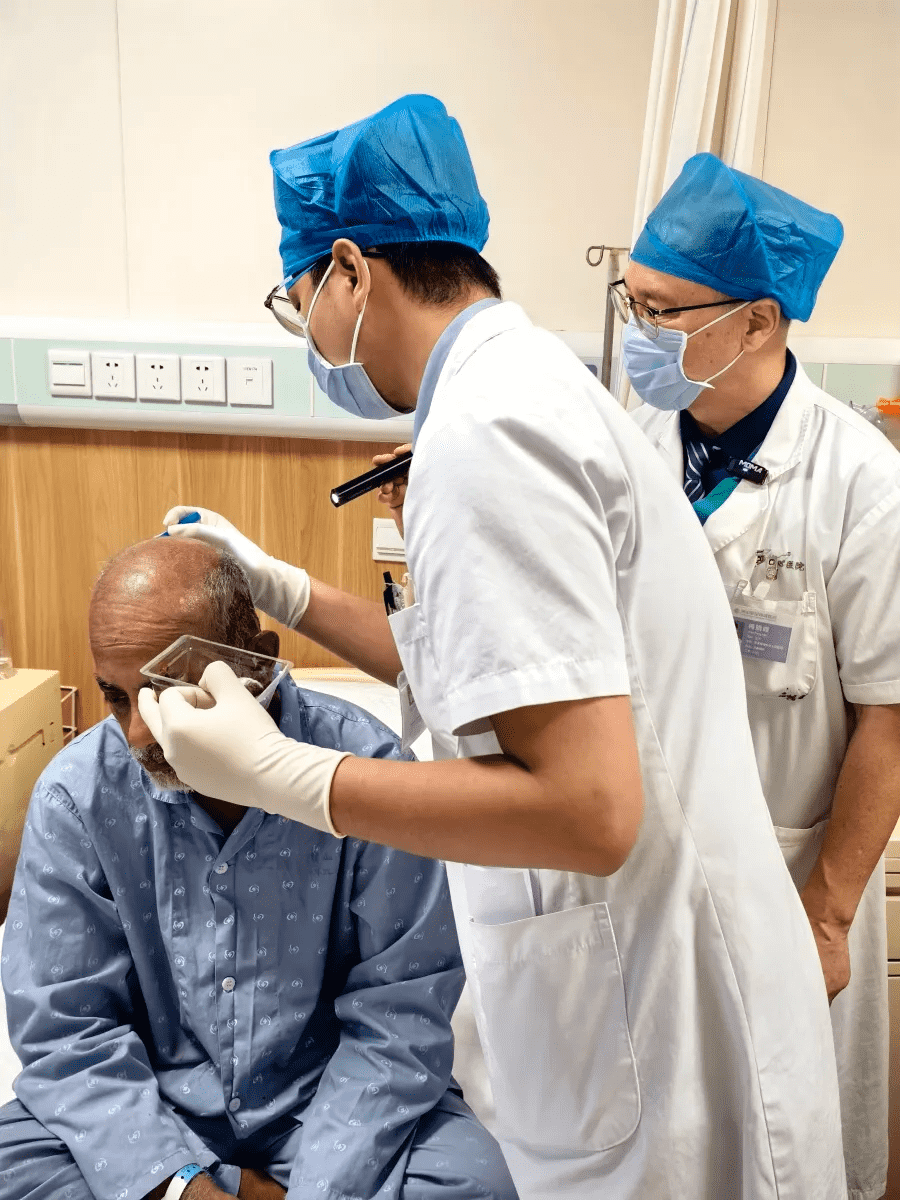
The medical team checks the patient’s surgical incision
Any problem at any stage could result in functional impairment or even threaten the patient’s life. A case this complex is extremely difficult for a single department to manage independently.”
According to Dr. Mei, multidisciplinary collaboration is not simply about bringing several specialists into the same operating room. “It means allowing each specialty to contribute its greatest technical strength, and then connecting those strengths seamlessly throughout the entire procedure.”
Beyond One Successful Surgery
Three weeks after surgery, Mr. Zakir’s hearing remained at its preoperative level. The mild facial weakness he had experienced before surgery had completely resolved, and symptoms such as headaches had disappeared. “China has very good medical technology,” he said. “There are advanced technologies here, and the doctors are very experienced.”His experience reflects a broader trend.
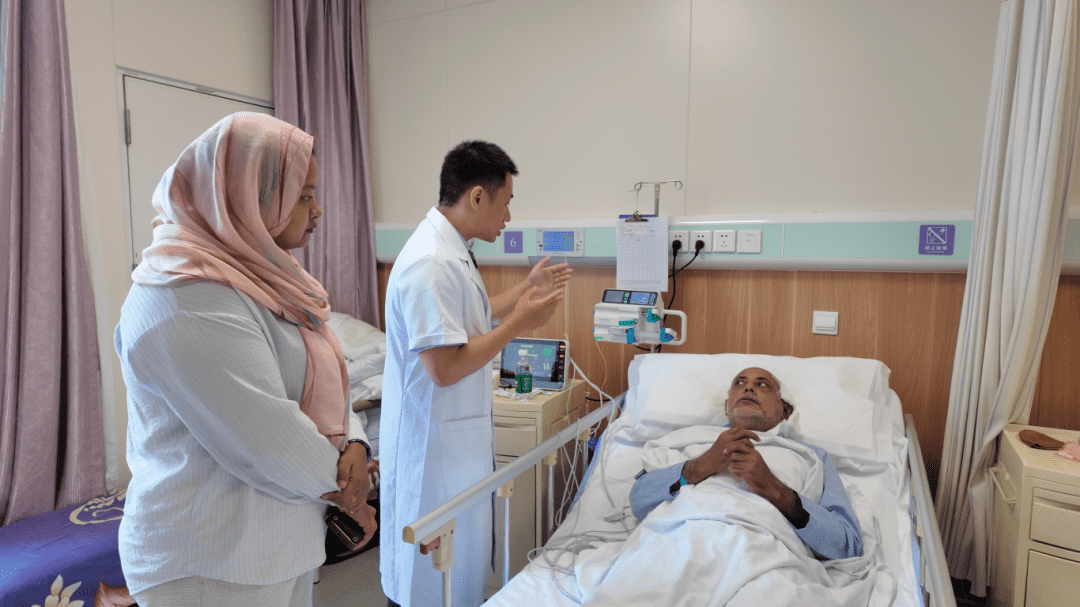
Postoperative Ward Round
As China’s medical capabilities continue to advance, an increasing number of international patients are beginning to consider China as a destination for complex medical treatment. This is more than a change in the direction of cross-border healthcare — it also reflects growing international recognition of Chinese medical expertise in selected areas involving complex and difficult conditions.
For Mr. Zakir, traveling from Bangladesh to Foshan was therefore more than a decision about where to undergo surgery. It was also a vote of confidence in Chinese medical expertise. In highly challenging fields such as skull-base tumor surgery, Chinese medical teams have continued to develop multidisciplinary treatment models, refined approaches to functional preservation, and comprehensive perioperative management strategies — offering international patients another option for complex care. For years, Chinese physicians traveled abroad to study advanced medical techniques and gain international experience; today, more international patients are choosing to travel to China for treatment. This transformation has not been built on slogans, but on years of clinical practice, technical development and successful outcomes.
The nearly 20-hour operation performed at Foshan Fosun Chancheng Hospital is one vivid example of that continuing change. International patients seeking complex surgical care in China can learn more about the hospital’s international healthcare services, including multilingual support, direct billing with international insurers, and neurosurgical care at the Fosun Health Brain Center.
Related Reading
· MDT Solves Transnational Challenges: Foshan Fosun Chancheng Hospital Safeguards a New Life for a Bangladeshi Woman
· When Precision Preserves a Future: A 20-Year-Old Bangladeshi Girl with a Rare Kidney Tumor Adjacent to Major Vessels
· Foshan Fosun Chancheng Hospital’s Multidisciplinary Team Conquers a “Surgical Everest”
· Where Care Meets Precision: How Foshan Chancheng Hospital Helps Head and Neck Cancer Patients
· New Chapter in China-Bangladesh Healthcare: Foshan Chancheng Hospital Brings Expertise and Compassion to Dhaka
· More Patient Stories from Foshan Fosun Chancheng Hospital
Source: Guangzhou Daily Xinhuacheng, republished by Fosun Health, August 28, 2026. Patient name is used as published.