


Thyroid Disorders Overview
Thyroid Disorders Overview
Thyroid disorders are not one disease. They are a position on two separate axes — how much hormone the gland is making, and what the gland itself looks like — and the two questions are answered by two different tests: a blood test answers the first, an ultrasound answers the second. Almost everything that confuses people about the thyroid comes from collapsing those two questions into one. This guide is built to keep them apart.
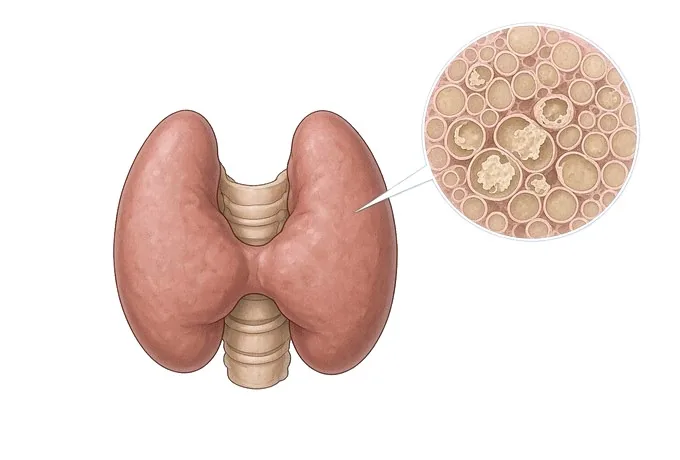
-
Two axes, not one disease
how much hormone the gland makes, and what the gland looks like — two questions, two tests
-
Blood answers function
TSH and free T4 move in opposite directions, so a high TSH means an underactive gland
-
Adjusted against TSH
a changed dose is re-measured about six weeks later — that rhythm sets the review interval
-
Thyroid disease is a subspecialty here
within our endocrinology department, alongside diabetes, metabolic and bone disease
Thyroid disorders are two axes, not one disease
The thyroid is a small gland at the front of the neck that makes two hormones, thyroxine (T4) and triiodothyronine (T3). Between them they set the pace at which the body's cells work: how quickly energy is used, how fast the heart beats, how the gut moves, how warm a person feels, and how the skin, hair and periods behave. The gland itself is controlled by the pituitary, a small gland at the base of the brain, which releases thyroid-stimulating hormone, TSH.
TSH is a control signal rather than a measure of power. The pituitary releases more of it when the gland is producing too little hormone and less when it is producing too much, and that feedback loop is why TSH and the hormone it stimulates move in opposite directions. It is also why a single number read on its own so often leads to the wrong conclusion, which is covered in the section on reading the pair below.
What follows from that is the practical point of this whole guide. The two things that can go wrong are independent of each other. A gland that looks entirely normal on scanning can be making far too little hormone — which is the usual appearance of autoimmune thyroiditis. A gland carrying several nodules can be making exactly the right amount. That is why the assessment asks two separate questions and uses two separate tests, and why a useful answer has to name a position on each.
The function axis and the structure axis
The function axis describes how much hormone the gland is delivering. It runs from an underactive gland, through normal, to an overactive one, and it is established by a blood test — TSH together with free T4. The structure axis describes what the gland looks like: whether it is of normal size and shape, whether it is diffusely enlarged, which is what a goitre means, and whether it carries one or more nodules. It is established by an ultrasound of the neck.
| Function | Structure | What it usually means, and where it leads |
|---|---|---|
| Overactive | Diffusely enlarged | The pattern most often seen when antibodies are driving the whole gland; the eye changes that sometimes come with it are covered in the thyroid eye disease guide |
| Overactive | One or more nodules | One nodule working on its own account; an uptake scan is usually what separates this from the diffuse form |
| Normal | One or more nodules | The commonest position of all: the blood tests are normal and the finding is structural, which is where the thyroid nodules guide takes over |
| Underactive | Normal or small | The commonest appearance of autoimmune thyroiditis, where function fails while the scan looks unremarkable |
| Underactive | Diffusely enlarged | Seen with iodine deficiency and with the goitrous form of autoimmune thyroiditis |
| Normal | Diffusely enlarged | A goitre with function preserved: worth an ultrasound and periodic review, and not automatically a problem |
The confusion worth naming, because it happens in both directions. "Does my thyroid look normal?" is an ultrasound question, and "Is my thyroid working normally?" is a blood question. A normal ultrasound does not rule out a hormone problem — a normal-looking scan in someone with a very high TSH is one of the commonest combinations in clinic — and normal blood tests do not rule out a nodule, because the tests measure different things.
It also explains why one test cannot be traded for the other. A report that answers one axis has answered half the question, and the second half is not optional. What each test contributes, and in what order they are arranged, is set out on the diagnosis page.
Why the symptom list cannot answer the question
The symptoms of an underactive gland are real, and almost every one of them is shared with something more common. Tiredness, feeling cold, gaining weight without changing anything, constipation, dry skin, hair thinning, low mood, poor concentration, heavier or irregular periods — each has an explanation that is more likely than thyroid disease in most people who have it.
| Symptom | Explanations that are more common than thyroid disease |
|---|---|
| Tiredness that rest does not fix | Shortened or broken sleep, iron deficiency, low mood, sleep apnoea, and simply working long hours |
| Weight gain without a change in eating | A gradual change in activity, ageing, some medicines, and the pattern of the year rather than of a month |
| Feeling cold | Iron deficiency, low body weight, a cold environment, and the ordinary range of what people notice |
| Constipation | Low fibre and fluid intake, reduced activity, medicines, and irritable bowel syndrome |
| Hair thinning | Iron deficiency, shedding after an illness or a pregnancy, and inherited pattern loss |
| Low mood and poor concentration | Depression and anxiety, poor sleep, stress, and alcohol — all of which also deserve treatment in their own right |
| Menstrual change | Perimenopause, polycystic ovary syndrome, contraception, fibroids, and the years either side of a pregnancy |
Two errors follow from that, in opposite directions. The first is the one that gets written about: because none of the symptoms points specifically at the thyroid, an underactive gland spends years being called stress, or age, or depression. The second is quieter and just as common — a borderline result gets treated while the real cause of the tiredness, whether anaemia, depression, sleep apnoea or something else, is never looked for.
The conclusion therefore has to come from a blood test rather than from a checklist. That does not make the checklist worthless: it decides whether the test is worth doing at all, and it is part of what a borderline result is judged against. How the symptoms are used, and what they do and do not establish, is set out on the symptoms page.
Reading the pair: TSH and free T4 move in opposite directions
TSH comes from the pituitary and tells the thyroid to work harder. When the gland is failing, the pituitary increases the signal; when the gland is overproducing, it withdraws it. The two measurements therefore move in opposite directions, and the pair is what is read — never one of them alone.
| TSH | Free T4 | What it is called, and what it means |
|---|---|---|
| High | Low | An underactive gland with the hormone level confirming it — the pattern that usually leads to replacement |
| High | Normal | A subclinical underactive gland: the hormone level is holding, and treatment is a decision rather than a reflex |
| Low | High | An overactive gland with the hormone level confirming it — the pattern that leads to the three treatment categories |
| Low | Normal | A subclinical overactive gland: whether it needs anything depends on the degree, the age and the heart rhythm |
The misreading to avoid is the one the name invites. A high TSH does not mean a strong thyroid; it nearly always means the opposite. People who read a raised TSH as evidence of an overactive gland arrive at their appointment expecting the reverse of what they will be told, and the conversation is spent undoing that before anything useful can be discussed.
The second point is that subclinical is not a decision. Where TSH has moved and free T4 has not, whether treatment is appropriate depends on how far it has moved, whether antibodies are present, what symptoms there are, your age, whether a pregnancy is planned, and whether anything makes the heart sensitive to thyroid hormone. A single abnormal measurement is also often transient: intercurrent illness, a recent iodine load, pregnancy, several medicines, and even the time of day all move TSH, which is why a repeat sample is usually the next step rather than a prescription.
What a full assessment contains, and what follow-up looks like
An assessment has three jobs: place the person on the function axis, place them on the structure axis, and say whether anything found on either calls for action now. A consultation that produces a prescription without the first two has skipped what makes the prescription appropriate.
| Test | The question it answers |
|---|---|
| TSH | Is function normal, and in which direction has it moved? The first-line test and the most sensitive single measure |
| Free T4, read with the TSH | Does the hormone level confirm the direction, or is the abnormality confined to the control signal? |
| Free T3, in selected cases | Is there overactivity that free T4 has not shown, and how marked is it? Not a routine addition |
| Antibodies — against thyroid peroxidase, and against the TSH receptor | Is autoimmunity the background, and which kind? This is what separates the common causes from one another |
| Ultrasound of the thyroid | What does the gland look like — its size, its texture, and whether a nodule is present with what features? |
| Fine-needle aspiration of a nodule, where the features warrant it | What is this nodule made of? Decided by size and ultrasound appearance, not by the blood tests |
| An uptake scan, where the cause of overactivity is unclear | Is the whole gland overworking, or one nodule? The answer changes which treatment is discussed |
| A repeat sample after an interval | Was the first result real? A single abnormal measurement is often transient |
The part most often left out of a consultation is what happens afterwards, and in thyroid disease it is the part that decides everything practical. A change in dose is judged about six weeks later, because that is roughly how long a new dose takes to reach a steady state in the body. Measuring sooner gives a number that reflects the change rather than the result of it, and acting on that number is how people end up on a dose that overshoots. Once the result has settled into range and stayed there, the interval between checks lengthens; during pregnancy, after any dose change, and after any intercurrent illness, it tightens again.
This is what makes a visit to another country realistic rather than theoretical: the adjustment is measured in weeks, and the review can be done anywhere the TSH can be drawn — provided the target and the date travel with the person.
Thyroid function testing, thyroid ultrasound and, where the features warrant it, fine-needle aspiration of a nodule are carried out by our endocrinology department, whose subspecialty structure covers thyroid disease alongside diabetes, obesity and metabolic disease, pituitary, adrenal and gonadal disease, and bone metabolism. The results are read together with the history rather than one at a time. Two endocrinologists lead that work: Dr Jiang Yiwen, whose published interests are thyroid disease and diabetes with its complications, and Dr Li Meng, whose published interests include thyroid disease, the acute and chronic complications of diabetes, secondary hypertension, uric acid disorders and gout, adrenal and pituitary disease, and obesity.
Why patients come to China for thyroid care
What international patients come for is almost never a medicine unavailable at home — levothyroxine is the same tablet everywhere. It is the assembly: both axes established rather than one; the blood tests read as a pair instead of a single TSH; an ultrasound with a structured description; a subclinical result handled as a decision rather than as a reflex prescription; and a written plan that names the dose, the target and the date of the next test.
Our hospital is a Class A tertiary general hospital with more than sixty years behind it, and thyroid disease is one of the subspecialties within our endocrinology department. The same department holds diabetes, obesity and metabolic disease, pituitary, adrenal and gonadal disease, and bone metabolism, which matters when a thyroid result is not the whole picture — a person with both a thyroid disorder and diabetes, or with a thyroid disorder and osteoporosis, is assessed once rather than in separate places. Where a nodule needs characterising, the department performs thyroid nodule aspiration to establish what it is early rather than watching it indefinitely.
Our hospital's traditional Chinese medicine department has been in place since the hospital was founded, and its Guoyi Hall is where senior physicians recognised at national and Guangdong provincial level see patients. Integrated Chinese and Western medicine is a designated specialty in Chancheng district. Acupuncture and tuina, including traditional tendon-regulating methods and Qing-dynasty bone-setting techniques, are part of that department's work, and one-finger Zen massage is national intangible cultural heritage.
Where a patient wants a combined approach, the position we would want stated to us is this one. It is an addition to the hormone replacement, not a substitute for it: the TSH measurements continue on the same schedule, so any effect is visible rather than assumed, and anything taken has to be known to the clinician managing the thyroid, because herbs and supplements can interact with prescribed medicines and some preparations contain iodine.
Most of the assessment can be established before travel is arranged. Sending your thyroid function results with their dates and reference ranges, your antibody results, any ultrasound report and the exact dose and brand of anything you take lets a clinician say whether both axes have been placed and which missing test is worth doing where you are. How to send that is on the practical questions page.










