


Trigeminal Neuralgia Overview
Trigeminal Neuralgia Overview
Trigeminal neuralgia is a pain disorder of the fifth cranial nerve, and it is recognised by the shape of the pain rather than by any test. The paroxysm is the signature: a stab of electric-shock pain lasting a fraction of a second to two minutes, confined to one or more divisions of the nerve, brought on by a stimulus that should be trivial — a touch, a draught, a toothbrush, chewing, speaking — and followed by a refractory period during which a second attack cannot be provoked. Between paroxysms the person is usually pain-free, and that interval is part of the diagnosis rather than a detail. Three things follow. The first is that this is a nerve disorder and not a dental one, which is why the commonest thing that happens to someone with it is dental work that removes teeth without removing pain. The second is that the diagnosis is made from the history, and the imaging that is done is looking for a cause , not for the disease. The third is that where the pain has this shape, one medicine class is both the treatment and the test, and a dramatic response to it supports the diagnosis. Where the pain is continuous, burning rather than electric, or where there is numbness, the pattern is a different one and it is managed differently.
-
48 hours
written opinion once complete records arrive
-
The history
is the diagnosis — no test returns positive for it
-
One medicine class
first, and reviewed before anything else is considered
-
124+
countries and regions our international patients come from
What trigeminal neuralgia is
The trigeminal nerve is the fifth cranial nerve and the main sensory nerve of the face; it has three divisions, covering the forehead and eye, the cheek and upper jaw, and the jaw and chin. In this condition the nerve produces pain in paroxysms, and the paroxysm has a shape that is unlike almost anything else in medicine.
What the attack is: a stab, an electric shock, a shooting or stabbing pain that reaches its maximum almost immediately and lasts from a fraction of a second to two minutes. It is severe — among the worst pains described — and it is unilateral, confined to one or more divisions and not crossing the midline. What provokes it: a stimulus that should be trivial. A draught of air, a touch on the face, washing, shaving, applying make-up, brushing the teeth, a sip of something cold, chewing, speaking, swallowing, or a smile. What follows it: a refractory period, lasting seconds to minutes, during which a second attack cannot be provoked however hard the trigger is pressed. And what lies between: often nothing at all.
Two things about that shape are the reason this page exists. The first is that the pain is referred into the teeth and jaw because that is where the nerve goes, which is why so much of this condition is first treated with a drill. The second is that the diagnosis is available from the description alone: no blood test and no scan returns positive for it, and a person who can say "it lasts a few seconds, a draught sets it off, and I cannot get a second one straight afterwards" has given the clinician most of what is needed.
What the condition is not is a continuous ache, a burning pain, or a numbness — and where those are present, the pattern is a different one that is managed differently. That distinction is set out on the treatment page, because it is the single commonest reason a treatment fails.
The three categories, and what each one changes
The classification here is not about severity. It is about what is causing the nerve to behave this way, and it decides what the workup has to look for.
| Category | What lies behind it | What it changes |
|---|---|---|
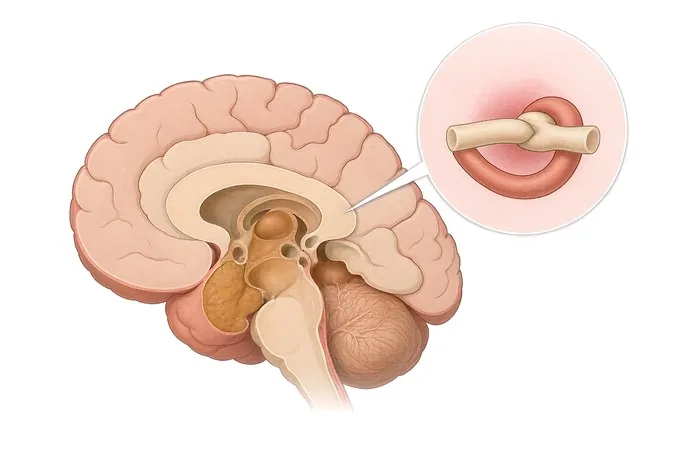
| Classical | A blood vessel in contact with the nerve where it leaves the brainstem, with morphological change in the nerve | The medicine is first; where it stops working, decompression of the vessel is a real option rather than a last resort |
| Secondary | An identifiable disease — demyelination, a tumour or cyst at the skull base, or another structural cause | The workup has to find it, and the treatment is aimed at it as well as at the pain. Bilateral pain and numbness point here |
| Idiopathic | No cause found on the investigations that were done | Treated as the pain disorder it is. Where the pattern later changes, the question is asked again rather than closed |
One practical note on that middle row. Bilateral pain — pain on both sides — is not a coincidence here; it is a reason to look for a secondary cause, most often demyelination, and it is the single finding most likely to change the plan. So is any numbness on the face, or a pain that is continuous rather than paroxysmal.
What makes facial pain urgent
Most facial pain is not an emergency and most of it is not this condition. What follows is what changes the timescale, and what each one warrants.
| Feature | What it warrants |
|---|---|
| Pain on both sides of the face | Not a coincidence. Assessment, and imaging looking for a secondary cause — demyelination most of all |
| Numbness, or a change in sensation on the face | Not part of the usual pattern. Assessment now, and the structural causes excluded rather than assumed away |
| Pain that is continuous, burning or aching rather than electric | A different pattern, managed differently. Named rather than treated as this condition by default |
| New severe headache with facial pain, jaw claudication, or visual change in someone over fifty | Not this condition. An urgent assessment for a different diagnosis, and the inflammatory markers that belong to it |
| Facial weakness, or a change in hearing, speech or swallowing | A skull base or brainstem problem until shown otherwise. Imaging now rather than at the next appointment |
| Pain that has stopped responding to a medicine that was controlling it | A review rather than a dose escalated by telephone. The first question is whether the pattern has changed |
| Pain that has led to not eating or not drinking | Not a footnote. Weight, hydration and nutrition are part of the assessment rather than a consequence to be noted |
The error to avoid is the reverse of this table too: pain that has the classical shape being investigated for months as dental or sinus disease while the person loses weight and stops going out. That is the commoner of the two errors, and it is more avoidable.
How the diagnosis is assembled
The assessment is a history, an examination, and — in most people — one scan. The history does the diagnosing; the scan does the looking for a cause.
| Item | What it establishes | What it does not do |
|---|---|---|
| The history, taken in the pain's own terms | How long an attack lasts, what provokes it, whether there is a refractory period, and which division it is in. This is the diagnosis | Not a screening question asked in passing. A person who cannot finish a sentence describing an attack has usually not been asked properly |
| Examination of the face | Sensation in each division, the corneal reflex, and whether anything else in the nervous system is involved | Not normal just because the pain is. A normal examination is expected here, and that is the point of doing it — what is not normal changes the diagnosis |
| MRI with a dedicated trigeminal protocol | Whether a vessel is in contact with the nerve where it leaves the brainstem, which is the finding that makes decompression a real option | Not a test that makes the diagnosis, and not answered by a routine brain scan. The sequences and the level have to be right |
| MRI to exclude a structural cause | A tumour, a cyst, or another lesion at the skull base, and demyelination where that is a possibility | Not excluded by a report that says "no acute intracranial abnormality" without saying what was looked at along the nerve |
| Blood tests where they are indicated | The causes of facial pain that are treated differently, and the baseline before the medicine is started | Not a screening panel done for its own sake. What is tested follows from what the history suggested |
| Dental and sinus assessment | Whether there is a dental or sinus source that accounts for the pain | Not a reason to remove teeth before the pattern has been named. Teeth removed for this pain do not stop it |
| The response to the first medicine | Where the pain is paroxysmal, a dramatic response to carbamazepine or oxcarbazepine supports the diagnosis as well as treating it | Not a diagnostic test in the formal sense, and not a reason to continue a medicine that is not tolerated in order to prove something |
| A repeat scan where the pattern changes | Whether something new has appeared, in someone whose pain has changed character or whose examination has changed | Not a routine. It is done because a question was raised rather than because a year has passed |
Why patients travel to China for a trigeminal neuralgia assessment
Most of what families are looking for here is not a new treatment. It is an answer to two questions: whether the pain really has this shape, and whether the scan that was done was the scan that answers anything. Both are commonly answerable from records, which is why the first step is a written opinion rather than a journey.
Where the person does need to be here, what an assessment adds is the assembly: neurology, imaging and the surgical and radiosurgical options contributing to one plan rather than three letters, with the trigeminal sequences performed as part of the study rather than on request. The programme is supported by 3.0T magnetic resonance imaging, dual-source computed tomography, positron emission tomography, three-dimensional digital subtraction angiography, long-term video electroencephalography, the full spinal fluid set, and evoked potentials.
What should not be assumed is that a particular procedure is available here, or that a procedure is the right next step at all. Where a medicine recommended or a procedure considered is not carried out within this pathway, that is named at the outset, before any payment is discussed — not at the end of a workup. Where the honest answer is that the plan already running is the right one and nothing here would change it, that is said as plainly as the alternative, and it is not converted into an itinerary.










