


Thyroid Nodules Overview
Thyroid Nodules Overview
The thyroid is a small gland that sits at the front of the neck, in front of the windpipe, and makes the hormone that sets the pace of the whole body. A nodule is a lump within it — an area that looks different from the surrounding gland — and the first thing worth saying is how ordinary they are. Nodules are found in a substantial share of adults, they become more common with age, and the great majority are not cancer. The modern problem with thyroid nodules is therefore not that they are dangerous, but that they are so often found by accident, on a scan performed for something else, and that an unexpected finding in the neck is frightening in a way that a normal test result is not. What settles the question is a sequence rather than a feeling. A blood test shows what the gland is doing, because a nodule and a thyroid problem are two separate things. An ultrasound describes the nodule in a standard vocabulary — what it is made of, how it reflects sound, its shape, its margins, whether any tiny calcifications are present — and those features, read together, place it in a risk category. Fine-needle aspiration is then offered when the category and the size together justify it. Most patients, after that sequence, are told something genuinely reassuring: this nodule is not suspicious, and it will be watched. Some need treatment for pressure or appearance rather than for risk. A minority need an operation, and when they do, how much is removed is decided by the needle result and by the whole clinical picture — not by the size of the lump and not by the patient's anxiety.
-
A nodule is not the same as a thyroid problem
the gland's hormone output and the lump are assessed separately, and treatable separately
-
It is the shape, not the size, that raises suspicion
several ultrasound features read together decide who needs a needle
-
Most needle results are benign
the value of the test is that it lets a nodule be left alone with confidence
-
48 hrs
from complete records to a personalised assessment plan
The thyroid gland, and what a nodule in it actually is
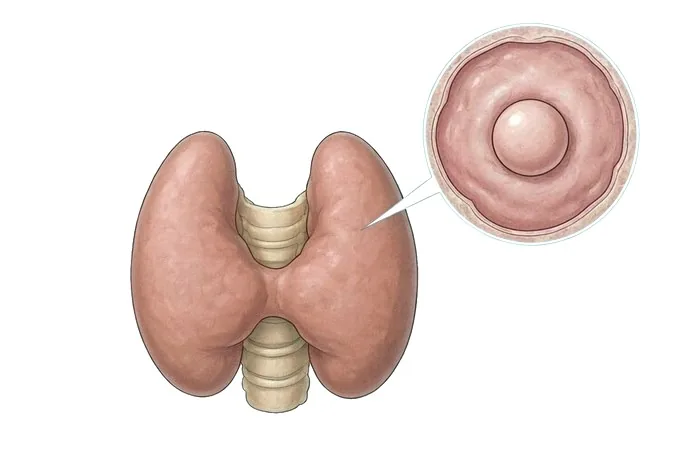
The thyroid sits at the front of the neck, wrapped around the windpipe, with two lobes joined across the middle by a bridge of tissue called the isthmus. It makes thyroid hormone, which sets the pace of metabolism — how fast the body burns energy, how warm it feels, how the heart beats, how the gut works. That is what the gland does. A nodule is about what the gland is: a discrete area within it that differs from the tissue around it.
Almost every nodule a patient is told about was found by a machine rather than by the patient. Nodules turn up on ultrasound, on CT of the neck or chest, and on scans done for completely unrelated reasons, and they become more common with every decade of life. The finding creates a specific and modern kind of worry — an abnormality discovered in someone who felt completely well — and the answer to it is not reassurance but characterisation. A nodule that has been properly described is either a nodule that needs watching, a nodule that needs sampling, or a nodule that needs treating for a reason other than risk.
Two questions get confused, and separating them is the point of this page. The first is what is the gland doing — is it making too much hormone, too little, or the right amount? The second is what is this lump — is it the ordinary kind of nodule, or something that needs a needle? These are independent. A patient can have a perfectly normal thyroid and a nodule that needs investigation. A patient can have an overactive thyroid and a nodule that is entirely innocent. Treating one has no bearing on the other, and each has its own test.
It is also worth saying what a nodule is not. It is not a diagnosis of cancer, and the large majority of nodules are not cancer. It is not a reason to have an operation by itself — most nodules are never operated on. And it is not something a patient has caused by diet, stress or behaviour. Nodules form as the gland renews itself over decades; that is why they become common with age, and why finding one is usually the beginning of a structured assessment rather than the beginning of an illness.
Describing a nodule: tissue, number, ultrasound features and function
A nodule is described along four axes at once, and the vocabulary is worth knowing because it is the vocabulary used to explain what happens next.
| Axis | What it means | Why it matters |
|---|---|---|
| What it is made of | Solid, cystic (fluid filled), or a mixture of the two | A purely fluid-filled nodule is almost always benign and often needs no sampling; a solid nodule is the one that has to be described in detail |
| How many | A single nodule, or several nodules within an enlarged gland (multinodular) | Having several nodules does not multiply risk, but it does mean the ultrasound report must say which one each comment refers to |
| Ultrasound features | How it reflects sound, whether it is taller than it is wide, whether its margins are smooth, and whether there are tiny bright specks (microcalcifications) | These features, scored together, are what place the nodule in a risk category — the basis of any decision to sample it |
| Function | Non-functioning (most), or autonomously producing hormone — the "hot" nodule on a radioisotope scan | Overactive nodules are a different problem with a different treatment, and are effectively never malignant |
| Cytology, once sampled | The result of fine-needle aspiration, reported on a standard scale from clearly benign to clearly malignant | This is the axis that changes the plan: the same-looking nodule with a benign and an indeterminate result are managed differently |
A practical consequence: because nodules are described rather than simply measured, the most useful thing a patient can bring to a consultation is the written ultrasound report with the images, not the size alone. "There is a nodule" and "there is a solid, hypoechoic nodule with irregular margins, taller than wide, in the right lobe" are the same finding with entirely different implications.
Two axes: how suspicious it looks, and what else is going on
Severity here is not a grade of illness. It is a pair of readings, and the decision emerges from the pair rather than from either one alone.
Axis one is the nodule itself: its ultrasound category, which expresses how suspicious it looks, and its size. A suspicious-looking nodule matters at a smaller size than a bland-looking one — that relationship is the whole logic of risk stratification. Axis two is the patient and the gland around the nodule: what the hormone tests show, whether the nodule is causing pressure, swallowing or voice symptoms, whether it is growing, and what the personal history contributes.
| What is assessed | What it tells you | Why it matters for the plan |
|---|---|---|
| Ultrasound risk category | How the cluster of features reads in the standard system, from benign-appearing through to highly suspicious | Sets the size at which sampling is warranted: the more suspicious the category, the smaller the nodule that justifies a needle |
| Size and growth | Current dimensions, and whether the nodule has enlarged on a repeat scan | Size is read together with the category rather than alone; growth over time is itself a reason to re-assess |
| Symptoms and function | Pressure, swallowing or voice change; and whether the gland is overactive or underactive | These are the reasons a benign nodule may still be treated. A changing voice is a nerve symptom and is investigated at any size, not scheduled |
| Patient factors | Age, sex, family history of thyroid cancer, inherited syndrome, and previous neck irradiation | These shift the threshold for investigation; a nodule in a young patient or one with a relevant family history is pursued earlier |
One reading deserves to be stated on its own, because it is the most common misunderstanding in this disease: a normal blood test does not make a nodule safe. Thyroid function and nodule risk are separate measurements. A patient with entirely normal hormones can still have a nodule that needs a needle, and being told "your thyroid tests are fine" is not the same as being told "your nodule is fine".
How a thyroid nodule is assessed
The assessment runs in a fixed order, because each step exists to answer a question the step before it cannot.
| Step | What it answers |
|---|---|
| Thyroid function blood test (TSH, free T4) | What the gland is doing. A low TSH moves the assessment towards an overactive nodule and a different pathway |
| Neck ultrasound | What the nodule is made of, how it looks in the standard vocabulary, and whether the lymph nodes in the neck are normal |
| Risk category and size, read together | Whether the nodule crosses the threshold for sampling — the decision that the rest of the assessment hangs on |
| Fine-needle aspiration | What the cells look like, reported on a standard scale; the test that separates a nodule to be watched from one to be removed |
| Molecular testing, when cytology is indeterminate | Whether a sample that is neither clearly benign nor clearly malignant can be refined — sometimes sparing an operation, sometimes supporting it |
| Calcitonin, and the family history | Whether a medullary tumour is a possibility, which is managed differently from the outset and carries implications for relatives |
Two practical notes. A radioisotope scan is not part of the routine assessment of an ordinary nodule; it belongs to the patient whose TSH is low, because it is the test that shows whether the nodule is overactive. And a nodule found on a CT or PET scan performed for another reason still needs its own ultrasound: the characterisation that decides everything cannot be done from the original scan.
Why patients travel to China for thyroid nodule assessment and surgery
Thyroid nodule assessment rewards a centre that does a great deal of it, because the decisions are fine-grained: reading ultrasound features consistently, knowing when a needle is justified and when it is not, and recognising the nodule that should be watched rather than touched. The thyroid surgery in our network is done by high-volume endocrine teams who work with intraoperative nerve monitoring of the recurrent laryngeal nerve — the structure whose preservation is what protects the voice — and with parathyroid preservation in mind, because the glands that control calcium sit immediately behind the thyroid and are the other thing an operation can disturb.
For international patients the practical sequence matters as much as the surgery. Ultrasound, blood tests and, where indicated, fine-needle aspiration can be arranged in a single visit, so that the question "does this need an operation" is answered from the results rather than deferred; and where surgery is needed, the extent of the operation is settled by the cytology result and the whole clinical picture. A written assessment follows within about 48 hours of complete records arriving. Around this sits the honest part of the offer: complete treatment here is typically 30%–50% of comparable care in Europe or the US, with more than 30 international insurers working with us on direct billing, and patients from 124 countries and regions. What patients comment on afterwards is usually not the operation but the fact that they were given the ultrasound category, not just a reassuring sentence.










