


Thyroid Cancer Overview
Thyroid Cancer Overview
Most thyroid cancer grows slowly, and the commonest type has one of the best survival rates of any cancer. That is why the difficult decisions are usually about how much treatment to do rather than how fast to move — and why the type, not the size, decides what happens next.
-
~85%
of thyroid cancers are papillary carcinoma
-
55
the age that divides staging in differentiated thyroid cancer
-
≤1 cm
papillary microcarcinoma — where active surveillance is an option
-
48 hrs
from complete records to a personalized MDT plan
What thyroid cancer is
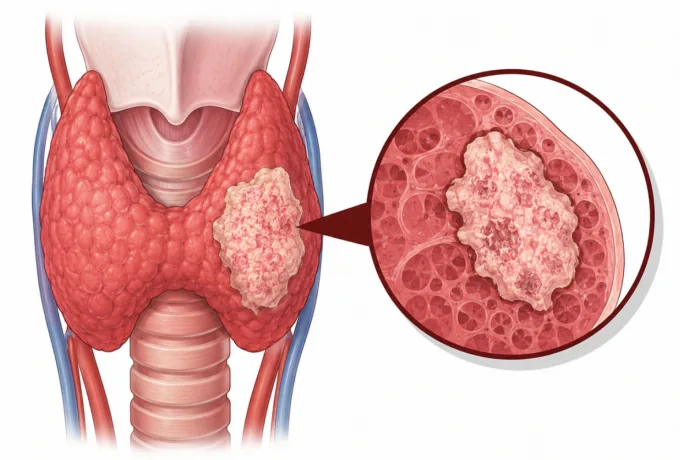
The thyroid is a butterfly-shaped gland at the front of the neck, wrapped around the windpipe, and it makes the hormones that set the pace of the entire body. Thyroid cancer begins when cells in that gland start dividing without control. It has one feature that shapes everything about how it is managed: most thyroid cancer grows slowly, and the commonest form has one of the highest survival rates of any malignancy — so the hard decisions tend to be about how much treatment to give, not how quickly to act.
The gland contains two quite different cell populations, and which one turns malignant decides almost everything that follows. Follicular cells make thyroid hormone; they give rise to papillary and follicular carcinoma — the differentiated cancers, which still behave like thyroid tissue and, in most cases, still take up iodine. Parafollicular C cells make calcitonin; they give rise to medullary carcinoma, a different disease with a different blood marker and a different genetic cause.
Thyroid cancer is also unusual in that the staging system is altered by age. In differentiated disease, a patient under 55 cannot be staged above Stage II however much disease is present, because age itself is such a strong determinant of outcome. That single rule is why two patients with similar scans can be described in completely different terms — and why the same operation can be the right answer for one and over-treatment for the other.
The main types
The pathologist decides the type from the cells and their architecture, and it matters more than the size of the nodule. These are the names you will see on a report:
- Papillary carcinoma — about 85% of all thyroid cancer. It travels along lymph channels, so it often involves neck nodes even when the primary tumour is small, and it is usually cured by surgery. Its classic molecular driver is a BRAF V600E mutation.
- Follicular carcinoma — around 10%. It cannot be separated from a benign follicular adenoma by needle biopsy alone, which is why some nodules need a diagnostic operation; it spreads through the bloodstream to bone and lung rather than through lymph nodes.
- Hürthle cell carcinoma — a variant once grouped with follicular cancer, more likely to involve lymph nodes and slightly less likely to take up radioiodine.
- Medullary carcinoma — about 4%, arising from the calcitonin-producing C cells. It releases calcitonin and CEA into the blood, which makes it trackable, and a substantial minority of cases arise from an inherited RET mutation — which makes testing the family part of the treatment.
- Anaplastic carcinoma — around 1%, occurring in older patients, growing over weeks and invading the structures of the neck. It is treated differently from every other type, and urgently.
- Poorly differentiated carcinoma — sitting between the differentiated cancers and anaplastic carcinoma, and behaving more aggressively than either papillary or follicular disease.
Two families are worth separating in your mind before any conversation about treatment. Papillary and follicular carcinoma are differentiated tumours: they still respond to thyroid-stimulating hormone and, in most cases, still take up iodine — which is the basis of two of the three treatments used. Medullary and anaplastic carcinoma do not, and are managed with surgery, radiation and systemic drugs instead.
What each stage means
For differentiated thyroid cancer the AJCC system divides patients at the age of 55. Under 55, only two stages exist. At or over 55, both the extent of the tumour and the lymph nodes count. This is not a technicality — it is the reason a young patient with node-positive disease may be told they have early-stage cancer.
| Stage | In plain terms | How it is usually approached |
|---|---|---|
| Under 55 — I | Tumour of any size, with or without involved neck nodes, and no distant spread | Surgery, and radioiodine where the type and the operative findings support it; most patients under 55 are in this group |
| Under 55 — II | Distant spread is present | The only way a patient under 55 moves beyond Stage I; treatment is planned around total thyroidectomy, radioiodine and systemic therapy |
| 70+ — I | A tumour up to 4 cm confined to the thyroid, no nodes, no distant spread | Lobectomy or total thyroidectomy, decided by the size, the molecular result and the patient's preference |
| 70+ — II | A larger tumour, or involved neck nodes, without distant spread | Total thyroidectomy with node dissection, then radioiodine in most cases |
| 70+ — III | Tumour extending beyond the thyroid into nearby tissue, or a smaller tumour with nodes | Surgery with wider margins and node clearance, followed by radioiodine and sometimes external beam radiotherapy |
| 70+ — IV | Tumour invading major neck structures, or distant spread; all anaplastic cancers are Stage IV at diagnosis | Multidisciplinary treatment built around surgery where it is possible, radiotherapy and targeted drugs |
Medullary carcinoma is staged with the same letters but behaves on its own terms: the calcitonin level, the RET result and the completeness of the first operation matter as much as the stage letter. Anaplastic carcinoma is always Stage IV at diagnosis, which is why it is discussed and treated on a different timescale from everything else on this page.
The markers that change treatment
A molecular result rarely decides whether an operation is needed. It decides what happens if the disease comes back, or if it is already advanced — and occasionally it changes the operation itself.
| Marker | Where it is found | How it changes treatment |
|---|---|---|
| BRAF V600E | The commonest driver in papillary carcinoma, found on the aspirate or the resected specimen | Associated with more extensive nodal disease; in anaplastic carcinoma it opens the door to targeted therapy with dabrafenib and trametinib |
| RET fusions | A subset of papillary carcinoma, especially in younger patients and after radiation exposure | A selective RET inhibitor becomes an option in advanced disease |
| RAS mutations | Common in follicular carcinoma and in some benign nodules | Helps classify an indeterminate aspirate, and is a candidate target in advanced disease |
| RET germline mutation | Around a quarter of medullary carcinoma, as part of MEN2 | Changes the operation — and means first-degree relatives should be tested, including children |
| TERT promoter | Associated with more aggressive behaviour across the differentiated types | Supports a more complete first operation and closer follow-up |
The practical consequence is that molecular testing should be requested at the time of diagnosis, not after a recurrence. Ask for it on the needle specimen if surgery has not yet happened, and on the resected tissue if it has. If the biopsy was taken elsewhere, the stored cell block can usually be tested without another procedure.
Why patients come to China for thyroid cancer care
Thyroid surgery is unforgiving of haste. Two structures sit against the gland — the recurrent laryngeal nerve, which moves the vocal cord, and the parathyroid glands, which control calcium — and both are preserved by surgeons who perform this operation at volume, every week. The rest of the treatment is about having every relevant discipline in one place rather than in a chain of referrals.
- High-volume thyroid surgery — with intraoperative nerve monitoring and deliberate preservation of the parathyroid glands, which is what keeps the voice and the calcium level normal afterwards.
- Central and lateral neck dissection — planned from the preoperative ultrasound and performed at the same operation where the imaging supports it, rather than as a second procedure later.
- Radioiodine treatment — iodine-131 given under nuclear medicine supervision for remnant ablation and for iodine-avid disease, with the isolation and dosimetry that go with it.
- Molecular testing from the aspirate — BRAF, RAS, RET and TERT, so that drug options are known before they are needed rather than after.
- One team rather than a sequence of appointments — thyroid surgery, endocrinology, nuclear medicine, pathology and radiology review the file together and issue a single written plan.
For a disease where over-treatment is often the greater risk, the most valuable thing a second opinion can do is tell you what not to do. That requires the whole file — ultrasound images, cytology, molecular result, and the operative note if an operation has already been performed. Send complete records and you receive a written assessment within 48 hours; where it is useful, a cross-border opinion from an overseas specialist can be arranged alongside it.










