


Stomach Cancer Overview
Stomach Cancer Overview
Stomach cancer is one disease name covering several tumours that behave differently, and both where the tumour sits and what the biopsy shows decide the treatment. This page explains the types, the stages, and the molecular markers that now drive drug choice.
-
~1.2M
new stomach cancer cases worldwide each year
-
~40%
of the world's stomach cancers occur in China
-
30–50%
of Europe or US cost for the same comprehensive drug treatment
-
48 hrs
from complete records to a personalized MDT plan
What stomach cancer is
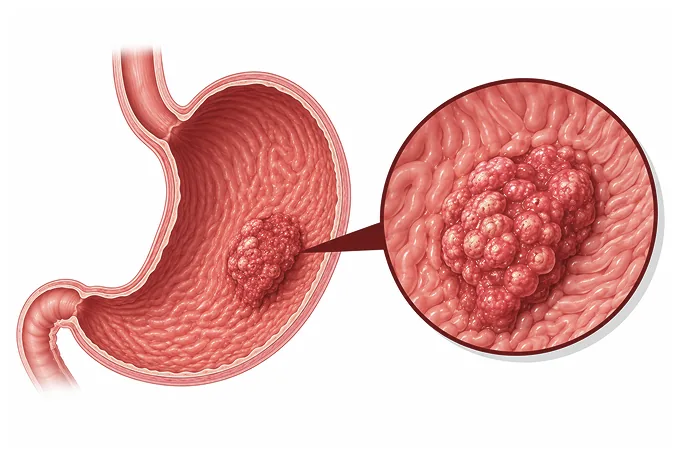
Stomach cancer begins when glandular cells in the stomach lining start dividing without control. The stomach is a muscular reservoir that stores food, secretes acid and begins digestion, and a tumour can arise anywhere in it — near the oesophagus, in the body, or at the outlet into the small bowel. More than 95% of stomach cancers are adenocarcinomas, meaning they arise from the glandular lining rather than from the muscle or the immune cells of the stomach.
The distinction that matters most is between early and advanced disease. Early stomach cancer is confined to the innermost layer of the stomach wall, where it can often be removed through an endoscope with the stomach left in place. Once it has grown into the muscle layer or beyond, treatment moves to surgery, and once it has spread to distant organs it is treated as a systemic disease. This is why the depth of invasion — assessed before any operation — drives the whole plan.
China carries a large share of the world's disease: roughly 40% of new cases worldwide occur here, and stomach cancer ranks among the three most common cancers in China by both incidence and mortality. The disease is common in East Asia and parts of South America and less common in North America and much of Europe — a pattern that follows diet and Helicobacter pylori infection more than it follows genetics.
The main types
Most stomach cancers are adenocarcinomas, and the subtypes below change both the treatment and the outlook:
- Intestinal-type adenocarcinoma — the commoner pattern, forming gland-like structures, usually arising in a stomach lining that has already been changed by chronic inflammation.
- Diffuse-type adenocarcinoma — the cells do not stick together and spread widely through the stomach wall. It tends to affect younger patients and includes signet ring cell carcinoma, in which mucus pushes the nucleus to one side of the cell.
- Gastro-oesophageal junction (GEJ) cancer — arising where the stomach meets the oesophagus, rising in frequency, and sharing behaviour and treatment with both stomach and oesophageal cancer.
- Hepatoid adenocarcinoma — a rare variant that behaves like liver cancer, can produce AFP and tends to metastasise to liver and nodes early.
- Gastric neuroendocrine tumours — arising from hormone-producing cells; well-differentiated tumours behave indolently, poorly differentiated carcinomas are aggressive.
Two classification systems sit alongside these names. The Lauren classification divides adenocarcinoma into intestinal and diffuse types, which roughly tracks how the disease spreads. The WHO classification describes the tissue pattern in more detail. Neither replaces staging; they are read together with it.
What each stage means
Staging answers three questions: how deep has the tumour grown into the stomach wall, how many lymph nodes are involved, and has it reached distant organs. The stomach wall has five layers, and the difference between a tumour in the first layer and one in the muscle decides whether an endoscopic resection is even possible.
| Stage | In plain terms | How it is usually approached |
|---|---|---|
| 0 | Cancer cells confined to the innermost lining of the stomach | Endoscopic resection when the lesion meets the size, depth and differentiation criteria |
| I | Tumour in the inner layers, with no or few lymph nodes involved | Surgery to remove the affected part of the stomach; very early lesions may be treated endoscopically instead |
| II | Deeper invasion into the muscle layer and/or more nodes involved | Drug therapy before surgery in many cases, then gastrectomy with lymph-node dissection |
| III | Tumour through the wall and/or several regional nodes involved | Perioperative chemotherapy around a gastrectomy with D2 lymph-node dissection; radiotherapy is discussed in selected cases |
| IV | Distant organs, the peritoneal lining, or distant lymph nodes | Systemic therapy chosen by molecular profile; surgery is reserved for specific problems such as bleeding or obstruction |
| Recurrence | Disease that returns after treatment that aimed at cure | Decided by where it returned and what was given before — systemic therapy, or local treatment such as radiosurgery for a single site |
Stomach cancer also spreads across the lining of the abdomen — the peritoneum — in a way that scans can miss. That is why, before committing to a major operation, many centres perform a diagnostic laparoscopy: a short procedure that looks directly at the peritoneal surface and takes samples if anything looks suspicious.
The markers that decide drug treatment
Once a biopsy confirms adenocarcinoma, the specimen is tested for markers that have nothing to do with staging but everything to do with drug choice:
| Marker | What it is | How it changes treatment |
|---|---|---|
| HER2 | A receptor protein overexpressed or amplified in a subset of gastric cancers | When positive, trastuzumab is added to first-line chemotherapy for advanced disease |
| PD-L1 | Reported as a Combined Positive Score from the biopsy specimen | The score guides whether an anti-PD-1 immunotherapy is added to first-line treatment |
| MSI-H / dMMR | Mismatch-repair deficiency, the same feature that predicts immunotherapy response in other tumours | Predicts benefit from PD-1 immunotherapy, and in some settings is used independently of PD-L1 |
| CLDN18.2 | A validated target in advanced gastric cancer | Targeted therapy against it is available in a number of countries and in clinical trials in China; availability should be confirmed with the treating team |
Testing is not optional and it is not decorative. A patient whose tumour is HER2-positive and one whose tumour is MSI-high can sit at the same stage and receive different first-line treatment, with different outcomes. If a biopsy was taken elsewhere, ask whether these tests were done — if they were not, they can usually be done on the stored tissue without another procedure.
Why patients come to China for stomach cancer care
Gastric cancer is treated more often, and more deeply, in East Asia than almost anywhere else — which is also why the surgical technique here is standardised rather than improvised. Our gastrointestinal cancer centres bring gastroenterologists, gastrointestinal surgeons, medical oncologists and radiation oncologists into one team for stomach cancer specifically.
- Endoscopic resection for early disease — endoscopic mucosal resection and endoscopic submucosal dissection (ESD) remove a very early cancer through the mouth, leaving the stomach in place.
- Laparoscopic and robot-assisted gastrectomy — including D2 lymph-node dissection, the standard in East Asia, and robotic surgery with magnified three-dimensional vision and instruments that hold still.
- Perioperative drug therapy — neoadjuvant chemotherapy to shrink a tumour before surgery, and adjuvant therapy afterwards, planned by medical oncology.
- Radiation where it helps — precise intensity-modulated radiotherapy, and CyberKnife radiosurgery for selected localised and recurrence settings.
- Nutrition as treatment, not afterthought — dietetic support before and after gastrectomy is part of the plan, because eating is the main quality-of-life issue after stomach surgery.
For complex or recurrent cases a multidisciplinary team — surgery, medical oncology, radiation oncology, radiology, pathology and clinical nutrition — reviews the file together and issues one plan. Send complete records and you receive a written assessment within 48 hours; where it is useful, a cross-border second opinion from an overseas specialist can be arranged as well.










