


Scars and Keloids Overview
Scars and Keloids Overview
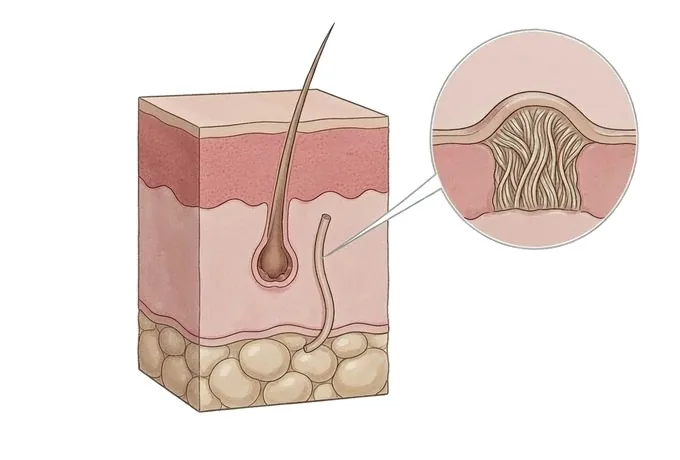
A scar and a keloid are the same process caught at different points. When skin is injured it is repaired in stages: inflammation, then a phase in which fibroblasts lay down collagen to close the gap, then a long remodelling phase in which that collagen is broken down and re-laid so the tissue becomes flatter, softer and paler. An ordinary scar is where this sequence finishes. A raised scar is where it has not finished yet. A keloid is where it never finishes: collagen continues to be produced after the wound has closed, the tissue advances beyond the boundary of the original wound into skin that was never injured, and it does not settle on its own. That single behaviour — whether the tissue stays inside the wound or crosses it — is the most useful distinction in the whole subject, because it changes what everything else means. A scar that remains within its wound and is still maturing usually flattens with time and is managed without an operation. A keloid does not respect that boundary, and it is the one skin problem in which surgery is a second-line measure, because the operation is itself a new wound. Two things follow. The question worth asking is not how large the problem is but which kind it is and how mature; and no treatment restores normal skin, so the aim is a scar that is flatter, softer, paler and less symptomatic — a real result even though it is not a disappearance.
-
A scar and a keloid are not two diseases
they are the same repair process stopping in different places, which is why one measure does not suit both
-
The boundary is what separates them
a hypertrophic scar stays within the original wound and often flattens; a keloid grows beyond it and does not settle
-
Where the wound is decides as much as what is done
tension across the repair is the strongest known local factor, which is why the same injury scars differently on the chest and on an eyelid
-
12–18 months
the time a scar normally takes to mature, and the reason an operation on a scar that is still settling is usually deferred
Why a scar and a keloid are not the same problem
Scars and keloids arrive in the same consultation and are not the same thing. Both are the product of one repair process, and the difference between them is where that process stops. When skin is wounded it is rebuilt in three broad phases: inflammation, then a proliferative phase in which fibroblasts produce collagen to close the gap, then a remodelling phase that can run for a year or more, in which that collagen is broken down and laid down again in a more organised pattern so the tissue becomes flatter, softer and paler. An ordinary scar is this sequence run to completion. A hypertrophic scar is the same sequence still in progress, or finishing at a higher level than usual: raised and red, but remaining within the outline of the original wound, and usually flattening over months to years. A keloid behaves differently: collagen continues to be produced after the wound has closed, the tissue spreads beyond the original boundary into skin that was never injured, and it does not settle by itself.
- The boundary is the test, not the size. How large a scar is says little about what will happen to it. Whether it stays within the outline of the original wound, or has crossed into intact skin, is what identifies it — and it is a distinction a patient can see for themselves.
- One settles with time and the other does not. A hypertrophic scar is still in its remodelling phase and responds to time, to measures that reduce tension and to treatments that interrupt the process. A keloid has left that phase behind; the same waiting serves it not at all. And because the operation is itself a new wound, a keloid is the one case in which surgery is planned with an adjuvant attached rather than on its own.
What treatment can and cannot do. Treatment can make a scar flatter, softer, paler and less itchy, and it can relieve the tightness that restricts a joint or an eyelid; in a keloid it can bring the growth to a stop in most cases with more than one measure used together. What no treatment does is turn scar tissue back into normal skin: scars have no hair follicles, no sweat glands and no ordinary dermal architecture, and nothing available restores them. That is why the goal is stated as improvement rather than removal.
The kinds of scar this term covers
The word scar covers several different behaviours, and which one is present decides whether the answer is time, a topical measure, an injection or an operation.
| Kind of scar | What is happening | What it means for treatment |
|---|---|---|
| Mature scar | The repair has finished its remodelling: flat or nearly flat, pale, soft and free of symptoms, though it may be widened or depressed | Nothing is required medically. Where appearance is the complaint, the options aim at texture and colour rather than at removing tissue |
| Hypertrophic scar | Still remodelling, or finished at a raised level: firm and red, but confined to the outline of the original wound, and often flattening over months to years | Non-surgical measures and an injection into the scar are the mainstay; surgery is deferred while the scar is still changing |
| Keloid scar | Collagen continues to be laid down after the wound has closed and the tissue advances beyond the original wound into uninjured skin, where it does not settle | More than one measure is usually needed. An operation is planned with an adjuvant attached rather than on its own, since removal alone carries a high chance of recurrence |
| Contracture scar | The scar shortens as it matures and pulls on the tissue around it, restricting a joint or a free margin such as the eyelid, the lip or the fingers | The indication is function rather than appearance: release with resurfacing is a treatment for movement and for closure |
| Acne and burn scarring | Multiple scars of more than one kind in one area, produced not by a single injury but by repeated inflammation, as in nodular acne or a burn healing over weeks | Ongoing inflammation has to be controlled first, since treating individual scars while new ones keep forming changes nothing |
Why it is worth naming the kind before discussing anything else. A patient who has read generally about scar treatment arrives with a list of options and no way to order them. The kind of scar is what turns that list into a sequence: a hypertrophic scar is supported and given time, a keloid is treated by stopping the process, and a contracture is treated by restoring a movement.
What makes a scar more or less of a problem
No scar in this group is dangerous in itself, and the assessment is about how much it interferes and whether anything atypical is going on behind it. That shifts the question from how big it is to what it is costing.
| Feature | Why it changes the plan |
|---|---|
| Whether it stays within the original wound or grows past it | The single most useful observation. It separates the hypertrophic scar, which can be supported and watched, from the keloid, which needs active treatment and has to be managed with the expectation of recurrence in mind |
| Where it is | Scars on the chest, the upper back, the shoulders, the jaw line and the earlobe behave worst, because these are the sites where the skin is under continuous tension. A scar in an exposed site also carries a burden that a scar under clothing does not |
| What it feels like | Itch, pain, burning and tightness frequently trouble a patient more than the appearance does, and they are the measures that a response to treatment can be judged against |
| Whether it restricts function | A scar crossing a joint, an eyelid or the mouth can limit movement or closure. That is a different category of problem from an unattractive scar and it changes both the urgency and the kind of treatment |
| How mature it is | Where the scar sits on the twelve to eighteen month timeline to maturity decides whether an operation is appropriate at all, since operating on a scar that is still changing tends to produce a worse result than waiting |
What urgent means here. Mostly it does not apply: this condition is intrusive rather than dangerous. The exception is a scar that has ulcerated without healing, or a nodule inside it that is growing — that is not ordinary scarring and is investigated rather than treated.
How a scar is assessed
The assessment answers four questions in order — what kind of scar is this, how mature is it, what is it doing to the patient, and is there anything atypical about it — and each step exists to make the next decision precise.
| Step | The question it answers |
|---|---|
| History of the wound and of the scar | How did it come about, how long did it take to close, did it become infected, what has already been tried and what changed, and does anyone else in the family scar in this way? This is where a keloid tendency is usually identified |
| Examination of the scar and its boundary | What kind is it? The outline of the original wound is compared with the extent of the tissue, the axis of the scar is compared with the natural lines of the skin, and the surface, firmness and colour are recorded |
| Recording of symptoms | How much does it itch, hurt, burn or pull? Since these complaints are what treatment is often judged by, they are written down at the first visit rather than remembered |
| Standardised photography and measurement | What will change be compared against? Photographs taken at a fixed distance and under the same light, with the dimensions of the scar recorded, make improvement something that can be shown |
| Assessment for anything atypical | Is this still a scar? An ulcer that does not heal or a nodule that is growing is not part of ordinary scarring, and a biopsy is taken in that situation rather than as a routine step |
Why the order matters. The kind of scar and its maturity decide whether an operation is on the table at all; the symptoms and the photographs make improvement measurable; and the assessment for anything atypical is what keeps a scar that is not behaving as a scar out of a routine treatment pathway.
Why patients travel to China for scar and keloid treatment
Scar treatment is a sequence rather than a single procedure, and the difficulty is rarely the technique — it is recognising which kind of scar is present, placing it on its own timeline, and combining measures in the right order. What an international pathway offers is that all of it is settled in one place, with the records to support it.
The distinction and the plan happen together. The history is taken, the scar and its boundary are examined, symptoms are recorded, and photographs and measurements are taken — in one facility and usually within a day or two. A patient leaves knowing which kind of scar they have, whether it is still maturing, and which measure comes first.
Both the non-surgical and the surgical answers are available in the same plan. Silicone, pressure, injections, laser and cryotherapy act on one side of the problem, and excision with an adjuvant, or release of a contracture, act on the other. A clinic that offers only one of these tends to recommend what it has, and here the recommendation follows the scar rather than the equipment list.
What is atypical is identified first, and the plan is written for the patient going home. A scar that has ulcerated without healing, or that contains a nodule which is changing, is investigated before anything cosmetic is considered. Which kind of scar was found, which measure was chosen and why, how long the response should take, what would count as improvement and what the next step would be are all provided in English, with the international desk coordinating with the patient, any insurer, and the treating team at home.










