


Prostate Cancer Overview
Prostate Cancer Overview
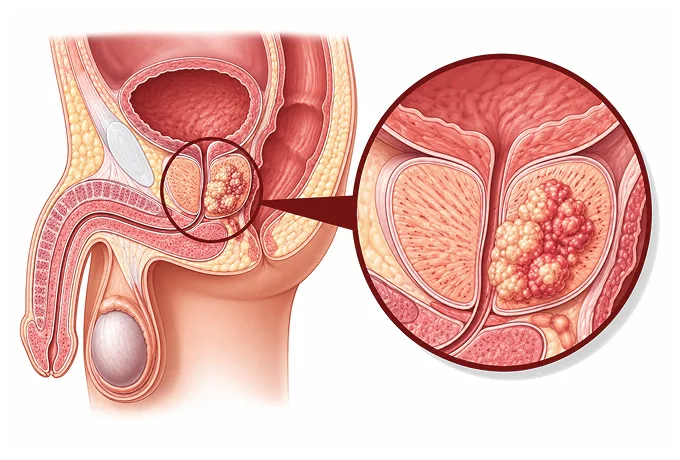
The prostate sits beneath the bladder and surrounds the urethra, producing the fluid that carries sperm. Cancer arising in its glandular cells is the second most common cancer in men worldwide — and the least symptomatic in its early years, because a tumour confined to the gland usually causes no pain, no bleeding and no urinary change that can be distinguished from ordinary enlargement. That is why it is found by a blood test rather than by symptoms.
-
Second
most common cancer in men worldwide (IARC)
-
5 grade groups
the ISUP grouping that replaced a single Gleason score in reporting
-
PSA
organ-specific but not cancer-specific — which is why MRI and biopsy decide, not the number alone
-
48 hrs
from complete records to a personalized MDT plan
What prostate cancer is
The prostate is a walnut-sized gland that sits just below the bladder and surrounds the first part of the urethra. Its job is to produce part of the seminal fluid. Because of where it sits, anything that enlarges it — benign hyperplasia, inflammation or a tumour — can press on the urethra and change urination, which is why urinary symptoms are far more often benign than malignant.
Almost all prostate cancers are adenocarcinomas arising in the peripheral zone of the gland, the outer part that a rectal examination can feel and that a biopsy samples. They range from tumours that will never cause harm in a man's lifetime to aggressive tumours that spread to bone early. The single most important early distinction is therefore not merely whether cancer is present, but how it is graded and how far it has spread.
Two consequences follow. First, the disease is often detected at a stage where it needs watching rather than treating — the origin of the active surveillance pathway. Second, the treatment choice has to be weighed against its side effects, because surgery and radiotherapy both act on the nerves and sphincter that control erections and continence. That trade-off, more than in almost any other cancer, is part of the clinical decision, and it is made with the patient rather than for him.
The main types
Prostate cancer is classified by its cell of origin, and the type determines how it behaves and what treatment it answers to:
- Acinar adenocarcinoma — the commonest type by far, arising in the glandular tissue of the peripheral zone, and graded by how closely the cells still resemble normal prostate glands.
- Ductal adenocarcinoma — arises in the ducts, tends to behave more aggressively, and is more often associated with spread than acinar disease of the same grade.
- Neuroendocrine and small-cell carcinoma — rare, aggressive variants that do not produce PSA and are treated with chemotherapy-based protocols rather than hormonal therapy.
- Treatment-related neuroendocrine prostate cancer — an uncommon transformation that can emerge after prolonged hormonal treatment and signals a change of strategy.
- Intraductal carcinoma and cribriform patterns — architectural findings reported alongside the grade group that mark a higher risk of aggressive behaviour even when the grade group looks modest.
For practical purposes, most patients are dealing with acinar adenocarcinoma, and the working questions are the grade group, the PSA level and the stage. The less common variants matter because they can change the treatment route — ductal and neuroendocrine types are handled differently from ordinary acinar disease.
What each stage means
Staging combines the AJCC classification with a risk grouping that clinicians use to choose treatment. The rows below follow the risk groups, because those decide the plan more directly than the stage number:
| Category | In plain terms | How it is usually approached |
|---|---|---|
| Low risk | PSA below 10, grade group 1, tumour confined to the gland | Active surveillance is a standard option, and often the preferred one |
| Intermediate risk | PSA 10–20 or grade group 2–3, still confined to the prostate | Surgery or radiotherapy; short hormonal treatment may accompany radiotherapy |
| High risk | PSA above 20, grade group 4–5, or locally advanced disease | Radiotherapy with long-course hormone therapy, or surgery within a combined plan |
| Node-positive | Cancer found in pelvic lymph nodes | Systemic hormonal treatment with radiotherapy; surgery only in selected cases |
| Metastatic, hormone-sensitive | Spread to bone or distant nodes, responding to testosterone suppression | Androgen deprivation plus intensification with a hormone-pathway drug or chemotherapy |
| Castration-resistant | Disease progressing despite very low testosterone | Androgen receptor pathway inhibitors, chemotherapy, PSMA radioligand therapy or PARP inhibitors by marker |
Two features of this table matter more than the rest. The first row is a treatment choice, not a delay: low-risk disease that is watched with PSA, MRI and periodic biopsy is being managed, and the point of surveillance is to reserve treatment for tumours that show signs of changing. The last two rows are not a single disease: metastatic prostate cancer is now split by whether it still responds to testosterone suppression, because that distinction decides which drugs are added.
Because the risk category is assembled from three inputs — PSA, grade group and stage — the records that matter most are the PSA history, the biopsy report with its grade group, and the imaging that established the stage. Sending all three together is what allows a treatment route to be stated rather than guessed at.
The markers that guide treatment
Prostate cancer has fewer routine molecular targets than some tumours, but a short list now changes eligibility for specific treatments and is increasingly tested at diagnosis:
| Marker | What it is | How it changes management |
|---|---|---|
| PSA | A protein made by prostate cells, measured in blood | Not a cancer-specific test: it drives detection, risk grouping and follow-up, but the biopsy and imaging decide what the number means |
| PSMA expression | A protein on the surface of most prostate cancer cells, imaged with a tracer | PSMA PET-CT localises disease that conventional scans miss, and high uptake makes PSMA radioligand therapy an option in advanced disease |
| BRCA2 and other DNA repair genes | Inherited or tumour-acquired faults in DNA repair | Confers higher risk and more aggressive behaviour; opens PARP-inhibitor treatment in advanced disease and triggers family counselling |
| Mismatch repair / MSI status | A rare pattern in which DNA repair errors accumulate | Makes immune checkpoint inhibitors likely to work in advanced disease, independent of other markers |
The practical point: for advanced disease, ask whether PSMA imaging and germline testing have been done, because both change what is available — imaging changes the treatment target, and a BRCA2 result changes both the drugs offered and the advice given to relatives. For early disease, neither test usually changes the immediate plan, which is why they are ordered by stage rather than for everyone.
Why patients come to China for prostate cancer care
Prostate cancer care is decided by three capabilities that a high-volume service either has or does not: imaging that finds the disease precisely, surgery and radiotherapy that treat it while protecting function, and systemic options that stay current.
- MRI-targeted biopsy — multiparametric MRI read with PI-RADS scoring and used to direct the needles, so that significant tumours are sampled rather than found by chance.
- Nerve-sparing robotic prostatectomy — the technique that preserves the nerves controlling erection and the sphincter controlling continence, chosen case by case according to where the tumour sits.
- Modern radiotherapy — intensity-modulated and stereotactic external-beam techniques, and brachytherapy, planned with MRI so the dose conforms to the gland.
- PSMA PET-CT — molecular imaging that localises disease conventional scans miss, used both for staging and for deciding eligibility for radioligand therapy.
- Current systemic options — androgen receptor pathway inhibitors, chemotherapy and PARP inhibitors for DNA-repair-deficient disease, with germline testing arranged in-house.
- Function-focused follow-up — continence and sexual function addressed by the team as part of the treatment plan, not as an afterthought once the cancer is dealt with.
Two practical consequences follow. Because surgery and radiotherapy offer comparable disease control for localised disease in the right patient, the choice is often made on side-effect profile and the patient's own priorities — so a written assessment should state both routes rather than one. And because systemic treatment now depends on markers, the imaging and the germline test belong in the file. Send complete records and the written assessment is returned within 48 hours of the file being complete.










