


Pressure Ulcers and Pressure Injuries Overview
Pressure Ulcers and Pressure Injuries Overview
This page is about a condition that is usually described by what can be seen on the skin, and is better understood as something happening underneath it. A pressure ulcer, or pressure injury, is an area of tissue that has been deprived of blood because it has been pressed against something for too long. The damage starts over the bone, in the tissue that has the least protection and the poorest blood supply, and the surface may show nothing but a patch of redness that does not fade. That is why the two ideas that organise this page are simple. The first is that the cause is pressure, so the first treatment is to take the pressure away — no dressing can compensate for tissue that is still being compressed. The second is that staging describes how deep the injury has reached, which decides what the wound needs, and it does not on its own predict what will happen. Almost all pressure injuries are preventable, enough is known about how they form, and the page therefore treats prevention as part of the clinical subject rather than as an afterthought.
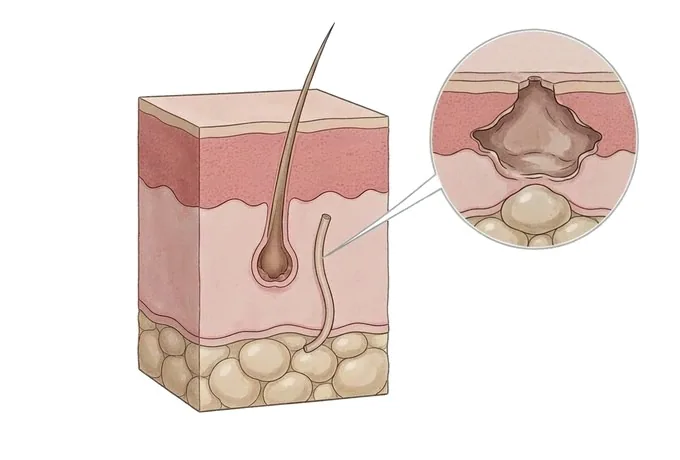
-
It begins underneath, not on the surface
so the first visible sign is often a patch of redness that does not fade, and the tissue beneath it is already affected
-
The cause is pressure, so the first treatment is pressure relief
a wound that is still being compressed will not heal whatever is put on it
-
Staging describes depth, not outcome
it tells you how far the injury has reached and what the wound needs, not what will happen to the patient
-
Most of them are preventable
repositioning, a suitable surface, skin care and nutrition are long established and are the whole of the preventive plan
Why a pressure ulcer is not a sore on the skin
A pressure ulcer has a misleading name. It sounds like a wound that has appeared on the surface, as a cut or an infection would. What actually happens is that an area of tissue is pressed between a bone and whatever the person is lying or sitting on, the small vessels supplying it are closed off, and the tissue is starved of blood. The injury is therefore at its worst where the bone is, and it travels outwards towards the skin.
- The surface finding understates what is happening. The earliest visible sign is a patch of skin over a bony point that stays red after the pressure is taken off, or that appears purple, maroon or dark blue in darker skin tones. The skin is still intact, and the tissue beneath it may already be damaged.
- Pressure is the cause, which makes pressure relief the treatment. Every other measure — cleaning, dressings, antibiotics, nutrition — is working against a background in which tissue is still being compressed. That is why the first question about any pressure injury is what is being done about the pressure, and it comes before the question of what is put on the wound.
- Other forces make the pressure worse. Sliding down a bed produces shear inside the tissue, dragging a person across a sheet produces friction at the surface, and moisture from incontinence or sweat softens the skin so that it tolerates both less well.
Why the distinction matters to a patient. A dressing is visible and feels like treatment; repositioning is invisible and is the thing that actually works. Families who understand that the wound is a pressure problem rather than a hygiene problem ask the right question at the bedside, and identify the warning sign — redness that does not fade — before there is any wound to dress at all.
What the stages describe
Staging records how deep the injury has reached. It is a description rather than a score: it tells the team what the wound needs, and it does not by itself say whether the wound will heal.
| Stage | What is present | What it means for treatment |
|---|---|---|
| Stage I | Skin intact, with redness that does not fade on pressure; in darker skin tones a persistent red, blue or purple change instead | Reversible. The plan is pressure relief and review, not a dressing — this is the point at which the process can still be stopped |
| Stage II | Partial-thickness loss: an abrasion, a blister, or a shallow open wound with a pink or red base | Relieve pressure and protect the wound bed; superficial wounds of this depth usually respond once loading stops |
| Stage III | Full-thickness loss, with fat visible in the wound and the tissue at the edge often undermined | Needs cleaning and debridement as well as pressure relief, and takes considerably longer to close |
| Stage IV | Full-thickness loss with muscle, tendon, joint capsule or bone exposed | The deepest stage; treatment includes control of infection and, where healing stalls, surgical repair |
| Unstageable | The base of the wound is covered by dead tissue or a dark crust, so its depth cannot be seen | Not a stage of its own: the wound is cleaned first, and staged once its base can be seen |
| Deep tissue injury | Skin intact but persistently dark red, purple or maroon, or a blood-filled blister | Treated as deep until proved otherwise; it may resolve, or it may open into a full-thickness wound |
Why the last two are not stages. They describe what cannot yet be seen rather than how deep the injury is. Reading the table as a ladder from one to four, with the other two appended, is what produces the most common misunderstanding: that a wound which cannot be staged must be mild. A wound covered in dead tissue may be the deepest one on the ward.
What makes an injury harder to heal
Two people with wounds of the same depth can have very different courses. What separates them is rarely the wound itself.
| Factor | Why it changes the course |
|---|---|
| Whether the pressure is actually off | The single largest determinant. A wound that is still loaded will not close, however well it is cleaned and dressed, and however good the surface |
| Sensation in the area | Someone who can feel pain is warned and shifts; someone who cannot has no such signal, which is why spinal cord injury and advanced neuropathy carry the highest risk |
| Nutrition and hydration | Building tissue requires protein, energy and fluid. Poor intake is a common and correctable reason that a wound stops improving |
| Infection and the tissue at the base | Wounds with dead tissue or infection cannot heal; the base has to be clean and the infection treated before progress resumes |
| The conditions underneath | Incontinence, spasticity, anaemia, diabetes and poor circulation all change how the tissue behaves, and each has to be managed rather than worked around |
Why the first row is the one to remember. Families often describe a wound as resistant or as unresponsive, and the answer is usually not a different dressing. It is that the same site keeps being loaded — by an interval that is too long, by a surface that is not doing its job, or by a heel that is quietly resting on the mattress.
How a pressure injury is assessed
The assessment is mostly done with the eyes and the hands, in good light, over the whole body rather than at a single spot.
| Step | What it establishes |
|---|---|
| Risk assessment | Whether preventive measures are needed at all, using a validated scale rather than an impression |
| Skin examination at every bony point | How many injuries are present. Pressure injuries are often multiple, and the one that prompted the visit is not always the worst |
| Staging and wound description | How deep each injury has reached, with site, size, depth and the tissue at the base recorded in a standard way |
| Assessment of what is being done about the pressure | The repositioning schedule, the support surface, the transfer technique and any device that presses on the skin |
| Nutrition and infection screen | Whether the patient has the material to heal with, and whether the wound is infected; both are treated as part of the wound plan |
Why the assessment is repeated rather than done once. A pressure injury is a moving target. The stage can change, the skin around it can change, and the plan only works if it is checked against what the wound is actually doing at the next review.
Why patients travel to China for the treatment of a pressure injury
The difficult part of a pressure injury is rarely the dressing. It is holding two things together at once: the wound care, and the plan that keeps pressure off the site for as long as it takes to heal.
The wound and the pressure are managed as one plan. Assessment, staging, cleaning, dressing, infection control, nutrition and the repositioning schedule are held together in a single arrangement, so that the wound is not being asked to heal against a pressure load that nobody has looked at.
Surgical repair is available when it is the right answer. For full-thickness injuries that have not closed, a flap procedure cleans the wound and covers it with tissue that brings its own blood supply. It is offered as one option among several, and always with the aftercare plan attached, because an operation without a plan to keep the pressure off the repaired area does not hold.
The plan is written to travel. Wound measurements and photographs, the current stage, the dressing regimen, the repositioning interval, the surface in use and the review dates are provided in English, so that the team who continue the care at home are working from a record rather than starting again.










