


Pituitary Tumor Overview
Pituitary Tumor Overview
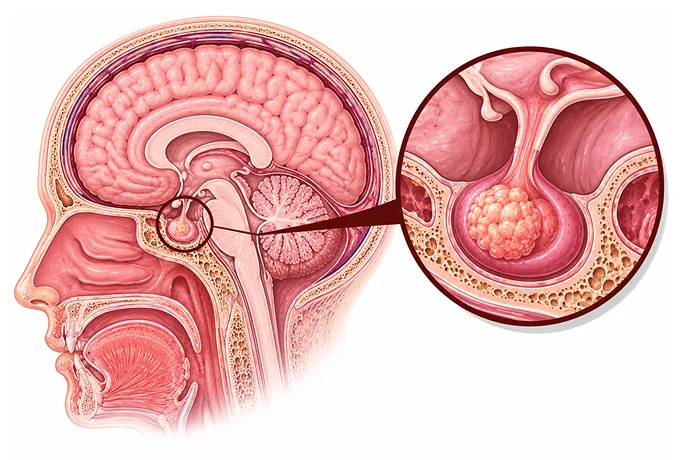
A pituitary tumour begins in the pituitary gland — a pea-sized gland that sits on a stalk beneath the brain, behind the bridge of the nose, and directs most of the body's other hormone glands. Almost every one of these tumours is benign: it does not spread. What makes it a particular kind of problem is that it acts along two lines at once. Some tumours make a hormone of their own, in excess, and change the body from the inside — cycles that stop, sweating and a change in the shape of the face and hands, weight gain around the trunk with high blood pressure. Others make nothing, and instead grow, pressing on what is packed around the gland: the nerves that carry sight from both eyes, and the healthy pituitary tissue itself. Most tumours are found because one of those two things happened.
-
Benign
it does not spread; the problems come from hormones and from pressure
-
Two lines at once
a hormone made in excess, or growth pressing on sight and on the gland itself
-
Three findings
which hormone, how large and what it touches, and what the gland can still do
-
48 hrs
from complete records to a personalized MDT plan
What a pituitary tumour is
The pituitary gland is small and central out of all proportion to its importance. It sits in a bony hollow at the base of the skull, joined to the brain by a stalk, and it issues the instructions that govern the thyroid, the adrenal glands, the ovaries and testes, growth, and the body's handling of water. It lies directly beneath the optic chiasm — the point at which the nerve fibres from the two eyes cross — and that anatomical accident explains half of what these tumours do.
Almost all pituitary tumours are benign. They arise from the gland's own hormone-producing cells, they do not spread to other parts of the body, and they do not behave like cancers. Cancer of the pituitary is exceedingly rare. So the word "tumour" here describes a growth in a confined space, and the clinical questions are about hormones and about pressure — not about spread and stages.
They act along two lines at once, and the balance between them decides the whole plan. A tumour that makes a hormone in excess changes the body from within, and the change is often gradual: periods that stop, unexplained sweating, weight moving to the trunk, hands and feet that seem larger, blood pressure and blood sugar that are harder to control. A tumour that makes nothing instead grows, and its effects are those of pressure in a small compartment — the peripheral vision going first, because the optic chiasm sits immediately above, and then the healthy part of the gland being squeezed until the body is short of the hormones it depends on.
Neither line announces itself dramatically. A loss of peripheral vision and a slow hormonal change are both easy to attribute to age, to stress or to being busy, which is why these tumours are often found months or years after they began. That is also why the assessment is deliberately three-sided: a scan shows what is there and what it touches, the hormone panel shows what it is doing, and the visual fields show what the optic nerves can still see. Each of the three can be abnormal while the other two are not.
Functioning and non-functioning tumours
Pituitary tumours are described along three axes, and a patient will usually be told all three:
- By whether they make a hormone. A functioning tumour produces one of the gland's own hormones in excess, and the symptoms are the symptoms of that hormone. A non-functioning tumour produces nothing measurable; it comes to attention through pressure on the optic nerves or on the rest of the gland, or by being found incidentally.
- By which hormone, when one is produced. The commonest is prolactin — a prolactinoma causes cycles to stop, fertility to be affected and milk to be produced outside breastfeeding, and it is also the one treated with medication first. A growth hormone-producing tumour causes acromegaly: the face, hands and feet change shape, with sweating, deeper voice and new snoring. An ACTH-producing tumour causes Cushing's disease, with weight moving to the trunk, easy bruising, purple stretch marks, high blood pressure and high blood sugar. Rarer types produce thyroid-stimulating hormone or the gonadotropins.
- By size. A tumour smaller than about a centimetre is called a microadenoma; one of a centimetre or more is a macroadenoma. Size is not a grade — it does not describe how aggressive the tumour is — but it shapes what can be pressed on and how the surgery is planned.
- By what it is touching. A tumour that has grown upwards meets the optic chiasm and takes peripheral vision first. One that grows sideways enters the cavernous sinus, where the nerves to the eye muscles and the carotid artery run. One that compresses the healthy gland, or interrupts the stalk that connects it to the brain, causes hormone deficiency — sometimes with a raised prolactin from the stalk being squeezed rather than from a tumour that makes it.
- By the tissue. Tissue is examined only when the tumour is removed. What it establishes is the tumour's type, which decides how it is followed and whether medication has a role — not a stage that changes the choice of operation.
Size, hormone and what the tumour presses on
These tumours are not staged the way cancers are. Three measures do the work instead, and all three belong in the plan:
| Measure | In plain terms | How it is used |
|---|---|---|
| Non-functioning | The tumour produces no measurable hormone | Comes to attention through pressure on the optic nerves or the rest of the gland; small ones are often observed and larger ones treated |
| Prolactin-producing | The tumour makes prolactin in excess — periods stop, fertility is affected, milk is produced outside breastfeeding | Medication comes first, and it usually lowers the hormone and shrinks the tumour; surgery is reserved for defined situations |
| Growth hormone-producing | The tumour makes growth hormone in excess — the face, hands and feet change shape, with sweating and new snoring | Surgery usually comes first, with medication used to control the hormone where surgery is not enough |
| ACTH-producing | The tumour makes ACTH, and the adrenal glands therefore make too much cortisol | Surgery is the usual first step; medication controls cortisol where surgery is not possible or not enough |
| Microadenoma | Smaller than about a centimetre | Often found because of a hormone; the visual fields are usually intact, and the plan turns on the hormone rather than on size |
| Macroadenoma | A centimetre or more, and it may extend upwards, sideways or downwards | Pressure on the optic chiasm and on the healthy gland becomes part of the plan, alongside the hormone question |
| What it touches | The optic chiasm above, the cavernous sinus beside it, the healthy gland around it | Determines whether sight is at risk, whether the gland is failing, and how the surgical approach is planned |
The practical point is that size and hormone are read together, and neither alone settles the plan. A small tumour that is making a hormone is treated for the hormone. A larger tumour making nothing is treated for the pressure it is exerting. And a tumour that is both making a hormone and pressing on the optic chiasm has two problems that have to be dealt with in an order, which is a decision best made once, by the specialists together, rather than in sequence.
The inherited syndromes, and when they matter
Genetic assessment here is not about choosing a drug. It is about recognising the minority of patients whose tumour is part of an inherited syndrome, because that changes the surveillance for life:
| Finding | What it is | How it changes management |
|---|---|---|
| Multiple endocrine neoplasia type 1 | An inherited syndrome that can produce pituitary tumours along with tumours of the parathyroid and pancreatic glands | Sets a lifelong surveillance programme covering the pituitary and the other glands involved |
| AIP gene change | A change associated with pituitary tumours arising at a younger age, and often with a family history | Justifies assessment and a defined follow-up, and matters to relatives |
| Familial isolated pituitary adenoma | Pituitary tumours in more than one family member without the other features of a syndrome | Assessment is offered rather than optional, since the follow-up applies to relatives too |
| Young age at diagnosis | A pituitary tumour in a patient in their teens or twenties | A reasonable reason to ask for genetic assessment, because inherited forms announce themselves early |
| An ordinary sporadic tumour | A single tumour in an adult in midlife with no family history | Genetic testing rarely changes anything; its absence from the plan is not a gap |
Two conclusions follow. First, for most patients no genetic test is needed and none changes the plan. Second, in the situations above, assessment is worth doing properly, because an inherited syndrome brings scheduled imaging and blood tests for a lifetime, and information that matters to relatives. Asking whether your case falls into one of those groups is entirely reasonable.
Why patients come to China for pituitary tumour care
The care of a pituitary tumour is decided by a small number of capabilities that have to work together, and it is the combination — not any single one — that the treatment consists of:
- A dedicated pituitary MRI protocol — thin slices through the gland with contrast, since a small tumour inside the gland is easily missed on a routine brain study, and since the relationship to the optic chiasm and to the cavernous sinus is what the surgical planning turns on.
- A complete hormone assessment, with the dynamic tests done properly — not a single prolactin level but the axes that matter, including the tests that require timed samples, since the treatment of a functioning tumour is the treatment of its hormone.
- Formal visual field testing, before and after treatment — recorded by perimetry rather than described, because the fields are the measure of what treatment preserved and the reason a tumour pressing on the chiasm is treated without delay.
- Endoscopic transsphenoidal surgery — through the nose and the sphenoid sinus, with no incision on the head, planned around the position of the chiasm and the cavernous sinus and around the hormone the tumour makes.
- Medical treatment where it is the first-line answer — dopamine agonists for a prolactin-producing tumour, somatostatin analogues and a growth hormone receptor antagonist for acromegaly, and medication to control cortisol in Cushing's disease.
- Radiation reserved for defined situations — stereotactic radiosurgery or fractionated radiotherapy for a residual or recurring tumour, or for one that still overproduces a hormone after surgery.
- Hormone replacement and long-term follow-up — cortisol, thyroid hormone, sex hormones and desmopressin where needed, reviewed at intervals, because the gland itself is part of what the tumour and its treatment affect.
- One written plan, reviewed together — neurosurgery, endocrinology, radiation oncology and neuro-ophthalmology reading the same scan, the same hormone panel and the same fields, so that the hormone question and the pressure question are weighed once rather than argued between departments.
Because this condition is usually managed over years rather than treated once, patients who live elsewhere commonly have the diagnosis confirmed and the operation or the medication started in China, then return home with a written schedule for the hormones, the imaging and the visual fields that follow. The records that make that workable are the MRI images and reports with dates, the hormone results with their reference ranges and the dates they were taken, the visual field printouts, the operative or radiotherapy record if treatment has been given, and the current medication list. Send those, and the written assessment is returned within 48 hours of the file being complete.










