


Peptic Ulcer Disease Overview
Peptic Ulcer Disease Overview
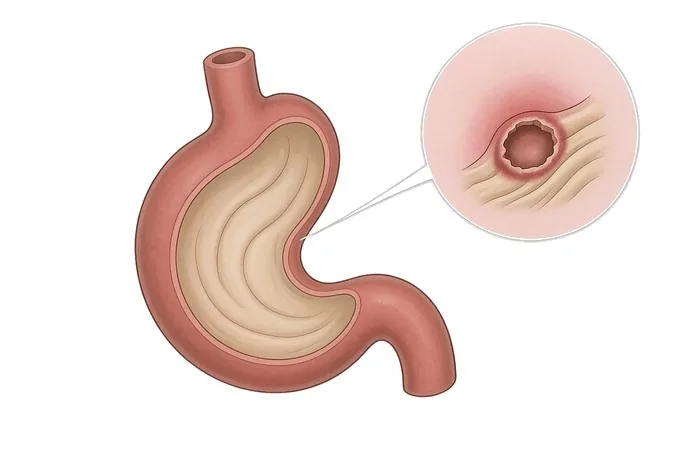
A peptic ulcer is a break in the lining of the stomach or the duodenum, and it is one of the few conditions in this guide that can usually be cured rather than merely controlled. What decides whether it is cured is a step that is easy to skip: finding out why it formed. The two causes that account for most ulcers are both treatable, and removing either of them changes what happens to the ulcer far more than the strength of the acid medicine does.
-
Two causes, both treatable
H. pylori infection and anti-inflammatory drugs including low-dose aspirin — find the cause and the ulcer stops coming back
-
Pain is not the diagnosis
the same burning pain in the same place can be an ulcer, functional dyspepsia, reflux or a stomach cancer
-
A gastric ulcer is biopsied
an ulcerated cancer can look exactly like a benign ulcer, so a gastric ulcer is sampled and its healing confirmed
-
A camera you swallow
magnet-controlled capsule endoscopy examines the stomach and small bowel without intubation
What a peptic ulcer is — and why “gastric pain” is not a diagnosis
A peptic ulcer is a break in the lining of the stomach or of the duodenum, the first part of the small intestine, and it extends deeper than a surface erosion. “Peptic” refers to the acid and pepsin that keep the break open. The two common sites give the condition its two names: a gastric ulcer in the stomach, and a duodenal ulcer in the duodenum. The useful question about either of them is not how the pain feels but what removed the lining’s protection.
The mistake this page exists to correct is the assumption that the pain identifies the disease. It does not. The same burning pain in the same spot, of the same severity, can be an ulcer with a treatable cause, functional dyspepsia with no ulcer at all, reflux, gallstone disease, or a stomach cancer. Severity does not separate them, position does not separate them, and the relationship to food does not separate them either. A symptom pattern decides how urgently to look; only looking decides what is there.
| What is happening | What it explains |
|---|---|
| Acid and pepsin digesting a breach in the lining | Why suppressing acid lets the ulcer heal — and why suppressing acid alone does nothing about the reason it formed |
| Helicobacter pylori living in the stomach lining and keeping it inflamed | Why eradicating the infection changes what happens next far more than the length of the acid course does |
| Anti-inflammatory drugs switching off the prostaglandins that protect the lining | Why an ulcer can form, and bleed, in someone who has never had a day of pain |
Two consequences follow. An ulcer is not the same as gastritis or a surface erosion, and treating the words as interchangeable is how people end up on repeated courses of acid medicine for years without anyone asking why the problem keeps returning. And a gastric ulcer and a duodenal ulcer are not the same disease in practical terms: a duodenal ulcer is almost never malignant, while a gastric ulcer has to be sampled and then checked again after treatment, because an ulcerated cancer can look exactly like a benign ulcer.
The two causes that are treatable: H. pylori and NSAIDs
Most peptic ulcers come down to one of two things, and both can be dealt with. The first is infection of the stomach lining with Helicobacter pylori, a bacterium that survives in acid and keeps the lining inflamed. The second is a non-steroidal anti-inflammatory drug — ibuprofen, naproxen, diclofenac, and also the low-dose aspirin that many people take daily for their heart and do not think of as a stomach drug at all.
| Cause | What it means for treatment |
|---|---|
| Helicobacter pylori infection | Detected by breath, stool or biopsy-based testing and treated with an eradication regimen, with a retest afterwards to prove it has cleared. Where this is done, the ulcer stops behaving like a recurring disease. |
| NSAIDs, including low-dose aspirin | The drug is reviewed rather than simply stopped or simply continued: substituted where possible, reduced to the lowest effective dose, or continued with mucosal protection when the cardiovascular reason for taking it is strong. |
| Acid and pepsin | Necessary for an ulcer to exist, and therefore the target that lets it heal — but not the thing that started it. This is why acid suppression heals the ulcer and does not prevent the next one. |
| Other and uncommon causes | Rare conditions that drive acid production far above normal, a cancer presenting as an ulcer, and other illnesses that injure the lining. These are looked for when the picture does not fit, and are the reason a non-healing gastric ulcer is re-sampled rather than simply re-treated. |
The practical difference between finding the cause and not finding it is the difference between an episode and a disease. An ulcer healed with acid suppression while the H. pylori infection is still present, or while the anti-inflammatory drug is still being taken, tends to come back — and it is a blunt fact of the condition that the return is often announced by bleeding rather than by pain. When the cause is identified and removed, the ulcer usually heals and stays healed.
Two things are often believed that are not causes at all. Spicy food does not cause ulcers, and neither does coffee, alcohol in ordinary amounts, or stress — the idea that it did dates from a period before the bacterium was recognised. This matters because it directs effort at the wrong place: people restrict their diet for years while the infection in their stomach goes untreated, or while the tablet they take for their back quietly keeps the lining unprotected. How each cause works is on the causes page.
Bleeding is the complication that most often arrives first
Bleeding is the commonest complication of a peptic ulcer, and for many people it is the first thing that happens — before any pain, before any diagnosis, and sometimes before anyone suspected an ulcer at all. Blood that has travelled through the digestive tract comes out as black, tarry, unusually offensive stool. Blood that has not comes up as red vomit or as something resembling coffee grounds.
| What you notice | What it means |
|---|---|
| Black, tarry, offensive-smelling stool | Digested blood from the upper digestive tract. It is the commonest way a bleeding ulcer announces itself, and it is not caused by diet or by iron tablets alone |
| Vomiting blood, or coffee-ground vomit | Active bleeding that needs emergency assessment and usually an urgent endoscopy |
| Dizziness on standing, breathlessness, palpitations, unusual tiredness | Blood loss that may have been going on slowly for weeks. It can be the only sign, and it is often found as anaemia rather than as a visible bleed |
| Sudden severe pain with a rigid abdomen | Perforation, which is a different emergency requiring immediate assessment and often surgery |
Two sentences are worth being blunt about. The first: having no pain does not mean having no ulcer. Ulcers caused by anti-inflammatory drugs and by low-dose aspirin are characteristically silent, which is precisely why they are the ones that present with bleeding. The second: black stools or vomiting blood are emergency care now, not a reason to wait and see whether it settles. A bleed that has stopped on its own has not been treated; it has paused.
What a full assessment contains, and why the camera cannot be replaced
The central test is gastroscopy, and it does three jobs at once: it sees the ulcer, it takes tissue for examination, and where the ulcer is the source of bleeding it treats it in the same session. Nothing else does all three, which is why a diagnosis made from symptoms leaves the important questions open.
| Test | The question it answers |
|---|---|
| Gastroscopy | Is there an ulcer, where is it, how large is it, and is it bleeding? A duodenal ulcer and a gastric ulcer look similar to the person who has them and mean different things |
| Biopsy of a gastric ulcer | Is this a benign ulcer or an ulcerated cancer? Sampling is standard for a gastric ulcer and is not routine for a duodenal ulcer, which is almost never malignant |
| H. pylori testing — breath, stool or biopsy-based | Is the treatable cause present? Each method has a place, and serology has a specific limitation: it cannot tell a current infection from an old one that has already cleared |
| Full blood count and iron studies | Has this ulcer been bleeding slowly? Anaemia is sometimes the only objective finding, and it changes how urgently things are arranged |
| Repeat gastroscopy after treatment | Has the ulcer healed, and does it still look benign? This is not an excess of caution for a gastric ulcer; it is what excludes a cancer that the first look could not distinguish |
| Imaging, and a review of every medicine | Whether the picture is something other than an ulcer — perforation, obstruction, gallstone disease — and which anti-inflammatory drugs or steroids are being taken, prescribed or bought |
The step people most often resent is the one that matters most: a gastric ulcer is looked at again after treatment to confirm it has healed and still looks benign. An ulcerated cancer can be indistinguishable from a benign ulcer at a single examination, and a gastric ulcer that has not healed is a reason to sample it again rather than to extend the acid medicine. How each test is interpreted is on the diagnosis page.
Where gastroscopy is arranged with us, it is performed by our gastroenterology department, which also carries out the biopsy and any endoscopic treatment of bleeding in the same session. For people who cannot or would rather not undergo conventional upper endoscopy, the department has magnet-controlled capsule endoscopy — a capsule of about 11 × 26 mm with an 8K, 140° field of view, controlled from outside the body by a magnet, which images the stomach in a 360° sweep and, on a single 12-hour battery, can cover the stomach and small bowel together without intubation.
Treating an ulcer: heal it, remove the cause, confirm the healing
Treatment has three separate jobs, and confusing them is the source of most of the disappointment in this condition: heal the ulcer in front of you, remove whatever caused it so that it does not come back, and look again to confirm the healing happened.
| Job | What it involves | How it is judged |
|---|---|---|
| Heal this ulcer | A defined course of acid suppression, with the length set by the site and size of the ulcer and by whether it has bled | Symptoms settling, and healing seen at the follow-up examination for a gastric ulcer |
| Remove the cause | Eradicating H. pylori if it is present, and reviewing every anti-inflammatory drug — substituted, reduced, or continued with protection | A negative H. pylori retest after treatment, and a documented decision about each anti-inflammatory drug |
| Confirm the result | Repeat endoscopy for a gastric ulcer, and a written plan stating what was found, what was treated and when to be reviewed | Healing confirmed, and a plan the person can act on at home |
Acid suppression is the part that heals the ulcer, and it works within a defined course rather than indefinitely. The commonest mistake is not the choice of drug but the pattern of taking it: stopping as soon as the symptoms settle and starting again when they return. That leaves the ulcer partly healed, allows the cause to keep acting on the lining, and is one of the ways an ulcer becomes a recurring complaint instead of a treated one.
Removing the cause is the part that stops it coming back, and the anti-inflammatory drug conversation is the more difficult half of it. A person taking low-dose aspirin after a heart attack or a stroke should not simply stop it, and a person taking it without a strong indication often should. Both decisions belong to a clinician who can weigh the gastrointestinal risk against the cardiovascular one, and the answer is sometimes to continue the drug with protection for the lining rather than to stop it. The full treatment sequence is on the treatment page.
Why patients come to China for peptic ulcer care
What an international patient comes for here is rarely a medicine, because the medicines for an ulcer are available everywhere. It is the sequence being completed in one place: a gastroscopy that sees and samples the ulcer, an H. pylori diagnosis with a regimen and a retest that proves it has cleared, the anti-inflammatory drug question answered by someone who can weigh both risks, and a written plan that says what was found and when to come back.
Our gastroenterology department carries out that sequence. Its published scope covers Helicobacter pylori infection, peptic ulcer, gastrointestinal bleeding, endoscopic treatment of bleeding oesophagogastric varices, and the screening and endoscopic treatment of early gastrointestinal cancer. Endoscopy uses a Fujifilm 7000 system with high-definition magnifying gastroscopes — 4K-class imaging with 140× optical magnification, which shows the fine detail of the mucosal surface — and small-bowel endoscopy where a lesion lies beyond the reach of a standard instrument.
Some of that equipment answers the "what if it is not an ulcer" question rather than the ulcer itself: fine-needle aspiration under ultrasound guidance, using a needle of about 1 mm to sample tissue beneath the surface; ERCP, which examines and treats the bile and pancreatic ducts through a duodenoscope with X-ray guidance; and stenting, which places an expandable metal or plastic stent to relieve a narrowing of the digestive tract, the bile duct or the pancreatic duct. The department also holds double-balloon enteroscopes, high-frequency and argon-plasma generators and a gastrointestinal function therapy device.
The department is led by Wu Ji, Chief Physician, whose published areas of expertise are digestive-system tumours, inflammatory bowel disease, cirrhosis, functional gastrointestinal disorders, ERCP, endoscopic sclerotherapy for oesophagogastric varices, and the screening and endoscopic treatment of early gastrointestinal cancer. Most of an ulcer assessment can be established before travel is arranged: send the endoscopy report with the ulcer's site, size and description and the biopsy result, the Helicobacter pylori test and whether it was repeated after treatment, blood counts and iron studies, and a complete medicine list. Our team will return a written opinion on whether the cause has been established and which missing step is worth arranging where you are.










