


Parkinson's Disease Overview
Parkinson's Disease Overview
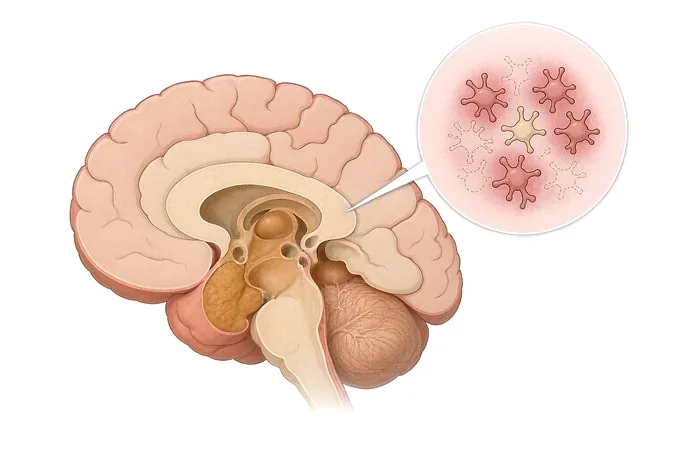
Parkinson's disease is a progressive neurological condition in which the nerve cells that make dopamine, in a small region of the brainstem called the substantia nigra, are gradually lost. The diagnosis is made on the examination and not on any scan, and it rests on one feature above all: bradykinesia — movement that has become slow, small and progressively smaller with repetition. Rest tremor and rigidity are the two features that can stand beside it. Tremor on its own does not make the diagnosis, and a meaningful number of people with early Parkinson's disease do not tremble at all.
-
Movement disorders
Neurology, functional neurosurgery and rehabilitation in one pathway
-
Imaging
3.0T MRI, DAT SPECT and PET-CT in one place
-
48 hours
Written second-opinion report after complete records arrive
-
124+
Countries and regions our international patients come from
What Parkinson's disease is, and what it is not
Parkinson's disease is a condition of movement and of much else besides. In the region of the brainstem called the substantia nigra, nerve cells that release dopamine into the circuits that start and smooth movement are lost over years. The loss is gradual, it begins years before anything is noticed, and by the time movement slows enough to be recognised, a substantial proportion of those cells are already gone. What follows is not weakness: strength is preserved, and what is lost is the ease, the size and the automaticity of movement.
The feature that carries the diagnosis is bradykinesia. In the clinic it is looked for in the small repeated actions rather than in the large ones: tapping the fingers, opening and closing the hand, turning the hand over, and getting up from a chair. Movement is slow to start, the amplitude drops as the action repeats, and the movement may stop altogether mid-task. In daily life the same thing appears as doing up buttons taking longer, a hand that no longer swings when walking, handwriting that gets smaller across a line, and a foot that catches rather than clearing the ground.
Beside bradykinesia sit two other motor features, and the diagnosis requires one of them. Rest tremor is present when the limb is supported and doing nothing, often described as rolling a pill between finger and thumb; it settles when the hand reaches deliberately for something and it disappears in sleep. Rigidity is the resistance felt when someone else moves the limb, and it is the feature patients usually describe as aching — across one shoulder, down one side — and treat for years as a muscular problem. Either one, with bradykinesia, is enough. Neither alone is.
The condition is also not only a condition of movement: loss of smell, constipation and acting out dreams during sleep often precede it by years, and pain, low mood and later changes in blood pressure and thinking shape the day as much as the movement features do.
Which phenotype, and which condition it really is
Once the diagnosis is established, the next question is which kind this is. In the tremor-dominant form, tremor is prominent and progression is often slower. In the postural instability and gait difficulty form, usually shortened to PIGD, the trouble is in standing, starting and turning, the tremor may be absent, and the course tends to be less forgiving.
Age divides it differently. Most people are diagnosed after 60; a minority — commonly quoted as around 1 in 10 — are diagnosed before 50, face more years with the condition, develop wearing-off and dyskinesia earlier, and have work, family planning and driving live at diagnosis.
The boundary that matters most is that Parkinson's disease is one cause of parkinsonism. Secondary parkinsonism has a named cause, and the one to look for first is medication: dopamine-blocking drugs — certain antipsychotics and anti-nausea drugs — can produce the entire picture and improve once withdrawn. Vascular causes and normal-pressure hydrocephalus belong in the same group.
The atypical parkinsonian syndromes — multiple system atrophy, progressive supranuclear palsy, corticobasal syndrome and dementia with Lewy bodies — begin by looking like this and then diverge. The red flags that point to them are early falls, early autonomic failure, early dementia, a vertical gaze palsy, symmetry at onset, a rapid course, or no response to an adequate levodopa trial.
How much, how long, and what it costs the day
Severity is not how much a hand shakes. It is read along two axes: what the condition has taken from movement and from everything else, and what it has taken out of the hours of a day. A person with a tremor and an intact day is less disabled than one with no tremor and four usable hours out of twelve.
| Axis | How it is described |
|---|---|
| Bradykinesia, and how far it has spread | Which limb began it, whether it now involves the other side, and whether it has reached the midline — speech, swallowing, turning in bed, getting out of a chair. The speed of the hand matters less than whether the trunk is now involved. |
| Phenotype: tremor-dominant or gait and balance | Which feature is prominent. The tremor-dominant form and the postural instability and gait difficulty form are associated with different rates of progression and different hazards, the second carrying falls and freezing with it much earlier. |
| Fluctuations and dyskinesia | Whether the day is now divided into 'on' and 'off', how many hours are good, whether the return of symptoms before the next dose is predictable, and whether involuntary movements appear at the best part of the dose. This axis is what moves a person toward device treatment. |
| The non-motor burden | Smell, sleep, acting out dreams, constipation, pain, blood pressure on standing, bladder urgency, mood and anxiety. In many people this axis carries more of the disability than the movement features do, and it is the one least often written down. |
| The response to levodopa, documented | How much improves, how long the improvement lasts, and how much of it was actually measured rather than recalled. This axis is diagnostic and therapeutic at once: it supports the diagnosis, and it is the entry criterion for deep brain stimulation. |
| What the day still contains | Dressing, bathing, handwriting, eating, driving, working, and leaving the house alone. Falls in the last six months, and whether the person has stopped doing something because of the condition rather than because of age. |
| Cognition, mood and the things treatment adds | Thinking speed and executive function, visual hallucinations, depression and apathy, and the impulse-control problems that dopamine agonists can produce — gambling, spending, eating, and sexual behaviour that the person does not recognise as new. Apathy and hallucinations change a plan more than any motor score. |
Read together they say which of four situations this is: newly diagnosed and untreated; treated and working well; treated and no longer working well, where the question is dose timing, another drug, or a device; or advanced, where swallowing, falls, cognition and the burden on the carer are what matters.
How the diagnosis is made, and what is excluded
The diagnosis is clinical and made by a neurologist. Investigations answer three questions in order: is this parkinsonism at all, is there another cause that would explain it, and is the dopaminergic pathway affected.
| Investigation | What it settles |
|---|---|
| The examination, and the medication list | Whether bradykinesia is present, whether tremor is a rest tremor or an action tremor, whether rigidity is present, and how the person starts, turns and walks. The medication list is read in the same breath, because a dopamine-blocking drug taken for years can produce the entire picture and stopping it can undo it. |
| A documented challenge with levodopa or apomorphine | The size of the response, measured as a motor score before and after a dose rather than recalled afterwards. A clear and sustained response is among the strongest supports for the diagnosis; a documented absence of one, at an adequate dose, is among the strongest reasons to reconsider it. The same measurement later becomes the entry criterion for device treatment. |
| MRI of the brain at 3.0T | Whether there is a structural or vascular explanation, including normal-pressure hydrocephalus, which is one of the few causes of the whole syndrome that can be treated directly, and whether there are features that point instead to an atypical syndrome. |
| DAT SPECT, also called a DaTscan, and substantia nigra ultrasound | Whether the presynaptic dopaminergic pathway is intact. A normal scan in a person with a tremor moves the diagnosis toward essential tremor, drug-induced tremor or a functional tremor rather than toward this condition. An abnormal one confirms dopaminergic loss, which several conditions share, so it does not by itself say which one. |
| Non-motor assessment, and blood and urine tests where indicated | Smell, sleep and dream-enactment, bowel function, lying and standing blood pressure, mood, and cognition — documented rather than asked about in passing. Blood and urine tests are aimed at the treatable imitations, including thyroid and metabolic causes in anyone and Wilson's disease in a person diagnosed young. Genetic testing is considered where onset is early or several relatives are affected. |
A workup worth having answers six things: whether bradykinesia is present and what accompanies it, whether the medication list could be producing it, what imaging excludes, whether the dopaminergic pathway is affected, how large the levodopa response is when measured, and what the non-motor symptoms are doing. The last two are the ones most often missing.
Why patients travel to China for movement-disorder care
Parkinson's disease is managed over decades, and most of that belongs near home. Travel becomes reasonable when the diagnosis is uncertain, when the day has begun to fragment and the answer has been to add drugs rather than re-time them, when a device is being considered and the question is whether the window is open, or when an implant needs programming unavailable at home.
Our pathway is run by neurology, functional neurosurgery and rehabilitation together, with 3.0T MRI, DAT SPECT and PET-CT in one place. Where stimulation is considered, evaluation is a single programme and programming is provided on site.
The practical questions are answered as for any other condition we treat: a written opinion within about 48 hours of complete records arriving, stating whether the diagnosis is secure, what the imaging excludes, how large the levodopa response is, whether the problem is timing or drug choice, and whether a device should be assessed. Complete treatment typically runs at 30–50% of comparable care in Europe or the United States.










