


Pancreatic Cancer Overview
Pancreatic Cancer Overview
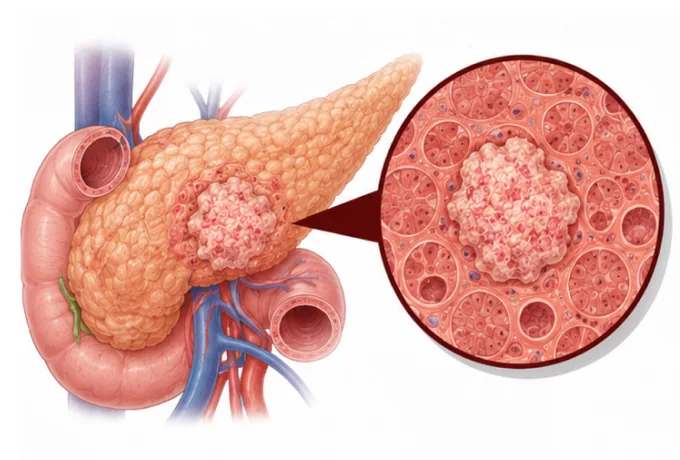
The pancreas sits deep behind the stomach and against the spine, so a tumour can grow there for a long time without producing anything a person would notice. That position — and the vessels wrapped around the gland — shapes every decision that follows.
-
~90%
of pancreatic cancers are ductal adenocarcinoma
-
KRAS
mutated in about 90% of ductal adenocarcinoma — the commonest driver
-
60–70%
arise in the head of the gland, which is why jaundice is so often first
-
48 hrs
from complete records to a personalized MDT plan
What pancreatic cancer is
The pancreas is a soft, lobulated gland about the length of a hand, lying horizontally behind the stomach and in front of the spine. It has two jobs that have nothing to do with each other: the exocrine part produces digestive enzymes that drain through a duct into the duodenum, and the endocrine part — the islets — makes insulin and other hormones and releases them into the blood. More than nine in ten pancreatic cancers arise from the exocrine, ductal side, which is why the disease is called pancreatic ductal adenocarcinoma and behaves so differently from a pancreatic neuroendocrine tumour.
Three anatomical facts explain almost everything about how this cancer presents and how it is treated. The gland lies deep in the retroperitoneum, so a tumour produces no lump that can be felt and no pain until it involves a nerve plexus. The bile duct passes through the head of the pancreas on its way to the duodenum, so a tumour in the head blocks it and causes jaundice long before the tumour itself is large. And the gland is wrapped around major arteries and veins — the superior mesenteric artery and vein, the portal vein, the coeliac axis — so whether the tumour can be separated from those vessels matters more than its diameter.
The pattern that follows from this is distinctive: the disease is comparatively uncommon in absolute terms, yet it accounts for a disproportionate share of cancer deaths, because the ratio of deaths to new diagnoses is unusually close to one. IARC data reflect that — most people are diagnosed at a point when the tumour is no longer confined to the gland. This is also why the diagnostic question is not simply "what stage is it" but "is it resectable, borderline resectable, locally advanced, or metastatic", and why that judgement is best made by a team that makes it every week.
The main types
Pancreatic tumours are not one disease, and the type changes the treatment more than the stage does in some cases:
- Pancreatic ductal adenocarcinoma — around 90% of all pancreatic cancer. Arises from the ductal epithelium, provokes a dense fibrous stroma, and is the type discussed on every other page of this cluster. About 60–70% sit in the head of the gland.
- Pancreatic neuroendocrine tumour — a much less common group arising from the islet cells. Biologically distinct, often slower growing, treated with different drugs, and sometimes curable even after it has spread. It should not be managed as if it were ductal adenocarcinoma.
- Acinar cell carcinoma — rare, arising from the enzyme-producing cells rather than the ducts, and generally treated along the same lines as ductal adenocarcinoma.
- Cystic tumours and their precursors — intraductal papillary mucinous neoplasms and mucinous cystic neoplasms are cysts with a variable potential to become invasive. Many are watched rather than removed, which is the one situation where pancreatic surveillance genuinely prevents a cancer.
- Ampullary and distal bile duct carcinoma — arising a few centimetres away, at the point where the ducts meet the duodenum. Treated with the same operation as a pancreatic head tumour, but with a better outlook because they cause jaundice earlier.
The practical consequence is that a tissue or cytology diagnosis matters before a treatment plan is committed to. A pancreatic neuroendocrine tumour found in someone who has been told they have ductal adenocarcinoma changes the drugs, the pace and the prognosis, and the two are distinguishable only on the specimen.
What each stage means — and what resectability means
The AJCC system stages pancreatic cancer from the tumour (T), the nodes (N) and distant spread (M) into four stages, and it is reported alongside a separate judgement that matters just as much:
| Stage | In plain terms | How it is usually approached |
|---|---|---|
| IA | Tumour 2 cm or less, confined to the pancreas, no involved nodes, no spread | Surgery, then adjuvant chemotherapy |
| IB | Tumour larger than 2 cm but still within the gland, no involved nodes | Surgery, then adjuvant chemotherapy |
| IIA | Tumour extending beyond the pancreas without involving the major arteries, no involved nodes | Surgery, then chemotherapy; vascular reconstruction if a vein is involved |
| IIB | Up to three involved lymph nodes | Surgery where the vessels allow it, then chemotherapy |
| III | Four or more involved nodes, or a tumour encasing a major artery | Chemotherapy first, sometimes with radiotherapy; surgery only if it becomes removable |
| IV | Distant spread — most often to the liver, peritoneum or lung | Systemic treatment, with drainage, pain control and nutrition support as needed |
Alongside the stage number, every pancreatic cancer is assigned a resectability category, and for treatment planning this is the more useful label:
- Resectable — the tumour does not touch the superior mesenteric artery, the coeliac axis or the hepatic artery, and the portal vein is clear or only abutted. Surgery is the first move.
- Borderline resectable — the tumour abuts or narrows a short segment of the portal or superior mesenteric vein that can be resected and reconstructed, or abuts an artery without encasing it. Chemotherapy comes first, and the operation is planned afterwards if the tumour pulls away.
- Locally advanced — the tumour encases a major artery, so a margin-negative operation is not achievable. Treatment is systemic, with radiotherapy considered for local control.
- Metastatic — there is spread beyond the pancreas, which takes surgery off the table at that point.
Two details carry most of the weight. First, resectability is a radiological judgement about vessels, and it is worth having it reviewed by a surgeon and a radiologist who do it regularly — the difference between borderline resectable and locally advanced decides whether an operation is ever considered. Second, a plan built on a CT scan alone is incomplete: staging laparoscopy sometimes finds small peritoneal deposits the scan missed, and it is easier to discover those before an operation than during one.
The markers that guide treatment
Pancreatic cancer was for a long time described as having no targetable mutations. That is now only partly true, and the markers worth testing fall into a short list:
| Marker | What it is | How it changes management |
|---|---|---|
| KRAS | The commonest driver mutation in ductal adenocarcinoma, present in roughly nine in ten tumours | Historically a marker with no drug to match it; specific KRAS variants now have inhibitors in clinical use and trials, which is why testing is worth doing |
| BRCA1, BRCA2 and PALB2 | Genes needed for repairing double-strand DNA breaks; around one in twenty patients carries a germline or somatic alteration | Confers sensitivity to platinum drugs, and supports maintenance treatment with a PARP inhibitor after a platinum response; also has implications for relatives |
| MSI-High or mismatch repair deficiency | A rare pattern — a small percentage of pancreatic cancers — in which DNA repair errors accumulate | Makes immune checkpoint inhibitors a reasonable option, which is unusual for this disease |
| NTRK and NRG1 fusions | Very uncommon gene rearrangements that drive the tumour | Where present, matched inhibitors can produce a response, so fusion testing is worth requesting in younger patients and in those without a KRAS mutation |
Alongside these, CA19-9 is measured in the blood. It is not a screening test and it is not a diagnostic test — it can be normal in a person who is Lewis-antigen negative, and it rises with any obstruction of the bile duct — but as a baseline before treatment, and as a trend afterwards, it is useful. A fall after chemotherapy or surgery supports the plan; a rise while on treatment is a signal to look again.
Why patients come to China for pancreatic cancer care
Pancreatic surgery is the most technically demanding abdominal operation there is, and the outcomes at a centre that performs it every week are not the same as at one that performs it occasionally. The grouping matters for two reasons: the operation itself, and the judgement about whether to recommend it at all.
- Volume in pancreatic resection — pancreaticoduodenectomy and distal pancreatectomy performed routinely, with the perioperative pathway, complication management and intensive care that a high-volume programme brings.
- Vascular resection and reconstruction — where the tumour abuts the portal or superior mesenteric vein, the vein can be resected and reconstructed in the same operation, which turns some borderline cases into operable ones.
- Endoscopic ultrasound and biliary drainage — EUS-guided tissue sampling and stent placement to relieve jaundice, which is often the first thing a patient needs and shapes everything after it.
- Modern systemic regimens — FOLFIRINOX and gemcitabine with nab-paclitaxel, and the genetic testing that places a patient on a maintenance PARP inhibitor instead of indefinite chemotherapy.
- A single plan rather than a series of opinions — surgery, medical oncology, gastroenterology, radiology, pathology and nutrition settle resectability and sequencing together, and the written assessment is returned within 48 hours of the file being complete.
Two practical points follow. Because resectability is decided on imaging, the imaging matters as much as the biopsy — send the DICOM files rather than a printed report, and nothing else can substitute for them. And because the correct sequence may begin with chemotherapy rather than an operation, a second assessment before travelling is useful: some patients who have been offered surgery elsewhere are found to be better served by chemotherapy first, and the reverse happens too.










