


Ovarian Cancer Overview
Ovarian Cancer Overview
The ovaries sit free in the peritoneal cavity with room to grow before they press on anything, which is why ovarian cancer tends to announce itself vaguely and to be staged surgically rather than by symptoms. The name also covers several different diseases, and the type — more than in most cancers — decides the treatment.
-
~90%
of ovarian cancers are epithelial — and most of those are high-grade serous
-
Fallopian tube
the fimbrial end is now understood to be where most high-grade serous cancers begin
-
BRCA1 / 2
inherited variants shape both risk and treatment — they qualify for PARP maintenance
-
48 hrs
from complete records to a personalized MDT plan
What ovarian cancer is
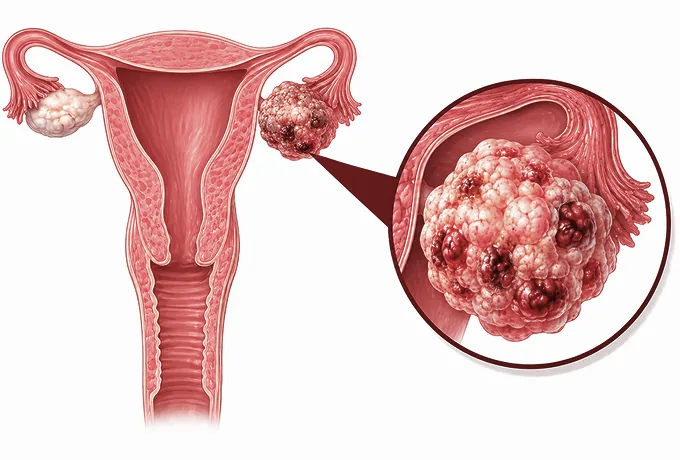
The ovaries are two small organs on either side of the uterus, each about the size of an almond, suspended in the peritoneal cavity by ligaments and blood vessels. That position defines the disease: an ovary has room to enlarge without pressing on anything, and the peritoneum — the lining of the abdominal cavity — is a surface to which tumour cells shed and spread early. Ovarian cancer is therefore usually a peritoneal disease by the time it declares itself, not a tumour confined to one organ.
Two consequences follow. The first is diagnostic: the symptoms it produces — bloating, fullness, pelvic discomfort — belong to ordinary digestion, and the disease is usually confirmed by imaging and surgery rather than found early by any symptom. The second is therapeutic: because spread is across the peritoneal cavity, the operation is measured not by what is removed from the ovary but by whether all visible tumour across the abdomen can be removed — the principle behind debulking surgery.
The third defining feature is genetic. Ovarian cancer has a stronger hereditary component than almost any common cancer except breast — inherited BRCA1 and BRCA2 variants account for a substantial minority of high-grade serous cases — and those same variants are what make PARP-inhibitor maintenance possible. A diagnosis triggers two parallel questions: what is the stage, and what is the genotype.
The main types
"Ovarian cancer" covers several diseases with different ages of onset, different markers and different treatment rules:
- High-grade serous carcinoma — the commonest epithelial type, and the most aggressive. It is now understood to begin in the fimbrial end of the fallopian tube, which is why risk-reducing surgery removes the tubes as well as the ovaries, and why fallopian tube cancer is treated as the same disease.
- Other epithelial subtypes — endometrioid and clear cell carcinoma (linked to endometriosis), mucinous and low-grade serous carcinoma. Each responds differently to chemotherapy; clear cell, in particular, is less platinum-sensitive and is managed on its own terms.
- Germ cell tumours — arise from the egg-forming cells, mostly in girls and young women, and are among the most curable of all ovarian cancers. Treated with the BEP protocol, usually with fertility preserved.
- Stromal (sex-cord) tumours — rare, arise from the hormone-producing cells, may secrete oestrogen and cause bleeding, and tend to be slow-growing.
The practical consequence: histology decides the protocol before stage does. A germ cell tumour at an advanced stage is still treated with curative intent and fertility preserved, while an epithelial cancer at stage I may still need full staging — the type, not the size, is what sets the plan.
What each stage means
Staging in this cancer is surgical: the FIGO stage is assigned from what the surgeon and pathologist find — peritoneal implants, washings, nodes — because spread across the peritoneal cavity is invisible to scans below a certain size. The stages as they affect decisions:
| Stage | In plain terms | How it is usually approached |
|---|---|---|
| I | Confined to one or both ovaries (or tubes) | Surgical staging; fertility-sparing surgery where criteria are met |
| II | Extension within the pelvis — uterus, tubes or other pelvic tissue | Surgery followed by platinum chemotherapy |
| IIIA–IIIB | Microscopic (IIIA) or small visible (IIIB) deposits beyond the pelvis | Surgery plus chemotherapy, sequence set by resectability |
| IIIC | Large deposits beyond the pelvis, or retroperitoneal nodes involved | Debulking surgery and platinum chemotherapy — order depends on feasibility |
| IVA | Malignant cells in a pleural effusion | Systemic treatment; surgery only if a complete debulking is achievable |
| IVB | Distant metastases — liver, spleen, lung, or nodes outside the abdomen | Chemotherapy first; surgery considered after a response |
The decisive practical question inside this table is not the stage number but the resectability assessment: can all visible disease be removed in one operation? Where the answer is yes, surgery comes first; where it is no, chemotherapy comes first and surgery is reassessed after three or four cycles — the interval-debulking pathway, which is standard rather than a compromise.
The markers that guide treatment
Ovarian cancer is among the cancers where the genotype most directly changes treatment, and testing is done on both blood and tumour:
| Marker | What it is | How it changes management |
|---|---|---|
| BRCA1 / BRCA2 | Inherited (germline) or tumour-acquired variants in DNA double-strand repair genes | Qualifies for PARP-inhibitor maintenance with the strongest evidence, and has implications for relatives |
| Homologous recombination deficiency (HRD) | A tumour-level test for defective DNA repair, even without a BRCA variant | Extends PARP-maintenace eligibility to a wider group after platinum chemotherapy |
| MSI / mismatch repair and TMB | Rare in ovarian cancer, but tested when immunotherapy is considered | Supports a PD-1 inhibitor in the small group whose tumours qualify |
| Folate receptor alpha and rare fusions | Surface markers and gene fusions assessed in later lines | Antibody–drug conjugates targeting folate receptor alpha are an option after platinum failure in defined disease |
The practical point: request germline BRCA testing for every epithelial ovarian cancer at diagnosis, not only for patients with a family history — the result changes maintenance treatment and informs relatives, and the tissue and blood should be sent together.
Why patients come to China for ovarian cancer care
Ovarian cancer surgery is among the most extensive operations in gynaecological oncology, and the outcomes that matter — completeness of debulking — are a direct function of the team's volume and the multi-organ capability behind it.
- Cytoreductive capability across organs — debulking may involve bowel resection, diaphragm stripping and splenic procedures; centres that do this routinely achieve complete resection more often, which is the factor the whole pathway depends on.
- Interval debulking done properly — the neoadjuvant-then-surgery pathway requires imaging-based reassessment and a surgical team able to operate after chemotherapy, at the right point in the cycle.
- Genetic testing and PARP maintenance in-house — BRCA and HRD testing on blood and tumour, and the maintenance phase managed by the same team that operated.
- Fertility-sparing protocols — for young women with stage I disease and germ cell tumours, surgery that preserves the uterus and one adnexa, with follow-up built for it.
- Germ cell tumour expertise — the BEP protocol demands experience with its toxicities, which concentrates in centres treating these young patients regularly.
- Coordinated follow-up — CA-125 trends, imaging schedules and maintenance therapy managed across time zones through the international service.
Two practical consequences follow. The order of surgery and chemotherapy depends on a resectability assessment that should be made before travel, from imaging — so send the CT, not just the reports. And because the maintenance phase after chemotherapy is where much of the value of genotyping is realised, the genetic test result should be available to the treating team, not filed at home. Send complete records and the written assessment is returned within 48 hours of the file being complete.










