


Meningitis & Encephalitis Overview
Meningitis & Encephalitis Overview
Meningitis and encephalitis are not two grades of the same illness. They are inflammation at two different levels , and which level it is decides both the name and the hour. Meningitis is inflammation of the membranes that line the brain and the spinal cord, and what it produces is fever, a headache unlike any the person has had, a neck that resists being flexed, and light that hurts — while thinking is usually clear. Encephalitis is inflammation of the brain substance itself, and what it produces is different in kind: a change in consciousness, behaviour, personality or speech, or a seizure. The two can occur together, and where they do both are named rather than one being treated as a milder version of the other. This guide follows the order people need it in: what each looks like, which organisms are behind them, what changes the timescale, how the diagnosis is assembled, and what treatment and follow-up actually consist of — including the months after the fever, which is where the part families are told about least often lives.
-
48 hours
written opinion once complete records arrive
-
One team
neurology, critical care, imaging, infectious disease and rehabilitation together
-
Suspicion, not confirmation
what starts the treatment in this condition
-
124+
countries and regions our international patients come from
What meningitis and encephalitis are
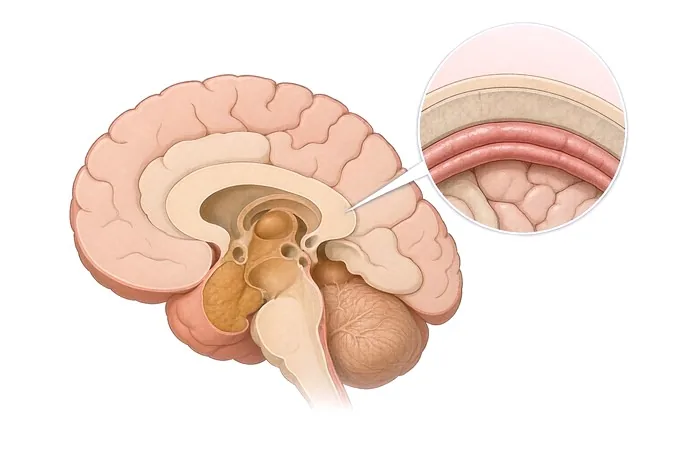
The brain and the spinal cord are wrapped in three layers of membrane, and between two of them the fluid that cushions them circulates. Meningitis is inflammation of those layers. The brain substance underneath them is not the problem, and that is why the mind is usually clear: what a person with meningitis describes is a headache, a fever, a neck that will not bend forward, and light that hurts.
Encephalitis is inflammation of the brain substance itself. The membranes may be entirely uninvolved. What a person with encephalitis presents with is not a headache with a fever but a change in who they are — they are less awake, or awake and not themselves, or their speech has gone wrong, or they have had a seizure. Family members usually notice this before any clinician does, and the sentence they use is worth listening to: they are not themselves.
That distinction is the entry point to everything else on this page. It changes which tests are requested, because a person with encephalitis needs imaging of the brain substance and an electroencephalogram in a way a person with straightforward meningitis does not. It changes what is started before the answer is available, because one of the treatable causes of encephalitis has a medicine that works only if it is given early. And it changes how the months afterwards are spent, because the two conditions leave different things behind.
The two can occur together, and this is commoner than the separate labels suggest. Where both are present the honest name is meningoencephalitis, and using it matters: a person labelled with the milder of the two when both are involved is a person whose level of illness has been written down as less than it is. What each looks like in a day is set out on the symptoms page.
The organisms, and what separates them
What separates the causes here is not only which organism it is but what the organism decides about time. Some of these are conditions in which nothing needs to happen tonight; two of them are measured in hours, and in those two the treatment is given before the diagnosis is confirmed rather than after it. The table below sets out the groups that account for most of what presents, what identifies each, and what the distinction changes.
| Group | What it is | How it presents | What the distinction changes |
|---|---|---|---|
| Viral meningitis | Most often an enterovirus; also mumps, herpes viruses, and HIV at the time of seroconversion | Fever, headache and neck stiffness in someone who is awake, alert and recognisably themselves, and who is often less unwell than the presentation suggests | Usually self-limiting, and usually managed rather than treated. The work is in excluding the two causes that are not |
| Bacterial meningitis | Pneumococcus, meningococcus, Haemophilus influenzae type b, group B streptococcus in a neonate, and Listeria in the very young, the old, the pregnant and the immunosuppressed | Fever with a severe headache, a neck that resists flexion, vomiting, and then — as it advances — drowsiness, confusion and a falling level of consciousness | The hours matter more than any other item on this page. Antibacterial therapy is given at the point of suspicion, not after a scan |
| Herpes simplex encephalitis | Herpes simplex virus, involving the temporal lobes and the structures of memory | A change in behaviour or personality, words that cannot be found, seizures, and a person who is not themselves — often with a fever that is unimpressive | The one treatable cause of encephalitis that is started on suspicion. Where it is stopped, it is stopped on an answer rather than on an assumption |
| Japanese encephalitis and other arboviral encephalitides | A mosquito-borne flavivirus endemic across much of Asia; other arboviruses elsewhere | Fever followed by a fall in consciousness, often with movement disorders and, in children, seizures | Endemic exposure is the clue that has to be asked for. There is a vaccine, which is the one genuinely preventive item here |
| Tuberculous meningitis | Mycobacterium tuberculosis, with a particular affinity for the base of the brain | A subacute course over days to weeks: headache, low-grade fever, a personality change, and then cranial nerve palsies and a falling level of consciousness | It is slow enough to be mistaken for something else, and the cost of that is measured in function. The regimen is prolonged and the monitoring is part of it |
| Cryptococcal and other fungal meningitis | Most often in someone whose immune system is impaired by a medicine, a condition or HIV | A headache over weeks, with a fever that may be low or absent, and a level of consciousness that declines slowly rather than over hours | The immune state is the question, not the headache. It is chronic, and it is treated as chronic rather than as an acute course |
| Autoimmune encephalitis | An immune response against the brain rather than an infection in it; sometimes triggered by an infection that has already cleared | A subacute change in behaviour, memory, movement or sleep, sometimes with seizures, and often weeks after a viral encephalitis has apparently resolved | Not an infection, and not treated as one. It is the reason a relapse after recovery is a separate question rather than a recurrence |
Two rows decide most of the consequence in practice. Bacterial meningitis is the one in which delay does the damage, and where the treatment must not wait for imaging. Autoimmune encephalitis is the one most often missed as an infection that has come back, and it belongs to its own pathway rather than to a second course of the same medicine. How the fluid separates them is set out on the diagnosis page.
What changes the timescale
Two clocks run here, and the whole of this section is about telling them apart. The first is the clock of viral meningitis, which is measured in days and in which the work is supportive and the worry is diagnostic rather than therapeutic. The second is the clock of bacterial meningitis and of herpes simplex encephalitis, which is measured in hours. What follows separates them, with the action attached to each.
| Feature | What it looks like | What it warrants |
|---|---|---|
| A falling level of consciousness | Drowsiness that is increasing, a person who is difficult to rouse, or intervals of wakefulness that are getting shorter | Assessment now, and treatment at the point of suspicion. This is the feature that moves the condition from days to hours on its own |
| A change in behaviour or personality | Not themselves, in the words of the family; words that cannot be found; behaviour that is out of character | Imaging and encephalitis cover, now. This is the presentation of the brain substance being involved rather than the membranes |
| A seizure, or a first seizure in adult life | A witnessed fit, or a period afterwards in which the person is not themselves and does not fully return | Imaging before the lumbar puncture, and the puncture deferred rather than cancelled. The order is the point |
| A rash that does not fade under pressure | Spots or bruise-like marks that persist when pressed with a glass or a finger | Meningococcal disease until shown otherwise, and the hour belongs to it. Contacts are a public health question from this moment |
| Focal signs, or swelling of the optic discs | Weakness or altered speech on one side, a pupil that has changed, or disc swelling seen on examination | Imaging before the puncture. This is the circumstance in which the puncture is deferred, and the rule is not relaxed |
| A subacute course over weeks, with a low-grade fever | Headache and a personality change progressing over a fortnight rather than a day | Tuberculous or fungal, and investigated as such. The error is treating the pace as reassurance |
| A deterioration weeks after apparent recovery | Someone who got better and is now declining, most often with behaviour or movement rather than with fever | Post-infectious autoimmune encephalitis until shown otherwise. It is not a recurrence and it is not managed with the same medicine |
What should not happen is the reverse of this list: a drowsy person being observed overnight because the fever is modest, or a lumbar puncture being performed through raised pressure because it was the next item on the list. These are also the answer to the question families are most often not given — what would make this worth coming back about. They are repeated on the symptoms page, because that is where they get used.
How the diagnosis is assembled
The assessment runs in a deliberate order, and the order is what prevents the two errors this condition invites: giving the treatment too late because a scan had to happen first, and taking the fluid through raised pressure because the puncture was the next step. Samples come first. Imaging comes where it is indicated. Treatment does not wait for either.
| Step | What it establishes | What it does not do |
|---|---|---|
| Blood cultures, drawn before the first dose | The organism, in a proportion of cases, from a sample that is safe to take and that cannot be recovered later | Not a reason to delay the dose. They are drawn and the dose follows, in that order and without a gap |
| The question of level: membranes or substance | Whether this is meningitis, encephalitis or both, which decides everything requested afterwards | Not a judgement made from the fever alone. It is made from the consciousness, the behaviour and the speech |
| Computed tomography where the criteria are met | Whether there is a mass, a collection or evidence of raised pressure that makes puncture unsafe at that moment | Not a routine step before every puncture, and not a reason to defer antibacterial therapy. The puncture is deferred, not cancelled |
| Lumbar puncture: pressure, cells, protein, glucose | The pattern that separates bacterial from viral from tuberculous from fungal, and the pressure at which the system is running | Not a single number to be read in isolation. The cell type, the protein and the glucose are read together, and with the clinical state |
| A multiplex polymerase chain reaction panel on the fluid | The organism named directly, in hours rather than in the days a culture takes, including where antibiotics have already been given | Not a substitute for the cultures and the chemistry, and not a reason to withhold treatment while it runs |
| Specific testing: herpes simplex, tuberculosis, cryptococcus | The three that change management most and that have to be asked for by name rather than assumed inside a panel | Not requested once and forgotten. Where the first sample is negative and the question is open, it is repeated |
| 3.0T magnetic resonance imaging | Whether the brain substance is involved, and in what pattern — which in encephalitis often points at the cause before the fluid does | Not a replacement for the fluid, and not a way to avoid the puncture where the puncture is safe |
| Long-term video electroencephalography | Whether fluctuating consciousness is seizure, and whether there is epileptiform activity that needs treating rather than watching | Not a screening test for everyone. It is requested where the level of consciousness does not match the rest of the picture |
What the assessment ends in is a written judgement of four things: which level is involved; which organisms remain plausible, and which have been excluded and on what grounds; what is still worth testing, including whether a repeat of the fluid is the right next step; and what the follow-up has to contain — hearing, cognition, and the interval at which each is reviewed. The full assessment, including what it costs and how long it takes, is set out on the diagnosis page.
Why patients travel to China for a meningitis and encephalitis assessment
Patients come for four reasons: an acute illness that was treated and never named, with a discharge summary that says meningitis and a family that still does not know which organism or what to watch for; a subacute course over weeks in which tuberculosis or cryptococcus is plausible and the question has not been asked by name; a relapse weeks after an apparent recovery, in which the real question is autoimmune rather than infectious; or a sequela that was never formally assessed — hearing most of all, and cognition after it. The value here is not a different machine. It is a team that runs neurology, critical care, infectious disease, imaging and rehabilitation in one pathway, and that is willing to reopen a question that has been closed too early.
What the pathway looks like. Neurology and critical care plan together, with infectious disease, imaging, rehabilitation and neuropsychology inside the same programme. 3.0T MRI, dual-source CT, PET-CT, 3D DSA and long-term video EEG sit within it, as do the full cerebrospinal fluid set — chemistry, cell differential, multiplex polymerase chain reaction, and specific testing for herpes simplex virus, tuberculosis and cryptococcus — and formal audiology. A written opinion is returned within 48 hours of complete records arriving. Fully treated costs typically run at 30–50% of comparable care in Europe or the United States, more than 30 commercial insurers are billed directly, and our international patients come from 124 countries and regions.
What must be said about the medicines and the procedures. Antibacterial therapy, antivirals, prolonged antituberculous or antifungal regimens, immunomodulation where the second peak is autoimmune, and lumbar puncture itself are each discussed as they sit in this pathway: what they are used for, what monitoring they require, and what their own risks are. No medicine is presented as one this hospital routinely holds, and no procedure is presented as one that ends the matter. Any medicine or procedure recommended that is not carried out within this pathway is named at the outset, before any payment is discussed — not at the end of a workup. Where the honest answer is that nothing further would change the outcome, that is said as plainly as the alternative.
What a records-only opinion can and cannot do. It can say which level the presentation fits, which organisms remain plausible and which have been excluded on the samples that exist, whether the fluid results were interpreted in the context of antibiotics already given, what the imaging shows, and what the follow-up has so far omitted. It cannot examine the person, and examination is where several of these distinctions are made: the level of consciousness, the optic discs, the neck, the rash, and the audiometry cannot be assessed from a file. We say so rather than implying otherwise.
What to send first. The discharge summary and the lumbar puncture results, complete rather than summarised — opening pressure, cell count and differential, protein, glucose, Gram stain, culture and polymerase chain reaction, with the dates each was taken relative to the first dose of any antibacterial. Alongside them: the imaging with its report, a list of what was given and for how long, and a short account in your own words of what changed and when, in the order it arrived.










