


Lupus Nephritis Overview
Lupus Nephritis Overview
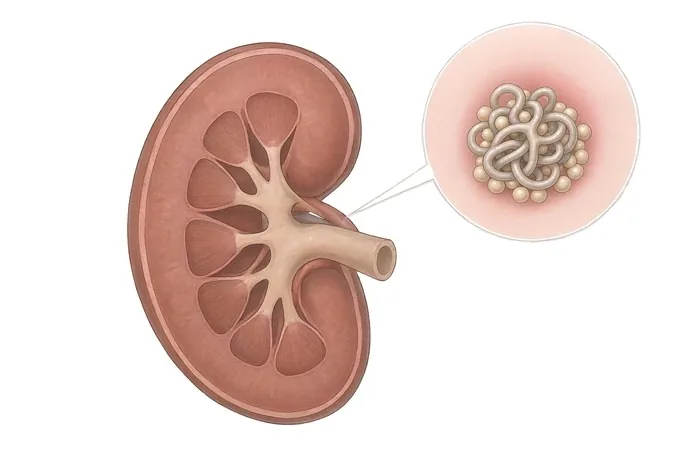
Lupus nephritis is kidney inflammation caused by systemic lupus erythematosus, and the first thing to understand about it is that the kidney has not caught anything on its own. Antibodies bind the body's own nuclear material, the resulting immune complexes settle in the filtering units, and inflammation follows. That single fact explains the whole shape of the care: the kidney is treated by treating the immune system, the rest of the body is assessed at the same time, and a kidney biopsy is standard rather than exceptional because what the microscope shows is what the treatment is chosen from. This guide follows the path patients actually walk — what moves before anything is felt, how the class is read, why treatment comes in two phases, and what living with the result actually involves.
-
A biopsy, not a guess
the class under the microscope decides how strong the treatment has to be
-
Two phases
months of induction to stop the inflammation, then years of maintenance to hold it
-
Tests before feelings
urine sediment, complement and anti-dsDNA usually move before anything is felt
-
2004
the year our nephrology department was established
What lupus nephritis is — a whole-body illness reaching the filter
Systemic lupus erythematosus is a disease in which the immune system makes antibodies against the body's own nuclear material — DNA, RNA and the proteins that package them. Those antibodies bind their targets and form immune complexes that circulate in the blood. Some of them end up in the kidney, because the kidney filters an enormous volume of blood and its filtering units are built to trap material out of it. Once deposited, the complexes activate complement, and complement calls in inflammation. The result is glomerulonephritis: inflammation of the filtering units, which leak protein and blood while it is active and scar over once it has been.
Whether the kidney is involved, and how severely, is the single strongest determinant of how lupus affects a person's long-term health. That is not a statement meant to frighten. It is the reason the kidney is looked for so persistently — and the reason that finding it early, while the inflammation is still active rather than scarred, changes what the rest of a life looks like.
Three things follow from the mechanism, and they shape every page in this guide. First, this is not a kidney disease that happens to occur in people with lupus: it is lupus, in the kidney. Treatment is aimed at the immune system, and a flare elsewhere in the body — a rash, painful joints, pleurisy, a falling blood count — matters to the kidney as much as the urine does. Second, what is active and what is scarred are different things. Active inflammation can be quietened; scar tissue cannot, and treating scar with immunosuppression adds risk without benefit. Third, the disease is measured, not felt. The tests move first, sometimes weeks before a person notices anything, which is why the monitoring schedule exists and why it is kept to even when life is going well.
The six classes, and why the class is what the treatment is chosen from
Lupus nephritis is classified by what a pathologist sees on the biopsy, using the classification agreed by the International Society of Nephrology and the Renal Pathology Society. The class is not a score or a ranking of how unwell someone is — it is a description of the pattern of injury, and different patterns call for different intensities of treatment.
| Class | What the biopsy shows | What it usually means |
|---|---|---|
| Class I — minimal mesangial | Deposits visible only on immunofluorescence or electron microscopy; the kidney looks normal under the ordinary microscope | Generally managed by treating the lupus rather than the kidney, with monitoring |
| Class II — mesangial proliferative | Increased cells and deposits confined to the mesangium, the scaffolding at the centre of the filtering tuft | Usually mild. Kidney-directed immunosuppression is often not needed; blood pressure, protein and lupus control are |
| Class III — focal | Inflammation in a minority of the filtering units, with active lesions, scarring, or both | Requires induction treatment. The proportion of active versus scarred lesions decides how far to go |
| Class IV — diffuse | Inflammation involving half or more of the filtering units, in a segment of each or throughout them | The class most likely to threaten the kidney, and the one treated most actively. Also the one where treatment has the most to gain |
| Class V — membranous | Thickened capillary walls from deposits on the outer side, often with heavy protein loss and a nephrotic picture; it can occur together with class III or IV | Protein loss dominates the picture. Whether immunosuppression is needed depends on how much protein is being lost and whether a proliferative class is present alongside it |
| Class VI — advanced sclerosing | Most filtering units already replaced by scar | Immunosuppression is generally not the answer here, and may do harm. Care turns to protecting the function that remains and planning replacement |
Two qualifications matter more than the class itself. The first is that the class carries a second reading alongside it — how much of what is present is active and how much is chronic — and it is that balance, more than the class number, that decides how hard to treat. The second is that the class is not fixed for life: it can change between biopsies, and a person whose disease behaves differently on a second look is re-evaluated rather than continued on the previous plan by default. Both are set out on the diagnosis page.
How it is tracked: activity, chronicity and the two treatment phases
Lupus nephritis is not staged by a single number. It is followed along two things at once: what the disease is doing now, and how much permanent change it has already left behind. Keeping those separate is what stops both errors — treating scar as if it were inflammation, and failing to treat inflammation because the damage already present looks discouraging.
| State | What the tests show | What it calls for |
|---|---|---|
| Active inflammation | Cells and casts in the urine sediment, protein rising, filtration falling over weeks, complement falling, anti-dsDNA rising | Induction treatment, aimed at stopping the inflammation while it is still inflammation |
| Partial response | Protein falling, sediment quietening, filtration stabilising — improvement that has not yet reached the target | Treatment continued, with the plan and the target restated rather than quietly extended |
| Complete response | Urine close to normal, filtration stable, blood tests settled | Maintenance, at the lowest dose that holds it — held for years, not months |
| Flare | The activity returning after a period of quiet, often first in the blood tests | Reassessment rather than reflex: how much is active, and whether a repeat biopsy would change the plan |
| Chronic damage predominating | Residual protein with a quiet sediment, filtration drifting down slowly, no signs of activity | Immunosuppression steps back; protecting the remaining function takes over |
| Kidney failure | Filtration far reduced, with the complications of reduced filtration dominating | Replacement therapy and transplantation planned years ahead, and timed to a period of quiet disease |
The row that catches people out is the third one. A complete response is the goal, and it is genuinely good news, but it is not the same as the disease being over: maintenance continues for years afterwards, because stopping early is one of the commonest ways a remission is lost. What the maintenance period actually involves, and how it is eventually stepped down, is described on the treatment page and the living-with-it page.
What a full assessment contains
An assessment has two jobs that are often confused: establishing whether the kidney is involved at all, and establishing what is happening in it well enough to choose a treatment. The second job needs the biopsy. Everything else is what tells you when to ask, and what to measure afterwards.
| Test | The question it answers |
|---|---|
| Urine microscopy | Is inflammation active right now? Red cells, white cells and cellular casts are the most direct answer available |
| Protein, measured quantitatively | How much is being lost — as a spot protein-to-creatinine ratio or a timed collection. This is the number the response is judged against |
| Creatinine and filtration rate, repeated | How much function is left, and is it falling over weeks rather than years? |
| Complement C3 and C4 | Is immune activity consuming complement? Low levels are one of the earliest signals of a flare |
| Anti-dsDNA antibodies | Is antibody production rising? It tracks activity in many people, though not perfectly in all |
| Antinuclear, anti-Smith and antiphospholipid antibodies | Is this lupus, and is there an added clotting risk that changes the plan? |
| Albumin and lipids | Has protein loss reached a nephrotic pattern? This affects both treatment and clotting risk |
| Kidney biopsy, with immunofluorescence and electron microscopy | Which class is this, how much is active, how much is scarred? The question everything else is arranged around |
| Screening for latent infection before immunosuppression | Is there something that would flare if the immune system were dampened? Asked before treatment, not after |
What matters about the two antibody and complement tests is that they are not a verdict, they are a trend. A single value is a reading; a series kept over months is a pattern, and the pattern is what a clinician acts on. That is also why the monitoring page asks you to keep your own dated record — a pattern reconstructed from memory is not a pattern.
Why patients come to China for lupus nephritis
Our nephrology department was established in 2004 and is the leading unit of the Fosun Health nephrology alliance. It runs 20 specialised beds, more than 30 haemodialysis machines and two continuous renal replacement therapy machines, and it sees close to 20,000 kidney outpatient visits and close to 1,000 inpatient admissions a year. The department performs kidney biopsy with immunofluorescence and electron microscopy, establishes and maintains vascular access, places peritoneal dialysis catheters, and provides double plasma exchange and hybrid blood purification. It works alongside rheumatology colleagues in planning and following immunosuppressive treatment, and it is supported by a dedicated kidney disease clinic in the traditional Chinese medicine department.
What international patients mostly come for is not a medicine unavailable at home. It is the assembly: a biopsy read for class, activity and chronicity rather than described in a line; the lupus assessed as a whole-body disease at the same time, with the kidney and the rest of the body in one plan rather than two; every medicine reviewed for its effect on the kidney and on the immune system; and a written schedule with dates and targets that a local team can continue. Those steps are described on the diagnosis page and the treatment page.
The first of them happens before any travel is discussed. Sending your records — urine results with dates, protein measurements, creatinine and filtration readings, complement and anti-dsDNA results if you have them, any biopsy report, and your full medicine list — lets a clinician tell you whether anything is missing and what can be established where you are. The practical questions page sets out what to send and what a first visit actually involves.










