


Lung Cancer Overview
Lung Cancer Overview
Lung cancer found early can often be treated with cure in mind. This page explains what the disease is and how it behaves — then opens into six full guides covering symptoms, diagnosis, treatment, causes, prevention, and the questions international patients ask most.
-
2.2M+
new lung cancer cases worldwide each year (WHO)
-
~70%
are found at a late stage — screening changes this
-
~1,000
CyberKnife radiosurgery cases at our Foshan center since 2022
-
48 hrs
from complete records to a personalized MDT plan
What lung cancer is
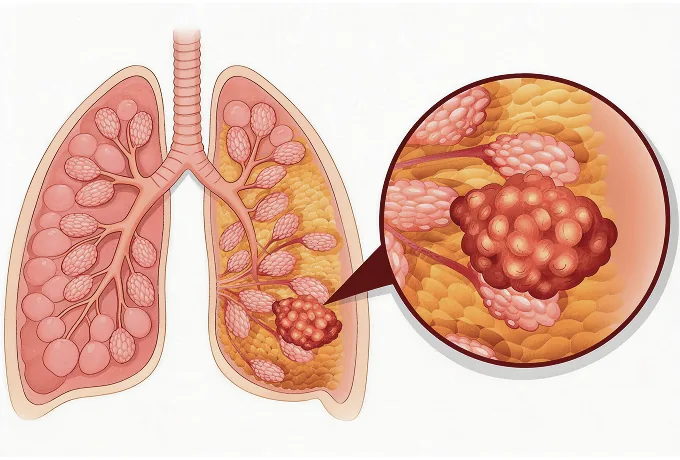
Lung cancer begins when cells in the lining of the airways, or in the lung tissue itself, grow out of control and form a tumor. What makes it different from many other cancers is how little it announces itself: the inside of the lung has no pain-sensitive nerves, and the lungs hold a large functional reserve, so a tumor can reach a considerable size without causing a cough, breathlessness or any other signal.
Two practical consequences follow from that anatomy. The first is that most lung cancers are found late — worldwide, close to 70% are diagnosed only after the tumor has spread or become impossible to remove surgically. The second is the reverse of the first: when lung cancer is found early, cure becomes a realistic goal, which is why screening exists. Symptoms and screening are covered in their own guides.
A diagnosis therefore always raises two separate questions, and both must be answered before anything is decided: how far the cancer has gone (its stage) and what is driving it (its molecular profile). Modern lung cancer care is built on those two axes, not on the diagnosis alone.
Non-small cell and small cell: two diseases, two plans
The two main types of lung cancer are not close variations of one illness. They arise from different cells, grow at different speeds and respond to different treatments — which is why the first thing a pathologist determines is which type is present.
| Non-small cell lung cancer (NSCLC) | Small cell lung cancer (SCLC) | |
|---|---|---|
| How common | The great majority of all lung cancers | A minority of cases |
| Growth pattern | Usually slower, and more often confined to one area when found | Fast-growing; spreads early, often before symptoms |
| Typical location | Frequently the outer lung tissue. Adenocarcinoma is the most common subtype; squamous cell carcinoma and large cell carcinoma are less common | Usually the central airways, close to the main bronchi |
| Main treatments | Surgery and radiosurgery, targeted therapy, immunotherapy, chemotherapy | Chemotherapy with radiotherapy; immunotherapy in selected cases |
| Targetable mutations | Frequently present — EGFR, ALK, ROS1, MET, RET, KRAS and others | Rarely targetable |
| Who it affects | Smokers and never-smokers alike; adenocarcinoma is the most common type in never-smokers and in women | Strongly linked to smoking |
Adenocarcinoma deserves particular attention in Asia. It is the subtype most often found in people who have never smoked, and it is more likely than other subtypes to carry a mutation that can be treated with a targeted drug. That single fact changes the first step for many patients: before any drug is chosen, the tumor should be tested.
What the stages mean
Staging describes how far the cancer has spread. It tells you what is physically possible — whether a surgeon can remove the tumor, whether the disease is confined to the chest, and whether treatment is aimed at cure or at long-term control.
| Stage | What it means | What treatment is usually aiming for |
|---|---|---|
| Stage I | The tumor is confined to the lung; no lymph nodes are involved | Cure. Surgery, or stereotactic body radiotherapy (SBRT) with breath-tracking CyberKnife when surgery is not suitable |
| Stage II | A larger tumor, or involvement of nearby lymph nodes on the same side | Cure. Surgery, usually combined with drug therapy before or after the operation |
| Stage III | Locally advanced — the cancer has reached lymph nodes in the centre of the chest | Still curative for some patients. Chemoradiotherapy, immunotherapy, and surgery in selected cases |
| Stage IV | The cancer has spread to the other lung, the lining of the lung, or distant organs such as bone, liver, brain or adrenal glands | Long-term control. Targeted therapy, immunotherapy or chemotherapy, with radiotherapy directed at specific sites when needed |
It is worth saying plainly what stage IV does and does not mean. It does mean the cancer cannot be removed by an operation. It does not mean there is nothing to do: with targeted or immunotherapy drugs, a proportion of advanced lung cancers are now managed the way a chronic illness is managed — with continuous treatment, periodic scans, and patients who return to work and family life. The number that matters is not the stage alone but which treatment the tumor will respond to.
Why molecular type matters as much as stage
Two patients can have adenocarcinoma of the same stage and need completely different drugs. The difference lies in the tumor's DNA. Molecular profiling examines the tumor tissue for driver alterations — EGFR, ALK, ROS1, MET, RET and others — and for PD-L1 expression, which indicates whether immunotherapy is likely to help.
This is why a targeted drug works only when its target is actually present, and why the test should come before the prescription rather than after it has failed. It also explains a pattern that surprises many international patients: in Asia, a markedly higher share of lung cancers in people who have never smoked — particularly in women — carry a treatable EGFR alteration than in Europe or North America. A tumor that would be treated with chemotherapy in one country can be a candidate for a daily tablet in another.
When the first targeted drug eventually stops working, the next question is what comes after it. Later-generation inhibitors, antibody–drug approaches and matched clinical trials matter here, and access to them varies considerably between countries. How we test and how treatment is chosen is set out in the diagnosis guide and the treatment guide.
Why international patients come to China for lung cancer treatment
Four practical reasons come up most often in conversations with patients and their families — none of them exotic, all of them consequential.
Volume, and the pattern recognition that comes with it
China carries close to one third of the world's lung cancer burden, with roughly 800,000 new diagnoses each year. Teams here meet this disease daily, in every stage and every molecular subtype — including the uncommon presentations that are seen only a few times a year in lower-volume centres.
The whole pathway under one roof
Low-dose CT and PET-CT imaging, endobronchial ultrasound and bronchoscopy, CT-guided biopsy, pathology, in-house NGS molecular testing, robotic surgery, breath-tracking radiosurgery and interventional oncology all sit inside the same hospital network. Diagnosis and treatment do not have to be assembled across several institutions or countries.
Earlier access to newer drugs
Later-generation EGFR and ALK inhibitors, antibody–drug approaches and mutation-matched clinical trials often enter routine use in China years before they become available in some other regions. For a patient whose first targeted drug has stopped working, that difference is not academic.
One decision, made by six specialties
Surgery, medical oncology, radiation oncology, interventional radiology, radiology and pathology review the case together and issue a single plan — within 48 hours of your records being complete — instead of a plan that depends on which department you happened to visit first.










