


Ligament Injury & Reconstruction Overview
Ligament Injury & Reconstruction Overview
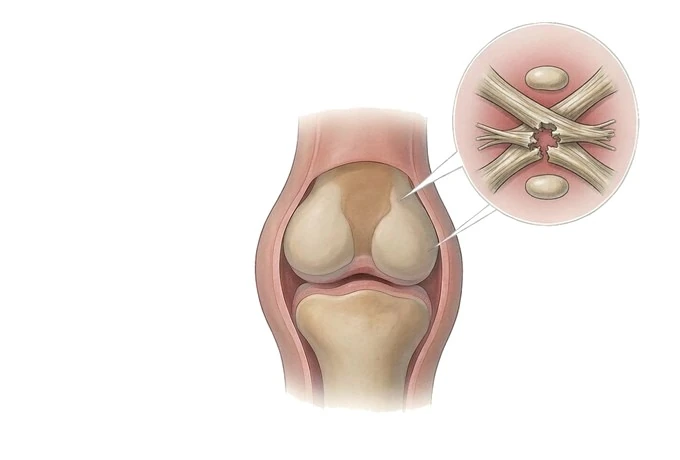
This page is about joints that have lost a restraint, and about asking three questions before deciding what to do about it. A ligament is not only a strap: it limits the directions a joint is not built to travel in, and it reports to the muscles where the joint is. An operation can restore the first of those. It does not restore the second, which is rebuilt by months of training. What the assessment has to produce is not a label but three answers: which ligament, how much abnormal movement the joint now allows, and what this person needs the joint to do.
-
A ligament does two jobs, and an operation restores one
it limits movement the joint is not built for, and it reports where the joint is; the second job is rebuilt by training, not by the graft
-
A complete tear is not automatically an operation
some people do well without one, and a partial tear that keeps giving way may need an operation more than a complete tear that does not
-
The name of the operation is the clue
a ligament torn through its middle is usually rebuilt, while one torn at the bone can often be repaired; the ankle frequently needs neither
-
Going back too early is the commonest reason a reconstruction fails
return is decided on measured strength and control rather than on a number of months
What a ligament does, and what changes when one is torn
The word sprain covers everything from a stretch to a complete rupture, and the same word is used for injuries that behave in opposite ways. The reason is that a ligament is doing two jobs, and only one of them can be repaired by an operation.
- The first job is mechanical. A ligament is a band of tissue running from one bone to another, positioned so that it becomes tight exactly when the joint is asked to move in a direction it is not built for. It is the joint’s end point, the thing that stops the knee sliding forwards, the ankle rolling inwards, or the two bones of the lower leg separating. When it is torn, that end point is lost, and the loss is measured by stressing the joint rather than by looking at it.
- The second job is sensory. Ligaments are richly supplied with nerve endings that report the position of the joint and the speed at which it is changing. The muscles that control the joint use that information to act before a person is consciously aware of anything. A torn ligament takes part of that reporting away, which is why a joint can feel unreliable even after the mechanical problem has been fixed, and why the feeling often returns only after the muscles have been retrained.
- An operation addresses the first job and starts the second. Replacing the ligament restores a restraint, and the rehabilitation that follows is what rebuilds control. This is why the same reconstruction produces very different results in two people with the same tear, and why the quality of the rehabilitation is treated here as part of the operation rather than as something that happens afterwards.
- A graft is not the original ligament. A reconstructed ligament is a piece of tendon, placed and fixed so that it takes over the mechanical role. It does not acquire the original nerve supply in the same way, and it does not make the joint the joint it was before the injury. What it does is restore a restraint that allows a well-trained joint to function — reliably for most activities, but not invisibly.
Why this matters to a patient deciding what to do. Two people with the same scan finding can reasonably make opposite decisions. A person whose knee is stable in daily life, whose sport does not involve cutting or pivoting, and who is prepared to train, can do very well without an operation. A person whose knee gives way while walking on a pavement, or who intends to return to a sport built on direction changes, is in a different position, because each episode of giving way costs a little more of the meniscus and the joint surface.
The ligaments injured most often, and why the site changes the answer
Ligaments are named for the bones they connect, and the name tells you a good deal about what happens when they fail. The table below sets out the structures most often involved, what each of them restrains, and how the site changes the treatment.
| Ligament | What it restrains | What this means for treatment |
|---|---|---|
| Anterior cruciate ligament (ACL) | It stops the shin bone sliding forward on the thigh bone, and it controls the rotation that happens when the foot is planted and the body turns | A tear through the middle of the ligament does not heal reliably, so it is usually rebuilt; the joint is tested both in a straight line and in rotation, because a reconstruction that restores one and not the other can still give way |
| Posterior cruciate ligament (PCL) | It stops the shin bone sliding backwards, and it is the main restraint when the knee is bent and something drives the shin backwards | A good proportion of these injuries are treated without an operation, because the ligament can heal with enough scar tissue to work; an operation is considered when the joint stays displaced or when more than one ligament is involved |
| Medial collateral ligament (MCL) | It resists the knee opening on the inner side, and it is the ligament most often injured at the same time as the anterior cruciate ligament | Most heal without an operation in a brace, with movement and loading allowed early; an operation is uncommon and is reserved for a ligament pulled off the bone or one that remains loose after that |
| Lateral collateral ligament and the posterolateral corner | They resist the knee opening on the outer side and stop it rotating too far outwards; the corner is a group of structures rather than a single band | Injuries here are less common and more often missed, and a knee that still rotates after an anterior cruciate reconstruction is often a corner that was never recognised |
| The lateral ligament complex of the ankle | It resists the foot turning inward, which is the commonest direction an ankle rolls, and it is injured more often than any other ligament in the body | Most heal with early loading and a structured programme of balance and strength work; an operation is reserved for a joint that remains mechanically loose after that, and it usually involves repair rather than a graft |
| The syndesmosis of the ankle | It holds the two bones of the lower leg together so that the ankle keeps its shape when weight passes through it | An injury here takes longer than a lateral sprain and is treated differently, and it is the reason a high ankle sprain should not be managed as an ordinary roll of the ankle |
| More than one ligament | Several restraints are lost at once, and the joint may have been momentarily dislocated at the moment of injury | The whole pattern is treated as one plan rather than one ligament at a time, and the blood supply behind the knee is checked first because that finding cannot wait |
Why the site matters more than the size of the tear. The same amount of torn tissue means different things in different places. The anterior cruciate ligament sits inside the joint, bathed in fluid that prevents the torn ends from knitting, which is why it is rebuilt rather than sewn. The medial collateral ligament lies outside the joint on a broad bed of tissue with a good blood supply, which is why it heals in a brace in most people. The lateral ligaments of the ankle are commonly injured, have enough healing capacity to recover in most cases, and can also be repaired directly when they do not.
Grading, and why the function matters more than the number
Ligament injuries are graded from one to three, and the grade is a description of how much of the ligament is torn. It is useful shorthand, and it is not a treatment plan.
| Grade or pattern | What it describes | What it means for treatment |
|---|---|---|
| Grade I | The ligament is stretched while its fibres stay intact, with tenderness but no looseness when the joint is stressed | Movement and loading are allowed early, the aim is to keep the joint moving and rebuild control, and an operation is not part of the question |
| Grade II | Part of the ligament is torn, and the joint moves more than the other side under stress, though it still reaches an end point | This is the grade where the scan matters least and the examination matters most, because a partial tear in a stable joint and a partial tear in a joint that gives way need opposite plans |
| Grade III | The ligament is completely torn and the joint has lost its end point when it is stressed | Complete does not mean an operation: the decision is made from how much the joint moves, what else was injured, and what the person needs to do with it |
| More than one ligament | Two or more restraints are lost, and the joint may have been dislocated at the moment of injury | The pattern is treated as a whole, and the artery and nerves behind the knee are assessed before anything else, because a missed vascular injury threatens the limb |
| Established or recurrent instability | The joint has been giving way for months or years, often needing less force with each episode | Repeated giving way takes a little more of the meniscus and the joint surface each time, which is why the aim is to stop the episodes rather than to treat them one at a time |
Why the grade alone is a poor guide. A grade is read from an image or from how the tissue looks at the time of an examination, and it says nothing about how the joint behaves in a person’s actual life. There are people with a completely torn anterior cruciate ligament who ski, cycle, lift and walk without their knee ever letting them down, because the muscles around the joint have taken over the work. There are also people with a partial tear that produces repeated giving way, because the part that remains is stretched and no longer provides a firm end point. The practical question is therefore not how much of the ligament is torn but what the joint does under load, and that is established by examination and by measurement rather than by the grade.
What has to be established before treatment is chosen
The assessment does not take long, and most of it is done with the hands. What it produces is a set of answers rather than a description, and each answer narrows the plan.
| Step | What it establishes |
|---|---|
| The history and the mechanism | How the injury happened, how the joint behaved in the minutes afterwards, and how it has behaved since — three answers that already narrow down which structure was loaded |
| The examination | Which ligament is torn, which other structures are involved, and how much the joint moves under a controlled stress compared with the other side |
| Objective measurement of laxity | A number for how much the joint moves, so that the finding before treatment and the finding after it can be compared rather than recalled |
| What else has been damaged | Whether a meniscus, a joint surface or a bone has been injured, because those findings change the plan and the outlook as much as the ligament does |
| What the joint has to do | The activities the person needs to return to, since the same injury in someone who walks for a living and in a competitive athlete leads to different decisions |
| The plan and the criteria for return | What will be done about each structure, in what order, and the measured strength, control and functional tests that have to be met before the joint is loaded again |
Why the last row is written down at the beginning rather than at the end. Return criteria are part of the plan, not a judgement made when the patient asks whether they can go back. When the strength symmetry, the single-leg control and the functional tests are named before treatment starts, both the patient and the clinician know what is being worked towards, and the decision at the end becomes a measurement rather than a negotiation. The same list makes it easier to explain why a certain date is too early, which is the conversation that most often goes wrong.
Why patients travel to China for ligament surgery
A ligament injury is not a diagnostic mystery, and the operations to reconstruct the common ones are performed in every country. What people travel for is the sequence: the whole assessment, the decision and the rehabilitation planned as one course rather than as three separate appointments with gaps between them.
The examination, the imaging and the plan happen together. The stress tests, the measurement of how much the joint moves, the review of the scan and the decision about whether an operation is needed are done in one assessment, so the recommendation comes from the findings rather than from the referral that arrived with the patient. Where the answer is that an operation is not necessary, that is stated as clearly as the alternative.
Repair and reconstruction are treated as different operations for different problems. Whether a ligament can be repaired at its attachment or has to be rebuilt with a graft is decided from the site of the tear, and where more than one ligament is involved the whole pattern is addressed rather than the most obvious one. The plan states what each part of the operation is for, and what it cannot be expected to restore.
Rehabilitation is arranged as part of the treatment. The stages after an operation, the milestones within them, and the criteria that have to be met before running and before cutting are set out in advance, with the physiotherapy plan written so that it can be continued at home. Because the decisions are made on measurements, the person continuing the care elsewhere is working from a record rather than from an impression.
The plan is written to travel, and that matters more in this condition than in most. A reconstruction is judged over a year rather than a week, and the second half of that year usually happens in another country. Measurements of laxity and strength, the operative findings, the grafts used and the criteria for return are provided in English, so that a physiotherapist at home knows what the joint is supposed to be doing at each stage.










