


IVF and ICSI Overview
IVF and ICSI Overview
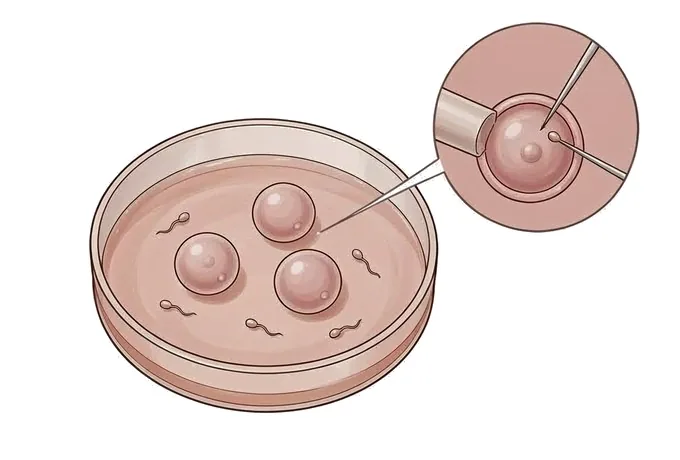
IVF and ICSI are not one treatment at two strengths. In vitro fertilisation brings eggs and sperm together in the laboratory and lets fertilisation happen on its own; it answers the question of whether sperm and egg can meet. Intracytoplasmic sperm injection introduces a single sperm directly into the egg; it answers a different question — whether the sperm can get in. That distinction decides who is offered which, and it is the reason a couple should never be asked simply to choose the more thorough-sounding option. Both are pathways rather than guarantees. A cycle is a sequence of decisions — stimulation, monitoring, egg collection, fertilisation, culture, transfer and luteal support — and each step has a point at which it is reviewed, adjusted or stopped. What the pathway cannot do is promise an outcome; what it can do is make sure the right technique is used for the right reason, that everything correctable is corrected before a cycle rather than after a failed one, and that the plan says in writing what happens if the response is not what was expected.
-
The two techniques answer different questions
IVF asks whether sperm and egg can meet; ICSI asks whether a sperm can get in
-
No indication means no added benefit
ICSI is indicated for a significant male factor and for fertilisation failure, not for reassurance
-
Correct what is correctable before the cycle
an untreated cavity or hormone problem is far cheaper to fix than a failed cycle
-
A cycle is a sequence of decisions
each step has a review point, and the plan says in writing what happens if the response is not as expected
What IVF and ICSI are, and what they are not
Both techniques produce an embryo in a laboratory and place it in the uterus. The difference is where in that process the laboratory intervenes, and that difference is what makes one of them appropriate and the other one merely additional:
- In vitro fertilisation (IVF). Eggs and sperm are placed together and fertilisation is left to happen on its own. It answers the question of whether the two can meet — which is why it is the technique of choice when the tubes are blocked or scarred, or when the numbers are low enough that the meeting has to be arranged rather than left to chance.
- Intracytoplasmic sperm injection (ICSI). A single sperm is introduced directly into the egg. It answers a different question — not whether the two can meet, but whether the sperm can get in. It is indicated where the semen line is significantly impaired, where sperm are obtained surgically, and where a previous cycle produced no fertilisation.
- ICSI is not a stronger version of IVF. This is the single most useful sentence in this page. Where there is no reason for it, adding ICSI does not improve the chance of a pregnancy, and it adds an intervention, a cost and an uncertainty that nobody can quantify. The question is not which one is better; it is which indication applies.
- Both are pathways rather than guarantees. A cycle is a sequence of decisions with review points — how stimulation is going, whether the response is adequate, how the embryos are developing, how many to transfer and what to freeze. The plan is written to be followed and reviewed, not to be won or lost in one attempt.
Why the distinction has to come first. Couples usually arrive having read that ICSI is the more advanced option and asking for it by name. The honest answer is that the technique belongs to the finding, not to the preference: a significant male factor makes ICSI the right answer, and the absence of one makes it an unnecessary step. Getting that order right — finding first, technique second — is also what makes the rest of the plan coherent, because the same finding that chooses the technique also shapes the protocol, the timing and what gets frozen.
Which situation each technique answers
Assisted reproduction is not a ladder, and the honest way to read the options is to pair each situation with the technique that actually answers it:
| Situation | What it blocks | What answers it |
|---|---|---|
| Tubal disease | Sperm and egg cannot physically meet, because the tubes are blocked, scarred or no longer able to pick up an egg | IVF — the laboratory does the meeting that the tubes can no longer do; this was the original indication and remains the clearest one |
| Significant male factor | The semen line falls below what insemination can reasonably bridge — too few sperm, poor movement, or an abnormal shape | ICSI — a single sperm is introduced into the egg, which is the step that a low count makes necessary rather than optional |
| Sperm that cannot reach the semen | Sperm are produced but cannot be ejaculated, because of obstruction, previous surgery or a congenital cause | ICSI combined with surgical sperm retrieval, planned as one treatment rather than as two errands |
| Ovulation that has not answered treatment | Ovulation has been induced or regulated, and the response has been optimised without producing a pregnancy | IVF, or insemination first where its own indications apply — the step is chosen by the finding, not by the length of time already spent |
| No explanation found | Every line has been assessed and nothing points anywhere, so no cause can choose the step | The step is chosen by age and by how long the couple have been trying — which is exactly why this category has its own treatment logic rather than a default one |
Why this is read as a set rather than a sequence. A couple with tubal disease does not need to pass through insemination to earn IVF; a couple with a significant male factor does not become a candidate for ICSI by having tried something else first. Each row above stands on its own, and the work-up exists to find out which row a couple is actually in — which is also why the assessment comes before the plan rather than inside it.
What decides the technique, and how fast the plan moves
There is no grading of assisted reproduction from mild to severe. What varies between couples is which technique is indicated and how quickly the plan should move, and five things set both:
| Factor | Why it changes the technique or the pace |
|---|---|
| The male finding | It decides the single most consequential choice in the laboratory — conventional fertilisation or ICSI — and therefore whether an additional intervention is part of the plan at all |
| The tubal finding | A finding that prevents sperm and egg from meeting removes the value of steps that depend on them meeting, which is why it moves the plan straight to IVF rather than through it |
| Age and ovarian reserve | Reserve is read as a prediction of how the ovaries will respond, and it decides how stimulation is planned, how many cycles are sensible to discuss, and how much time there is for steps other than the definitive one |
| Previous cycles and fertilisation history | A previous cycle in which no egg fertilised is itself an indication for ICSI in the next one; a previous cycle that ended without a transfer changes what the plan has to prepare for |
| Findings that must be treated first | A cavity that needs surgery, a hormone disorder that needs control, or a treatment elsewhere that threatens fertility each change the order of the plan before a cycle is arranged |
Why pace, rather than severity, is the practical question. Most couples asking how serious their situation is are really asking how fast they should move and what they should agree to. Those answers come from the table above, and they can only be given once the assessment is complete — which is the strongest argument for doing the assessment rather than waiting for the situation to declare itself.
What has to be established before a cycle begins
The preparation for a cycle is not a formality, and it is the part with the highest return on the time it takes:
| Step | What it establishes |
|---|---|
| The shared history and screening | What in either partner’s history already points somewhere, and whether anything needs treating before a cycle rather than during one — infections, medicines, thyroid function, immunisation status |
| Ovarian reserve | How the ovaries are likely to respond to stimulation, from AMH and the antral follicle count — a prediction about the protocol, not a verdict on whether a pregnancy is possible |
| The uterine cavity | Whether the place the embryo has to implant in is normal — polyps, fibroids that distort the cavity and adhesions are corrected before transfer, not after a failed cycle |
| The semen line | Which technique the cycle will use. This is the question the male work-up exists to answer, and it is answered by a repeat analysis and, where indicated, urological assessment |
| Consent, screening and legal preparation | What is agreed in advance about consent, the number of embryos transferred, the storage and disposition of any remaining embryos, and which rules apply where the treatment is carried out |
| The written plan and what will be frozen | The protocol, the review points, the criteria for transferring or freezing, and what happens if the response is not what was expected — decided before the cycle rather than during it |
Why so much of the plan is written in advance. A cycle moves quickly once it starts, and the decisions inside it are easier to make well when they were expected. The part that is arranged beforehand — corrected findings, agreed technique, frozen material, documented consent — is also the part couples most often describe afterwards as the reason the process felt manageable rather than improvised.
Why patients travel to China for assisted reproduction
Assisted reproduction is a sequence of decisions that belong to one team, and travelling for it is usually about keeping that sequence intact rather than about any single procedure:
- Both partners are assessed in the same place, on the same days. The technique the cycle uses depends on the male finding, so an assessment that leaves the male partner out is not a complete one — seeing both together is what makes the first decision possible.
- The fork between IVF and ICSI is decided by the same team that runs the cycle. There is no handover between a clinic that investigates and a laboratory that treats, so the finding that chooses the technique is the same finding that shapes the protocol.
- What is correctable is corrected before the cycle. Cavity assessment and any necessary correction, hormone review and screening happen in advance, because fixing them inside a cycle is not possible and after a failed one is expensive.
- Records and frozen material are prepared to travel. Results are issued in English, the plan is written down with its review points, and the arrangements for stored eggs, sperm or embryos are documented — so that anything that continues elsewhere continues from a record rather than from a memory.
- The schedule is built around a calendar rather than an itinerary. Part of a cycle follows the cycle itself, so planning happens around dates that can be predicted rather than around dates that are convenient.










