


Hyperthyroidism Overview
Hyperthyroidism Overview
The thyroid is a small gland at the front of the neck that makes the hormone which sets the pace of the body — how fast energy is burned, how warm the body runs, how quickly the heart beats and the gut moves. In hyperthyroidism the gland makes more of that hormone than the body needs, and everything downstream speeds up. The first thing worth being clear about is that hyperthyroidism is not a single disease. It is a small group of conditions that share the same end result and have quite different beginnings: a gland driven by antibodies that behave like its own switch (Graves' disease), one or more nodules that have started to work on their own without waiting to be told, and a gland that is not overproducing at all but leaking hormone it had stored, because it is inflamed. This is not a fine distinction. It decides the treatment. Drugs that block hormone production work on the first two and are the wrong answer for the third, and the uptake scan is the test that tells them apart. The second thing worth saying is what an overactive thyroid actually does. It is rarely the hormone level itself that harms a patient; it is the organ it unsettles. The heart is the one that matters most — it races, and in older patients it can fall into an irregular rhythm — and the eyes, the bones and a pregnancy each have their own stake. Treatment today has three established routes — drugs, radioactive iodine and surgery — and the type of hyperthyroidism, the size of the gland and the patient's own circumstances are what choose between them. None of this needs to be frightening, and all of it is easier to decide once the diagnosis has been narrowed down rather than left as a general label.
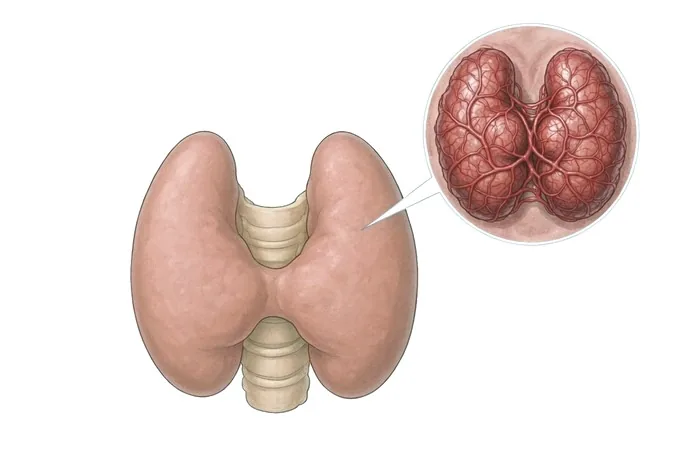
-
It is a group of diseases, not one disease
antibody-driven, nodule-driven and leaking glands need different treatments
-
The uptake scan is the test that decides
it separates a gland that is overproducing from one that is only leaking
-
The heart is what usually needs watching
a racing or irregular heartbeat is the most common consequence
-
48 hrs
from complete records to a personalised assessment plan
The thyroid, and what it means when it runs fast
The thyroid sits at the front of the neck, wrapped around the windpipe. It makes thyroid hormone, and that hormone is best understood as a pace setting rather than a fuel: it tells the heart how fast to beat, the body how much heat to make, the gut how quickly to move, and the mind how quickly to run. When the thyroid makes too much of it, every one of those systems is told to go faster than it should.
Two words are used almost interchangeably and should not be. Hyperthyroidism means the gland is producing too much hormone. Thyrotoxicosis means there is too much hormone in the blood, whatever produced it — and the difference is the entire reason this page begins here. A gland that is inflamed because of thyroiditis does not produce extra hormone; it leaks the hormone it had already made and stored. Blood tests look identical in both cases and the patient can feel equally unwell, but the treatment could not be more different: drugs that block hormone production do nothing useful for a gland that is only leaking, and using them delays the right care.
What an overactive thyroid does to the body follows from the pace setting. The heart beats faster and may become irregular. The body runs warm and sweats. Weight falls even though appetite is often good. Hands tremble, sleep is short, and the mind races with it. Muscles tire, particularly on stairs. Periods become lighter and less regular. Over time, bone is drawn down. And in Graves’ disease, which is antibody-driven, the eyes may be involved in their own separate process — one that runs partly on its own clock and is treated in its own right.
Two questions have to be answered, and they are different. The first is what is the gland doing: blood tests answer it directly, and they answer it quickly. The second is what is making it do that: antibodies, an ultrasound and an uptake scan answer it. The first question names the problem. The second decides the treatment — and skipping it is the commonest way for an overactive thyroid to be treated in a way that never quite works.
What is making the gland overactive
This is the table that everything else depends on, because the six causes below are treated in three quite different ways.
| Cause | What is happening | How it is recognised |
|---|---|---|
| Graves’ disease | Antibodies against the thyroid stimulating hormone receptor behave like the hormone that switches the gland on, so it is stimulated continuously and diffusely | Receptor antibodies in the blood, a diffusely enlarged gland on ultrasound, and often eye changes; the most common cause |
| Toxic multinodular goitre | Several areas within a long-standing knobbly goitre have become autonomous and produce hormone without being asked | A nodular gland on ultrasound and several areas of activity on the uptake scan; more common with increasing age |
| Toxic adenoma | A single nodule has become autonomous — the classic "hot" nodule, producing hormone on its own while the rest of the gland rests | A single nodule on ultrasound with activity concentrated in it on the uptake scan, and reduced activity elsewhere |
| Thyroiditis | The gland is inflamed and leaking stored hormone rather than making extra; subacute, postpartum and silent forms exist — coded separately as E06.1 | A tender gland and raised inflammatory markers in the subacute form, and low or absent uptake on the scan — the key negative finding |
| Iodine load | A sudden excess of iodine lets a predisposed gland produce more hormone than usual | A history of iodinated contrast, an iodine-containing drug such as amiodarone, or iodine supplements shortly before the symptoms began |
| Exogenous hormone | Too much thyroid hormone is being taken as a tablet — at a dose higher than needed, or inadvertently | Raised hormone levels with a low uptake on the scan and a quiet gland on ultrasound; the history is what resolves it |
The practical point is simple. The first three are production problems and answer to drugs that block production, to radioactive iodine and to surgery. The last three are release or supply problems and answer to none of those in the same way: thyroiditis is watched and treated symptomatically, iodine-induced overactivity is managed while the load clears, and exogenous hormone is corrected by adjusting the dose. An uptake scan is what puts a patient in the right one of those two groups, which is why it earns its place.
Two axes: how much hormone, and what it is doing to the body
Severity in an overactive thyroid is not one number. It is a pair of readings, and the second is usually the one that determines urgency.
Axis one is the hormone — how far the free hormone levels have risen and how suppressed the TSH has become. Axis two is the body — which organs are being unsettled by it, and how badly. A patient can have quite high hormone levels and feel mostly hot and restless; another can have a more modest rise and present with a heart rhythm that has gone irregular. The second axis is what decides who is treated today and who can be assessed over the coming weeks.
| What is assessed | What it tells you | Why it matters for the plan |
|---|---|---|
| Free T4 and free T3 | How much hormone is circulating, and whether the pattern is predominantly T3-driven | Sets how aggressively treatment is started and how closely it is monitored while the drugs take effect |
| The heart | A fast resting pulse, palpitations, and above all whether the rhythm has become irregular, and whether the heart is coping | The commonest serious consequence, and the reason an older patient is treated promptly rather than observed |
| The eyes, in Graves’ disease | Protrusion, lid retraction, grittiness, swelling, double vision, and whether the process is active | Eye disease follows its own course and influences which thyroid treatment is chosen; it is assessed in its own right |
| Symptoms and daily function | Weight lost, sleep lost, ability to work, tremor, and how much the patient has withdrawn from normal life | Describes the burden that treatment is meant to lift, and gives something concrete to measure improvement against |
| Bone and calcium | Whether long-standing overactivity has drawn calcium out of bone, and the calcium level itself if surgery is being considered | Bone loss is silent and is one of the reasons a mild-looking picture is still worth treating properly |
| Warning signs of thyroid storm | Fever, a very fast heart, agitation or confusion, vomiting, and a patient who looks more unwell than the numbers suggest | Storm is a medical emergency and the one presentation that must never be managed at home or waited out |
One reading deserves to stand alone, because it is the most common way this illness is underestimated: an overactive thyroid can be dangerous without feeling dramatic. An older patient may have no tremor and no sense of being wired at all, and arrive instead with weight loss, a low mood, and a heart that has gone into an irregular rhythm. The hormone level is not what makes this serious; the rhythm is.
How an overactive thyroid is assessed
The assessment runs in a fixed order, because the early tests establish the problem and the later ones decide what to do about it.
| Step | What it answers |
|---|---|
| TSH, free T4 and free T3 | Whether the gland is overactive at all, and how much hormone is circulating. This is the test that establishes the diagnosis |
| TSH receptor antibodies | Whether this is Graves’ disease — the answer that points away from a nodular cause and has implications for the eyes |
| Neck ultrasound | Whether the gland is diffusely changed or nodular, and whether any single nodule stands out |
| Radioactive iodine uptake scan | The decisive question: is the gland overproducing hormone, or merely leaking what it stored? The answer changes the treatment |
| ECG, blood count and liver tests | Whether the heart rhythm has been affected, and a baseline before antithyroid drugs are started |
Two notes that change what a patient should expect. First, a low uptake on the scan is not a failed test — it is the finding that identifies thyroiditis or exogenous hormone and steers the patient away from drugs that would not have helped. Second, the uptake scan is not part of the work-up of every patient: when the antibody is clearly positive and the gland is diffusely enlarged, the diagnosis of Graves’ disease is already secure. The scan earns its place in the patients where the answer is genuinely in doubt.
Why patients travel to China for hyperthyroidism treatment
An overactive thyroid is not difficult to diagnose, and it is not difficult to treat. What it rewards is getting the type right, because that single decision determines whether a patient spends a year on tablets that were never going to work, or is offered the one treatment that fits. That is the part our endocrine teams are set up to do quickly: the full panel of thyroid antibodies, an ultrasound, and an uptake scan arranged so that the answer is available from results rather than assembled over months of appointments.
Where treatment follows, all three established routes are available — antithyroid drugs with structured monitoring, radioactive iodine, and thyroid surgery performed by high-volume teams who work with intraoperative monitoring of the nerve to the voice box and with preservation of the parathyroid glands in mind. Where eye disease is part of the picture in Graves’ disease, the thyroid decision is made with the eyes in view rather than around them, because some thyroid treatments suit an eye that is active better than others.
For international patients the practical sequence is the same as the clinical one. Blood tests, antibodies, ultrasound and, where indicated, the uptake scan can be arranged in a single visit; a written assessment covering which type this is and which treatment fits follows within about 48 hours of complete records arriving. Around this sits the honest part of the offer: complete treatment here is typically 30%–50% of comparable care in Europe or the US, with more than 30 international insurers working with us on direct billing, and patients from 124 countries and regions. What patients most often say afterwards is that they finally understood which thyroid problem they had — and that the treatment followed from that, rather than the other way round.










