


Hyperparathyroidism Overview
Hyperparathyroidism Overview
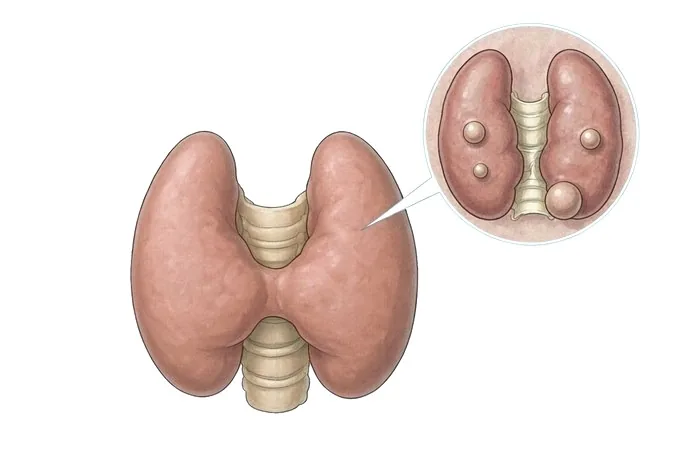
The parathyroid glands are four small glands sitting behind the thyroid in the neck. Their name is misleading: they have nothing to do with the thyroid gland. Their job is calcium: they measure the level in the blood continuously and release parathyroid hormone to correct it, raising calcium when it falls and switching off when it is high enough. In hyperparathyroidism that thermostat is out of order. Too much hormone is released, calcium rises, and because the body keeps blood calcium within a narrow range whatever the cost, the extra is taken from the one place it is stored: the skeleton. It is not, for most people, an illness that is felt: it is a slow withdrawal from the bone and a slow deposit in the kidney, and it can go on for years unnoticed. One distinction decides everything that follows. In the primary form the gland itself is at fault and blood calcium is high; in the secondary form the glands are doing their job correctly, and something else — usually long-standing kidney disease or vitamin D deficiency — has pushed calcium down so that the glands are working overtime to restore it. The hormone is raised in both, the calcium is high in one and low or normal in the other, and the answer to one is often an operation while the answer to the other is to treat the cause. Getting that right is the most important step.
-
It is rarely felt — and still worth treating
the calcium is taken from bone and deposited in kidney before anything is noticed
-
Primary and secondary point opposite ways
high calcium in one, low calcium in the other, and different treatment entirely
-
Two numbers make the diagnosis
a raised calcium, and a parathyroid hormone that should have switched off
-
48 hrs
from complete records to a personalised assessment plan
The parathyroid glands, and the calcium they control
The parathyroid glands are four small glands on the back of the thyroid. They share a name with it and nothing else. Their entire purpose is to hold the calcium level in the blood steady, and they do it with a single hormone:
- What calcium does — calcium is not only what bones are made of. It is what nerves use to carry signals, what muscles use to contract, and what the heart uses to keep a steady rhythm. That is why the body defends the blood calcium within a narrow range and will take calcium out of bone to do it.
- What parathyroid hormone does — it raises blood calcium, by three routes: releasing calcium from bone, increasing the amount reabsorbed by the kidney, and switching on the active form of vitamin D so that more calcium is absorbed from food. It is a single control knob with three effects.
- What goes wrong — one or more parathyroid glands begin releasing hormone when they should be quiet. Calcium rises. The body corrects the blood level by moving calcium out of bone, which is why a condition that looks like a hormone problem is, in the long run, a bone and kidney problem.
- Why it is so often missed — because a modestly raised calcium does not feel like anything. There is no pain, no lump, no change that a patient would notice. It is found on a blood test taken for an entirely unrelated reason.
The word "hyperparathyroidism" covers two conditions that point in opposite directions, and this is the point most worth holding on to. In primary hyperparathyroidism the gland is the problem and the calcium is high. In secondary hyperparathyroidism the gland is doing exactly what it should: something else has lowered the calcium — most often kidney disease, sometimes vitamin D deficiency or poor absorption — and the glands are compensating. Same hormone, opposite calcium, and a completely different plan: when the calcium is low rather than high, an operation on the glands is the last thing wanted.
One more thing follows from the mechanism. Because the skeleton is where the extra calcium comes from, the harm accumulates silently: a patient can have normal blood tests, no symptoms, and a bone density that has been slipping for years. The question is never simply whether a patient feels unwell, but what the calcium is doing to the bone and the kidney.
What is making the parathyroid hormone high
This is the table everything else depends on: the causes below are treated in opposite ways, some by an operation and some by treating something else entirely.
| Cause | What is happening | How it is recognised |
|---|---|---|
| A single adenoma | One of the four glands has developed a benign growth and releases hormone regardless of the calcium level; the other three are suppressed | Raised calcium with an unsuppressed parathyroid hormone and a single enlarged gland on imaging; by far the commonest cause |
| Hyperplasia of all four glands | All four glands are enlarged and overactive together, sometimes as part of an inherited syndrome such as MEN1 or MEN2A | Raised calcium and parathyroid hormone with more than one gland enlarged, or a family history or another endocrine tumour |
| Parathyroid carcinoma | A malignant parathyroid tumour, which is rare and usually produces a markedly higher calcium than the benign forms | A very high calcium and parathyroid hormone, often with a palpable or unusually large gland; confirmed on histology rather than suspected from blood tests |
| Kidney-driven (secondary) | Long-standing kidney disease lowers calcium and raises phosphate, so the glands work overtime; they are the messenger, not the fault | A raised hormone with a calcium that is low or normal, alongside impaired kidney function and a raised phosphate |
| Vitamin D deficiency and poor absorption | Too little calcium is absorbed from the gut, calcium in the blood falls, and the glands compensate — a second route into the secondary form | A low vitamin D with a raised parathyroid hormone and a normal or low calcium, sometimes after weight-loss surgery or with coeliac disease |
| Familial hypocalciuric hypercalcaemia | An inherited change in the calcium sensor means the gland tolerates a higher calcium than normal; it resembles primary hyperparathyroidism but is not it | A raised calcium with a normal or high hormone but very little calcium in the urine, often with a family history; it should not be operated on |
The first three are primary hyperparathyroidism and are potentially curable by an operation. The next two are secondary: the operation is not the answer, and the answer is to correct the vitamin D, control the phosphate or manage the kidney disease, after which the hormone falls. The last is a mimic that looks like primary disease on a calcium and hormone test and must be excluded before any operation is offered — which is why a 24-hour urine calcium belongs in the assessment of everyone being considered for surgery.
Two axes: how high the calcium, and what it has already touched
Severity in hyperparathyroidism is not one number. It is a pair of readings, and the second is what decides who needs an operation now and who can be watched.
Axis one is the calcium — how far above the reference range it sits, and how far the parathyroid hormone has risen with it. Axis two is what the calcium has already done — to the skeleton, to the kidneys, and to the way a patient feels and thinks. The second axis is the one that carries the argument, because the classic finding in this condition is a patient with a high calcium and no symptoms at all.
| What is assessed | What it tells you | Why it matters for the plan |
|---|---|---|
| The calcium level itself | How far above normal it sits, once albumin is taken into account | One of the criteria used to decide whether an operation is indicated, and the number used to judge whether the picture is stable or progressing |
| The skeleton | Bone density at the sites this condition shows first, and whether there has been a fracture from a minor fall | Bone loss is silent and is the commonest reason an apparently symptom-free patient is advised to have surgery |
| The kidneys | Kidney function, whether stones have formed, and whether there is calcium deposited in the kidney tissue | Kidney involvement is both a reason to operate and a reason not to wait, because damage already done may not be fully reversible |
| The way the patient feels and thinks | Tiredness, low mood, irritability, concentration and sleep, judged against how the patient was before the calcium was found | Symptoms that a patient has adjusted to are still symptoms; asking specifically is the only way to find them |
| Age at diagnosis | Whether the calcium was found in a younger patient | Being diagnosed at a younger age is itself one of the recognised criteria, because the exposure to a raised calcium is longer |
| Warning signs of hypercalcaemic crisis | A markedly raised calcium with vomiting, severe thirst, passing large volumes of urine, drowsiness, confusion or a reduced level of consciousness | This is a medical emergency and the one presentation that must never be waited out at home |
One reading deserves to stand alone, because it is how this condition is most often underestimated: "no symptoms" is not the same as "no disease". The calcium comes from bone, so a patient who feels perfectly well can have a skeleton that has been quietly losing density for years and a kidney that has already formed a stone. That is why the criteria for operating are built on what can be measured rather than on what can be felt.
How hyperparathyroidism is assessed
The assessment runs in a fixed order, and the order matters: the diagnosis is made from blood and urine, and the imaging comes afterwards.
| Step | What it answers |
|---|---|
| Calcium and parathyroid hormone, together | Whether the calcium is genuinely raised, and whether the hormone has failed to switch off. These two numbers, read together, are the diagnosis |
| Urine calcium over 24 hours | Whether the calcium is being lost in the urine as expected or retained: the distinction that identifies the inherited mimic and prevents an unnecessary operation |
| Vitamin D, phosphate, kidney function | Whether the picture fits primary disease, whether vitamin D deficiency is contributing, and whether kidney disease is the real driver |
| Bone density and kidney assessment | What the calcium has already done to the skeleton and the kidney — the information that decides whether treatment is needed |
| Localising scans, only if surgery is planned | Where the overactive gland is, so that the operation can be planned. These do not make the diagnosis and are not needed to make it |
Two notes that change what a patient should expect. First, the hormone result is read as "inappropriate", not as "high": a level in the upper half of the normal range alongside a raised calcium is still abnormal, because it should have been suppressed. A report saying the hormone is "normal" while the calcium is high is the finding, not a reassurance. Second, the localising scans come last — they are planning tools for an operation, and a patient who is not having surgery does not need them. Doing them early creates an avoidable problem: finding a harmless nodule that then has to be explained.
Why patients travel to China for hyperparathyroidism treatment
What this condition rewards is getting two decisions right: whether it is primary or secondary, and whether an operation is indicated. Both are easier to make when the calcium, the hormone, the urine, the bone density and the kidney are read together by people who do this every week — which is what our endocrine, parathyroid surgery and renal teams are set up to do.
Where an operation follows, the standard of care is focused parathyroidectomy guided by imaging and confirmed during the operation by a rapid parathyroid hormone measurement, so the team knows the abnormal gland has been removed before the incision is closed. Where hyperplasia rather than a single adenoma is expected, the operation is planned as an exploration of all four glands rather than a targeted removal. And where the cause is secondary, the plan is built around the kidney and vitamin D rather than around the neck.
For international patients the practical sequence matches the clinical one. Calcium and hormone, urine calcium, vitamin D and kidney function, a bone density scan and a kidney assessment can be arranged in a single visit, and a written assessment of whether this is primary or secondary and whether an operation is indicated follows within about 48 hours of complete records arriving. Around this sits the honest part of the offer: complete treatment here is typically 30%–50% of comparable care in Europe or the US, with more than 30 international insurers working with us on direct billing. What patients most often say afterwards is that they finally understood why the calcium was high — and that the answer decided the treatment rather than the other way round.










