


Goiter Overview
Goiter Overview
An enlarged thyroid is one of the few medical findings that announces itself in the mirror, and the reaction to it is usually out of proportion to what it turns out to mean. The first thing an endocrinologist does is separate two questions that the neck cannot answer on its own: how big is the gland, and how is it working. A thyroid can be considerably enlarged while producing exactly the right amount of hormone — that is what non-toxic goiter means — and it can be of ordinary size while producing far too much. Treating those two possibilities as one is the commonest mistake made about goiter, and it is the mistake the assessment exists to prevent. The reasons a gland enlarges are fewer than people expect. Worldwide, the leading one is iodine: a diet short of it makes the gland work harder and grow, which is why iodised salt changed the picture across entire regions. Where iodine is already adequate, autoimmune thyroid disease takes the lead, enlarging the gland from two opposite directions — Hashimoto's thyroiditis, which tends to push the hormone levels down, and Graves' disease, which pushes them up. Nodular disease accounts for much of the rest, the gland becoming uneven over the years and enlarging itself from within. Most goiters are harmless and are monitored rather than treated. The ones that need action are identified by three things and three things only: whether the gland is pressing on the windpipe, the gullet or the nerve to the voice; whether it is changing the hormone levels; and whether it contains a nodule whose features call for a needle test. Answer those three and the plan writes itself.
-
A statement about size, not function
an enlarged gland can be working normally, overactively or underactively
-
Iodine cuts both ways
too little enlarges the gland worldwide; too much also enlarges it
-
Compression, function, nodules
the three questions the assessment is built to answer
-
48 hrs
from complete records to a written assessment plan
What a goiter is, and what it is not
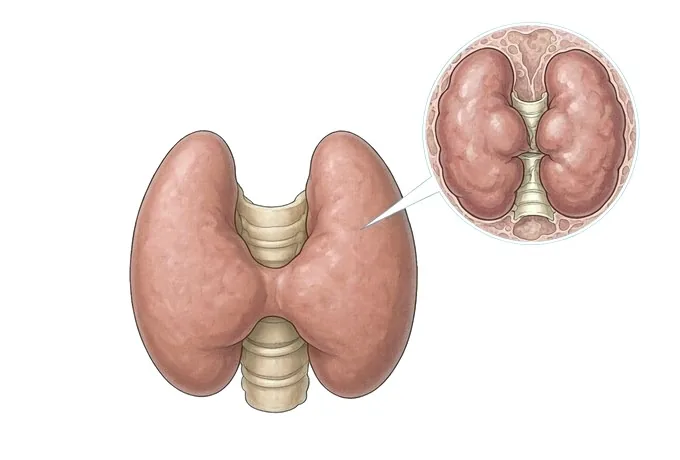
A goiter is an enlarged thyroid gland — nothing more specific than that. The thyroid is a small, butterfly-shaped gland at the front of the neck, wrapped around the windpipe, and it makes the hormones that set the pace of the body’s metabolism. When it grows, the neck shows it: a fullness, a visible swelling, a collar that no longer sits the way it did.
The most useful thing to understand about the word is what it does not describe. A goiter is a statement about size. It says nothing about function.
- It does not tell you how the gland is working. A thyroid can be enlarged and produce exactly the right amount of hormone, too much, or too little. Goiter, overactive and underactive are three separate questions, and the hormone test is done first for that reason.
- It does not tell you why it is enlarged. A shortage of iodine, an autoimmune process, several nodules growing side by side, inflammation, a drug — all of these produce an enlarged gland, and they lead to different plans.
- It does tell you the gland deserves a look. Most goiters are harmless and stay harmless. The ones that matter are those pressing on the windpipe or the gullet, those changing the hormone levels, and those concealing a nodule that should be assessed on its own terms — and none of those can be ruled out by looking at the neck.
The thyroid grows the way most glands grow: in response to demand. When the body needs more thyroid hormone than the gland can easily supply — during puberty, in pregnancy, on a diet short of iodine — the gland’s cells multiply to meet the demand and the gland becomes larger. That is a normal response working overtime, not a disease in itself.
What has changed is not the gland but who notices it. Iodine supplementation in some regions and better nutrition in others have turned goiter from a common sight into an occasional finding, and ultrasound now measures glands that would never have been noticed by hand. Most people told they have a goiter were not unwell and are not unwell. What determines the outcome is what the assessment turns up, not the size on its own.
The two shapes a goiter takes
Goiters are described by the shape the gland has taken rather than by how large it has become, because the shape points both to the likely cause and to the plan. Five labels cover almost everything seen in clinic.
| What it is called | What the gland looks like | What usually lies behind it |
|---|---|---|
| Diffuse goiter | The whole gland is evenly enlarged and smooth to the touch, without distinct lumps | A shortage of iodine, autoimmune disease, or the increased hormone demand of puberty and pregnancy |
| Nodular goiter | The gland is uneven, with one or more distinct lumps enlarging it from within | Nodular thyroid disease, which becomes more common with age |
| Multinodular goiter | Several nodules of different sizes, sometimes with the gland so large that it descends behind the breastbone | Years of uneven growth and repair within the gland |
| Toxic goiter | An enlarged gland that is producing too much hormone, sometimes driven by a single overactive nodule | Graves’ disease, or a nodule that has become autonomous |
| Non-toxic goiter | An enlarged gland that is producing the right amount of hormone | A shortage of iodine, nodular disease, or simple glandular overgrowth |
Why the label matters more than the size. A gland of the same dimensions can mean three entirely different things depending on which of these shapes it has taken, and the plan follows the meaning rather than the measurement. A smooth, uniformly enlarged gland that is working normally is usually watched. The same size of gland made up of nodules needs each nodule read by its ultrasound features. An enlarged gland that is overactive is treated for its overactivity first, because the hormone excess is what damages the heart and the bones — and the size is reviewed once that is controlled.
What moves a goiter up or down the list
An enlarged gland is not by itself a reason to act. What sorts goiters into those that can be watched and those that need treatment is a short list of features, and every one of them is checked during the same assessment.
| Feature | Why it changes the plan |
|---|---|
| It presses — on swallowing, breathing or the voice | Compression of the gullet, the windpipe or the nerve to the vocal cords is the strongest single reason to consider surgery, whatever the hormone levels are doing |
| It extends behind the breastbone | A gland that descends into the chest is harder to examine, harder to monitor and capable of narrowing the airway; it also has less room to grow before it causes trouble |
| It is changing the hormone levels | An overactive gland affects the heart and the bones over time and is treated in its own right; an underactive gland affects the whole metabolism and is replaced |
| It contains a nodule with suspicious features | The nodule, not the goiter, becomes the question that drives the workup — and may drive the decision to operate |
Where size fits in. Size matters mainly through its consequences: how much room it leaves in the neck, how visible it is, and how difficult it makes monitoring the gland behind it. A very large goiter that presses and an ordinary goiter that does not are handled in opposite ways — which is why the assessment begins with what the gland is doing to its neighbours, not with how big it has become.
How a goiter is assessed
The assessment is short and is designed to answer three questions in a single pass: how big is the gland, how is it working, and is there anything inside it that needs to be looked at separately.
| Step | The question it answers |
|---|---|
| Blood tests | How is the gland working — normal, overactive or underactive — and is there an autoimmune cause behind the enlargement? |
| Ultrasound | What shape has it taken — smooth or nodular — how large is it in measured terms, and does any nodule carry features that call for a needle test? |
| Imaging and needle tests, where indicated | Does the gland extend behind the breastbone, and what is any suspicious nodule actually made of? |
Why the three are read together. Each step can be reassuring on its own and misleading on its own. A gland can feel smooth and be nodular inside; a gland can look uniformly enlarged on ultrasound and turn out to be overactive on blood tests; a nodule can look unremarkable and still warrant a needle on its features. When the three agree, the conclusion is solid enough to build a plan on — and when they disagree, the disagreement is itself the finding that decides the next step.
What patients usually want is the answer, not the sequence — but the sequence is what makes the answer trustworthy. The whole design of the assessment is that no gland is called harmless on appearance alone, and none is called harmless without the function question having been asked.
Why patients travel to China for goiter assessment
A goiter that needs attention usually needs it for a structural reason, and structural problems in the neck are solved with imaging, a plan and, sometimes, an operation. The international pathway is built around getting the whole picture into one visit.
The assessment arrives complete, not in instalments. Hormone and antibody tests, ultrasound, and a needle test where a nodule warrants one, are organised within a single facility, so a question that in many health systems spans several appointments and several waiting lists is answered inside one short visit — with the imaging read while the patient is still there.
Previous imaging is reviewed before arrival. Earlier ultrasound images, reports, and any CT or scan already performed are read in advance — the images themselves, not only the radiologist’s summary — so that the first consultation starts from what is already known rather than rediscovering it.
Where surgery is needed, the decision is made by a team rather than by a single opinion. Endocrine surgery, endocrinology, radiology, pathology and, where the airway is involved, anaesthesia, review the same images together. Vocal cord function is documented beforehand, the airway is planned explicitly, and the patient is told what that plan is.
Costs are set out before commitment. An itemised estimate for the assessment — and for any treatment that follows — is provided in advance; international-desk staff coordinate with the patient and with any insurer or assistance company throughout, and written opinions and follow-up plans are issued in English for the doctor at home.










