


Diabetic Nephropathy Overview
Diabetic Nephropathy Overview
Diabetic nephropathy is kidney disease caused by years of diabetes, and its defining feature is how little it announces itself. Nothing hurts, nothing visibly changes, and the first evidence is a number on a screening test: a small amount of albumin in the urine, or a filtration rate that has started to drift down. This guide follows the path patients actually walk — what the two tests measure and why both are needed, how the disease is staged, when the picture is not diabetic at all and needs a biopsy, and which treatments slow the loss rather than merely improving a glucose chart.
-
Two numbers
urine albumin and filtration rate — checked together, every year
-
Silent
no symptom at all in the early years, which is why screening is annual
-
Biopsy only if atypical
a short history, active urine sediment or absent retinopathy means a second kidney disease may be present
-
2004
the year our nephrology department was established
What diabetic nephropathy is — a filter under years of load
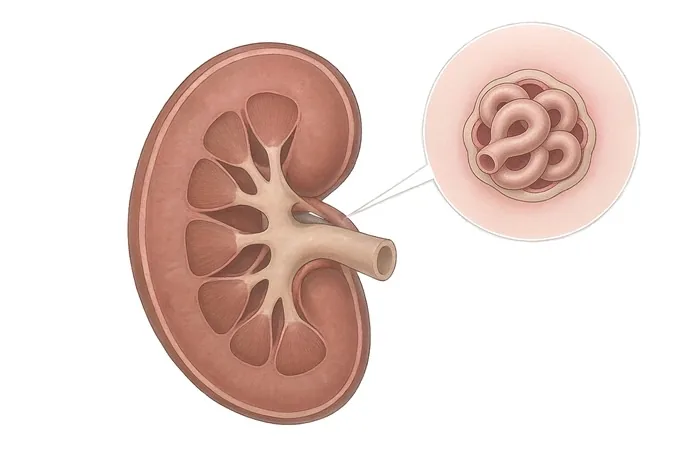
Each kidney contains roughly a million filtering units. Every one of them is a bundle of capillaries whose walls let water and small molecules through while holding back cells and protein. Diabetic kidney disease is what happens to those walls after years of raised glucose and, in most people, raised pressure alongside it. The wall thickens, the selective barrier becomes less selective, and the filtering surface is gradually replaced by scar tissue that does no filtering at all.
The first thing to escape is albumin — the smallest of the blood proteins, and the one that leaks first when the barrier loosens. That leak is measured, and it is the earliest measurable sign of the disease. Later, as the scarring accumulates, the whole unit scleroses and stops contributing, which is what the filtration rate is measuring when it falls.
Two consequences follow, and they shape everything in this guide. First, the disease is silent until it is not: the leak and the scarring produce no sensation, so the diagnosis is made on numbers rather than on symptoms. Second, the disease is measured in years. Nothing about it is decided in a single clinic visit, and nothing about the treatment works in a week; what changes the outcome is a regimen that is still being taken a decade later.
Three patterns, and why the third one changes the treatment
The word "diabetic nephropathy" covers more than one course. Separating them is not academic, because the third pattern is treated for a different disease entirely.
| Pattern | What the tests show | What it means for the plan |
|---|---|---|
| Classic albuminuric disease | Albumin in the urine rises gradually, from modest to heavy, and the filtration rate falls later | The textbook course. Diagnosis from the pattern alone; treatment is the four-layer foundation set out on the treatment page |
| Non-albuminuric disease | The filtration rate falls while the albumin test stays normal or near-normal | Easy to miss if only the urine is checked. The same protective medicines apply; the screening has to include the filtration rate |
| A separate kidney disease on top of diabetes | An atypical feature: a short diabetic history, a sudden heavy protein loss, blood cells and casts in the sediment, or a filtration rate falling unusually fast | Requires a kidney biopsy. The treatment belongs to the other disease — often immune-directed — and has nothing to do with glucose |
| Diabetes plus a second common cause | Hypertensive scarring, vascular disease, or the effect of medicines taken for years | Two contributors managed together; the relative weight of each decides where the effort goes |
| Advanced disease of any pattern | Filtration far reduced, with the complications of reduced filtration dominating the picture | The aim shifts from slowing loss to planning replacement — access, dialysis modality and transplantation — years ahead |
The third row is the one that justifies a biopsy, and it is the one most often missed in practice, because a person with diabetes and protein in the urine is so readily assumed to have diabetic nephropathy. The red flags are set out on the diagnosis page. Where one of them is present, a biopsy is not an escalation — it is the difference between a correct treatment and an incorrect one.
How it is staged: the filtration axis and the albumin axis
Kidney disease in diabetes is staged on two independent axes, and the stage is always written as a pair. One axis describes how much filtration is left; the other describes how much albumin is leaking. Neither substitutes for the other, and the risk carried by a given stage is roughly the product of the two.
| Axis | Grade | What it means |
|---|---|---|
| Filtration (G) | G1 to G2 | Filtration normal or only mildly reduced. The stage at which almost everything is still preventable |
| Filtration (G) | G3a and G3b | Moderate reduction. Where complications begin to appear and medicine doses need review |
| Filtration (G) | G4 | Severe reduction. Planning for replacement starts here, not later |
| Filtration (G) | G5 | Kidney failure. Replacement or a decision about conservative care |
| Albumin (A) | A1 | Albumin normal or only slightly above. Silent loss of filtration can still be happening at this grade |
| Albumin (A) | A2 | Moderately increased — the stage at which treatment most reliably pulls the number back down |
| Albumin (A) | A3 | Severely increased, often with visible swelling. The heaviest risk per unit of filtration |
What matters more than the grade on any single report is the direction of travel. One filtration value is a reading; four values across two years are a slope, and the slope is what tells you whether the plan is working. That is also why the prevention page insists on keeping your own dated record — a slope reconstructed from memory is not a slope.
What a full assessment contains
An assessment for diabetic kidney disease is mostly blood and urine, and almost all of it can be done in an afternoon. Its value lies not in the individual tests but in whether they are put together into one picture by one clinician.
| Test | The question it answers |
|---|---|
| Urine albumin-to-creatinine ratio, repeated | Is albumin leaking, and is it persistent? Two abnormal results out of three over three to six months answer this |
| Filtration rate from blood creatinine, repeated | How much function is left, and at what rate is it changing? |
| Urine microscopy | Are there red cells and casts? Their presence points away from a purely diabetic cause |
| Dilated eye examination | Is diabetic retinopathy present? In type 1 diabetes its absence makes a diabetic cause unlikely |
| Blood pressure, measured properly | Is the pressure actually controlled — including at night and at home, not only in the clinic? |
| Long-term glucose average, with its limits understood | How much exposure has there been? The number becomes less reliable as filtration falls |
| A full medicine review | Is anything being taken that stresses the kidney — including things bought without a prescription? |
| Kidney biopsy, only where indicated | Is a second, treatable kidney disease present? Asked when the picture is atypical, not routinely |
The repetition matters as much as the test. Albumin excretion varies from day to day, and it rises temporarily with exercise, fever, infection, heart failure and high glucose — so a single abnormal result is a reason to repeat, not a diagnosis. Details are on the diagnosis page.
Why patients come to China for diabetic kidney disease
Our nephrology department was established in 2004 and is the leading unit of the Fosun Health nephrology alliance. It runs 20 specialised beds, more than 30 haemodialysis machines and two continuous renal replacement therapy machines, and it sees close to 20,000 kidney outpatient visits and close to 1,000 inpatient admissions a year. The department performs kidney biopsy, establishes and maintains vascular access, places peritoneal dialysis catheters, and provides double plasma exchange and hybrid blood purification. It is supported by a dedicated kidney disease clinic in the traditional Chinese medicine department.
What international patients mostly come for is not a medicine unavailable at home. It is the assembly: both tests read together over a real interval, an atypical feature actively looked for rather than assumed away, every medicine reviewed for its effect on the kidney, and a plan written down with dates and targets. Those four steps are described on the diagnosis page and the treatment page.
The first of them happens before any travel is discussed. Sending your records — urine albumin results with dates, creatinine readings if you have more than one, your blood pressure record, your glucose readings and your medicine list — lets a clinician tell you whether anything is missing and what can be established where you are. The practical questions page sets out what to send and what a first visit actually involves.










