


Diabetic Foot Ulcers Overview
Diabetic Foot Ulcers Overview
This page is about a wound that is usually described by its size, and is better understood by asking why it is there. A diabetic foot ulcer is the place where three problems meet. Nerve damage has removed the sensation that would have made the person notice a stone, a blister or a crack between the toes while it was still nothing. Poor circulation means the tissue is not receiving enough blood to repair itself, so a wound that would close on another foot does not close on this one. And abnormal pressure, from a callus, a deformity or a shoe, keeps loading the same spot, so the site is injured again as fast as it tries to heal. That is why the treatment described here is not a dressing but three measures working at once: taking the load off the site, dealing with the blood supply, and controlling infection, with blood sugar and the other risk factors managed across all three. Most of the outcomes that people fear begin as something that takes a minute to find, which is why the daily foot check is treated on this page as part of the treatment rather than as general advice.
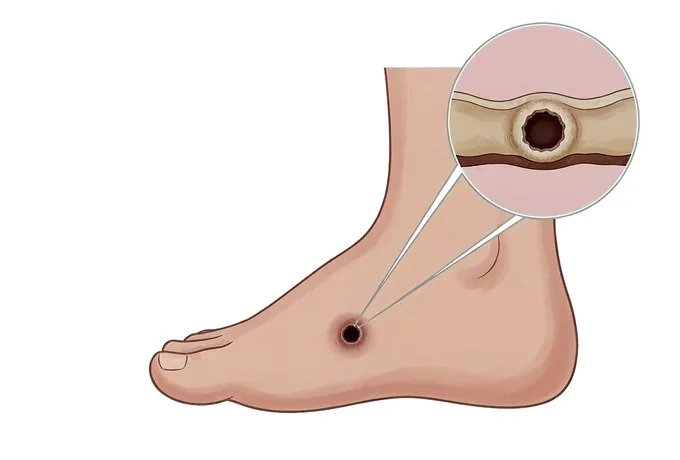
-
The wound is the visible part of a problem with three causes
nerve damage hides it, poor circulation prevents repair, and pressure keeps re-injuring it
-
Offloading comes first, and a dressing cannot replace it
a wound that is still being loaded will not close, whatever is put on it
-
Blood supply has to be assessed, not assumed
tissue without enough blood cannot heal, so this is decided by measurement rather than by appearance
-
Infection can look smaller than it is
a deep infection in a foot that cannot feel pain may show very little on the surface
Why a diabetic foot ulcer is not just a wound on a foot
The phrase describes a wound by its position, and that is the least useful thing about it. What makes a foot ulcer in diabetes different from a cut that heals is that three separate problems have arrived in the same small area of skin, and each of them would be manageable on its own.
- The sensation that would have given the warning is gone. Neuropathy removes the feeling that makes a person shift their weight, take a stone out of a shoe, or notice a blister the same day. The injury is not being ignored; it is not being felt. This is why a foot check is a clinical examination rather than a matter of paying attention.
- The tissue does not have the blood supply to repair itself. Circulatory disease narrows the arteries that feed the foot. A wound in tissue with poor flow does not close on schedule, and the measures that would repair it elsewhere — cleaning, dressings, even a skin graft — are working against a supply line that is too thin.
- The load has not changed, so the wound keeps being re-injured. A callus, a clawed toe, a raised arch or a shoe that presses in one place keeps applying the same force that started the ulcer. Healing and re-injury proceed at the same time, which is why the wound stays static for weeks.
Why this changes what a patient should expect. A plan that deals with only one of the three can appear to be working and still fail. Dressings are visible and feel like treatment; offloading and the circulation are invisible and are the parts that decide the outcome. Families who understand that a foot ulcer is a load problem, a blood-supply problem and a sensation problem at once ask a more useful set of questions, and they know that a foot that cannot feel has to be looked at rather than trusted.
The three problems that meet in the same spot
The three causes are not alternatives between patients, and they are not stages. Most foot ulcers have more than one of them acting at once, and the plan has to name each one that is present.
| Problem | What it does to the foot | What it means for treatment |
|---|---|---|
| Nerve damage | Takes away pain and protective sensation, so injuries are not noticed and are not reported until they are visible | The foot has to be examined rather than relied upon; the site has to be protected from load even when it does not hurt |
| Poor circulation | Leaves the tissue short of the blood and oxygen it needs to repair itself and to resist infection | The blood supply is assessed formally, and where it is insufficient it is restored rather than worked around |
| Abnormal pressure | Concentrates force on a callus, a deformed toe or a bony prominence, which keeps breaking the skin down again | The load is taken off the site by a means suited to the wound, and it stays off for as long as healing takes |
| Infection | Spreads through tissue that cannot defend itself, and in a foot without sensation may produce few outward signs | Infection is looked for deliberately, sampled properly, treated, and reassessed if the wound does not respond |
| Glucose and the rest of the picture | High blood sugar impairs healing and defence, and the conditions that travel with diabetes add their own effect | Control of glucose, blood pressure, cholesterol and smoking is part of the wound plan, not a separate conversation |
Why the list is read as a set rather than a ladder. The commonest reason a foot ulcer does not improve is not that the wrong treatment was chosen, but that one of these was never assessed. A wound that is being cleaned and dressed while it is still loaded, or while the circulation has never been measured, is being treated on one axis out of three.
What makes a foot ulcer harder to heal
Two ulcers of the same size in two patients can behave very differently. What separates them is rarely the wound itself.
| Factor | Why it changes the course |
|---|---|
| Whether the site is really offloaded | The single largest determinant. A wound that is still bearing weight or still pressed by a shoe will not close, however carefully it is cleaned and dressed |
| The blood supply to the foot | Tissue that does not receive enough blood cannot repair itself or fight infection; where this has not been measured, an unhealing wound is being blamed on the wrong thing |
| Whether infection has reached bone | A wound that probes to bone changes the treatment entirely, and dressing alone will not resolve it |
| Sensation in the foot | Someone who can feel pain is warned and protects the site; someone who cannot has no such signal, so the protection has to be arranged from outside |
| Glucose control and nutrition | High blood sugar impairs healing and immunity, and building tissue requires protein, energy and fluid; both are common and correctable reasons progress stalls |
| The shape of the foot and the shoe on it | A deformity concentrates force on one spot, and a shoe that presses there undoes the offloading that the rest of the plan depends on |
Why the first two rows are the ones to ask about. A wound that has been treated for weeks without progress usually has one of two explanations: the site is still being loaded, or the circulation has never been measured. Both are answered by examination rather than by a change of dressing.
What the assessment has to establish
The assessment of a foot ulcer is relatively short, and most of it is done with the eyes and the hands.
| Step | What it establishes |
|---|---|
| Examination of the whole foot | What the wound is, how deep it goes, and whether there is a second one under a callus, between the toes or at the heel |
| Sensation testing | Whether the foot can feel, which decides how much the person can be relied on to notice a problem and how much protection has to be built into the plan |
| Circulation assessment | Whether there is enough blood reaching the foot to heal, established by pulses and measurements rather than by how the foot looks |
| Infection and bone assessment | Whether the wound has spread beyond the surface or reached bone, which changes both the treatment and the timescale |
| Assessment of load and footwear | Where the pressure is coming from and what has to change so that the site is not being re-injured while it heals |
| Glucose, nutrition and the wider picture | What the patient has to heal with, including blood sugar control, kidney function and nutrition, all of which are correctable |
Why the assessment is repeated rather than done once. A foot ulcer changes, and so does the foot around it. The plan only holds if it is checked against what the wound is doing at the next review, and if a wound that is not responding leads to the three questions being asked again rather than to a different dressing.
Why patients travel to China for the treatment of a diabetic foot ulcer
The hard part of a foot ulcer is not the wound care, which is well understood. It is holding three lines of treatment together at the same time, and knowing which one is holding the others back.
The three problems are assessed and treated as one plan. Sensation, circulation and load are examined in the same assessment, so that the wound is not being asked to heal while one of the three has never been looked at. Where the circulation is insufficient, restoring it is arranged as part of the wound plan rather than as a separate referral.
Work on the vessels is available where it is needed. For a wound that cannot heal because the blood supply is inadequate, restoring flow by an endovascular or surgical route is considered and discussed as one option among the plan, with its own risks and its own decision.
Surgery is offered with the aftercare attached. Where a deformity keeps loading the site, or where infection or tissue death cannot be controlled, an operation may be the right answer. It is planned together with the protection that follows it, because an operation without a plan to keep the load off the repaired foot does not hold.
The plan is written to travel. Wound measurements and photographs, the state of the nerves and the circulation, the offloading arrangement, the footwear specification, the dressing regimen and the review dates are provided in English, so that the team continuing the care at home are working from a record rather than starting again.










