


Chronic Bronchitis and Emphysema Overview
Chronic Bronchitis and Emphysema Overview
Chronic bronchitis, emphysema and COPD are three names for overlapping changes in the same airway, and almost everything that follows depends on knowing which of them is being discussed. One describes what the airways are doing, one describes what has happened to the air sacs, and one is the clinical diagnosis that treatment is built around. This guide is organised around that distinction, and around the measurement that settles it.
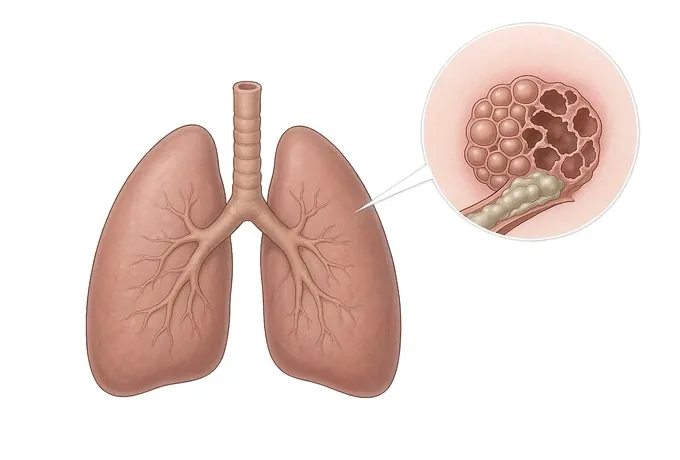
-
Three names, one airway
chronic bronchitis, emphysema and COPD describe different parts of the same lung, not three separate diseases
-
Spirometry decides
the diagnosis turns on the ratio measured after a bronchodilator, not on how long a cough has lasted
-
Stopping smoking changes the slope
inhalers relieve symptoms and reduce exacerbations; stopping is what slows the rate at which lung function falls
-
Since the hospital was founded
our traditional Chinese medicine department, which includes a dedicated lung disease clinic
What COPD is — three names for one airway
Chronic bronchitis, emphysema and COPD are not three diseases. They are three ways of describing overlapping changes in one lung, and getting the names straight matters here more than in most conditions — because patients arrive holding all three words at once, usually without knowing which of them was diagnosed or what each one refers to.
Chronic bronchitis describes the airways. It is defined from the history: a cough that brings up sputum on most days, for at least three months in each of two consecutive years, once other causes have been excluded. It says nothing by itself about how much the airflow is obstructed, and a person can meet that definition with breathing tests that are entirely normal.
Emphysema describes the alveoli, the air sacs where oxygen crosses into the blood. The walls between neighbouring sacs are destroyed, so several small elastic sacs become one large floppy space: surface area for gas exchange falls, the elastic recoil that helps push air out is lost, and air becomes trapped. It is defined by structure rather than by symptoms.
| Name | What it describes | How it is established |
|---|---|---|
| Chronic bronchitis | The airways — increased mucus production and a cough that brings up sputum, on most days for at least three months in each of two consecutive years | From the history, once other causes of a chronic productive cough have been excluded |
| Emphysema | The alveoli — destruction of the walls between air sacs, loss of elastic recoil, trapped air, and less surface for gas exchange | From imaging, and most precisely from CT; it is a structural finding rather than a symptom |
| COPD | The combination — persistent respiratory symptoms together with airflow limitation that does not fully reverse | From spirometry performed after a bronchodilator, read with the symptom and exacerbation history |
COPD is the diagnosis that unites those two descriptions. It is defined as persistent respiratory symptoms together with airflow limitation that does not fully reverse, and the limitation has to be demonstrated rather than assumed. This is the label treatment is organised around, and the one to reach for when asking what should be done next.
The overlap runs in both directions, and that is what makes the words slippery. Chronic bronchitis without airflow limitation is common and is not COPD by itself, though it is often what comes first. Emphysema visible on a scan in someone whose breathing tests are still above the threshold is also common. And some people have clear airflow limitation with almost no cough and no sputum at all.
One further distinction is worth keeping hold of. The first two names are descriptions; COPD is a diagnosis, and the diagnosis rests on a measurement rather than on any description. That measurement, and the reason symptoms cannot stand in for it, is set out on the diagnosis page.
The patterns of COPD, and why the numbers matter more than the label
COPD has been described by pattern for two centuries, and the old descriptions still turn up in clinic letters: the thin, barrel-chested person whose main problem is breathlessness, and the person who is blue-tinged and swollen, whose main problem is cough and sputum. Both pictures are recognisable, and both are less useful than they sound.
| Pattern | What characterises it | What it changes |
|---|---|---|
| Emphysema-predominant | Breathlessness dominates while cough and sputum are modest; the chest is hyperinflated; weight loss is common; gas exchange may hold up until late | Points towards attention to nutrition and exercise, and towards lung volume reduction in selected cases |
| Chronic bronchitis–predominant | Productive cough and sputum dominate; blue-tinged lips, a raised red-cell count and right-heart strain are more likely; a low oxygen level is more common | Raises the priority of airway clearance, vaccination and an oxygen assessment |
| Eosinophilic | A raised blood eosinophil count, sometimes with features that overlap with asthma | Identifies who is more likely to gain from an inhaled corticosteroid being added, and who is less likely to |
| Frequent exacerbator | Two or more exacerbations, or one that needed hospital assessment, within a single year | Changes the aim of treatment: reducing the next exacerbation becomes the target rather than symptom relief alone |
| Alpha-1 antitrypsin deficiency | Emphysema at a young age, worst in the lower zones, with little smoking history, or with a family history and liver problems | Makes testing relatives and stopping smoking urgent, and opens specific treatment questions |
What actually decides treatment is a short set of numbers rather than the pattern: how much the airflow is limited, how breathless the person is in ordinary life, how many exacerbations have occurred in the past year, and what the blood eosinophil count shows. Those four are collected at every review, and they change; the descriptive label rarely does.
The eosinophil count is the one that most often surprises people, because it decides a genuine fork in treatment. An inhaled corticosteroid reduces exacerbations in some people and not others, and it carries risks of its own, so the decision is made on the inflammatory picture rather than on how severe the disease feels. That fork is set out on the treatment page.
Breathlessness is recorded with a short five-point scale that asks which activity brings it on, from hurrying on the flat through to being breathless while dressing. It takes under a minute and it does something a single lung-function figure cannot: it records what the disease costs the person, which is the thing treatment is trying to change.
The symptoms, and why they arrive in layers
Symptoms in COPD arrive from two places, and the two do not behave in the same way. The airways produce the cough and the sputum — the chronic bronchitis layer, which is impossible to miss. The alveoli produce the breathlessness and the shrinking capacity for effort — the emphysema layer, which is felt but is rarely connected by the person feeling it to the lung that is causing it.
| Layer | What the person notices | Why it behaves as it does |
|---|---|---|
| Airway layer | A cough that brings up sputum, worst on waking and present most days | Mucus-producing cells increase their output, the cilia that normally clear it work less well, and secretions pool overnight |
| Alveolar layer | Breathlessness on exertion, a longer recovery after effort, and eventually breathlessness at rest | Air trapping means the lungs do not empty before the next breath, so each breath starts from an over-inflated chest |
| The layer that produces nothing | Nothing at all, for years | Lung function can fall a long way before a person changes what they do, because the body accommodates to the loss gradually |
| Systemic effects | Weight loss, muscle wasting, fatigue, poor sleep and low mood | The disease affects more than the lung, and these add to the breathlessness rather than merely accompanying it |
The third row is where the damage is done. Sensation and measurement do not run in parallel, and they fail in both directions. People whose spirometry looks alarming are often still working, still walking and still describing themselves as fine, because the change has been gradual enough that each new limit feels normal.
And people who have coughed and produced sputum every morning for years are often reassured by exactly that: because the symptom has not changed, they assume the disease has not changed, when in fact no measurement has ever been made. A stable symptom and a stable disease are two different statements, and only one of them can be checked at home.
This is why the condition is so often found late. The breathlessness of early COPD appears only when the effort demanded exceeds a reserve that has been quietly shrinking. What the symptoms look like in more detail, and how they are told apart from other conditions, is covered on the symptoms page.
An exacerbation is a turning point, not a bad cold
An exacerbation is an acute worsening of breathlessness, cough or sputum that needs more treatment than usual. It is the event patients most often underestimate, because its early form feels like the ordinary course of the disease rather than like an event, and it is the event with the greatest influence on what happens next.
Three changes define it, and they are worth knowing by heart, because each one on its own is a reason to act rather than to wait. More breathlessness than usual, particularly on activity that was previously manageable. More sputum than usual. And sputum that has changed colour from clear or white towards yellow or green. Fever, more cough, wheeze, disturbed sleep and a general sense of being unwell usually travel with them. Confusion, drowsiness, blue-tinged lips and new chest pain are different, and belong in the emergency column.
| What has changed | What it means | What to do |
|---|---|---|
| More breathlessness than usual | The most important of the three, and the one most often attributed to something else | Start the worsening step of the written plan, and act on it within hours rather than days |
| More sputum than usual | The mucus load has increased and clearance is failing | Keep fluids up, follow the plan, and treat the change as a reason to be assessed rather than to wait |
| Sputum that has become purulent | A shift towards bacterial infection, one of the two situations in which antibiotics are considered | Contact the treating team, because whether an antibiotic is appropriate is a clinical decision rather than a colour chart |
The reason exacerbations carry so much weight is what they leave behind. Recovery is slower than most people expect: breathlessness, exercise capacity and quality of life commonly take several weeks to return to where they were, and sometimes do not return fully.
Frequency matters as much as severity. Two or more exacerbations in a year, or one that needed hospital assessment, identifies a person in whom the next year is likely to hold more of them, and it changes the aim of treatment from relieving symptoms towards preventing the next event.
What turns all of this into something usable is a written action plan, which attaches a specific instruction to each of the three signs and states who to contact and when. It is described on the living-with-it page, and for a person with COPD it is the most useful document to keep within reach.
What a full assessment contains
An assessment has four jobs: to confirm the diagnosis with a breathing test, to describe how severe the limitation is and how the disease behaves, to identify the parts that are treatable, and to establish a baseline so that later changes can be read against something.
| What is done | The question it answers |
|---|---|
| Spirometry before and after a bronchodilator | Is there airflow limitation that does not fully reverse? The ratio after a bronchodilator is what confirms or excludes the diagnosis |
| A symptom score, and a count of exacerbations in the past year | How much is the disease costing the person, and how is it behaving? These, rather than the lung-function figure alone, decide treatment |
| Oximetry, and arterial blood gases where needed | Is the blood oxygen persistently low enough to matter, and is carbon dioxide being retained? These answers decide whether long-term oxygen is indicated and how oxygen should be given |
| CT where it will change a decision, or to look for another explanation | Is there bronchiectasis, a mass, another interstitial process, or a pattern of emphysema that opens a different option? |
| A watched check of inhaler technique, plus vaccination, smoking, weight and mood | Is the treatment reaching the lungs, and are the reversible contributors to breathlessness being addressed? |
It is the combination that changes management, not any single figure. Two people can share the same lung-function ratio and need quite different things, because one has never had their inhaler technique watched and the other has never had their oxygen level measured. A number on its own answers a question nobody asked.
The breathing test and its bronchodilator manoeuvre are carried out by our respiratory and critical care medicine department, which also provides sleep studies where breathing at night is part of the picture, and radial-probe ultrasound bronchoscopy or CT- and ultrasound-guided lung biopsy where a lesion in the lung needs to be sampled rather than watched. The trace is read together with your history rather than on its own.
What can be settled before travel is arranged — which reports to send, and what each of them answers — is set out on the practical questions page.
Why patients come to China for COPD care
The medicines for COPD are the same everywhere, so nobody travels for a drug they cannot obtain at home. People travel for the assembly, and in COPD the assembly is usually where results are lost: a diagnosis confirmed by a post-bronchodilator ratio rather than inferred from a cough; a severity description that includes symptoms and exacerbations rather than only the lung-function figure; an oxygen assessment that answers a question rather than prescribing a cylinder; and an inhaler technique watched and corrected on the device actually in use.
Our hospital is a Class A tertiary general hospital with more than sixty years behind it. Its traditional Chinese medicine department has been in place since the hospital was founded and includes a dedicated lung disease clinic whose scope covers chronic bronchitis and emphysema alongside asthma, using root-cause and symptomatic approaches. Our Guoyi Hall is where physicians recognised at national and Guangdong provincial level see patients, and integrated Chinese and Western medicine is a designated specialty in Chancheng district.
Where a person wants a combined approach, the position we would state is the one we would want stated to us. It is an addition to the inhaled treatment, not a substitute: the measurements continue unchanged, so any effect is visible rather than assumed, and everything taken has to be known to the clinician managing the lung disease. In COPD there is one further point worth making plainly — no tablet or infusion reverses destruction of the alveoli, so anything sold on that promise deserves caution rather than enthusiasm.
On the respiratory side, the assessment is carried out in-house by our respiratory and critical care medicine department, whose published capabilities include pulmonary ventilation testing, respiratory interventional techniques, radial-probe ultrasound bronchoscopy, CT- and ultrasound-guided lung biopsy, sleep studies and mechanical ventilation. Its published medical staff comprises two chief physicians, one associate chief physician, four attending physicians and one resident physician; its clinical leads include Zhong Xiangzhu, chief physician, whose public scope covers chronic obstructive pulmonary disease, asthma, chronic cough, lung infection and lung cancer, and Tang Lin, chief physician, whose public scope covers respiratory intervention and respiratory oncology.
The department is a vice-chair unit of the Fosun Medical respiratory specialty alliance and of the Foshan Medical Association respiratory branch, and it holds national accreditation for drug clinical trials and for residency training in internal medicine.
Most of the assessment can be established before travel is arranged. Sending the spirometry report with the values before and after a bronchodilator, the symptom score, the number and dates of exacerbations over the past year, oximetry or blood-gas results, CT reports where they exist, the exact inhalers and devices in use with their doses, and a note of any oxygen already prescribed lets a clinician say whether the diagnosis is secure and whether the treatment matches the disease being described.










