


Cervical Spondylosis Overview
Cervical Spondylosis Overview
Cervical spondylosis is the wear that accumulates in the discs, joints and bony edges of the neck with age. Most people never need an operation — the questions that decide everything are which pattern you have, and whether the spinal cord is involved.
-
30,000+
spine procedures performed at our Foshan spine centre to date
-
4
endoscopic platforms — discoscope, foraminoscope, microscope and UBE
-
Cervical–sacral
robotic navigation in use across the whole spine
-
48 hrs
from complete records to a written treatment plan
What cervical spondylosis is
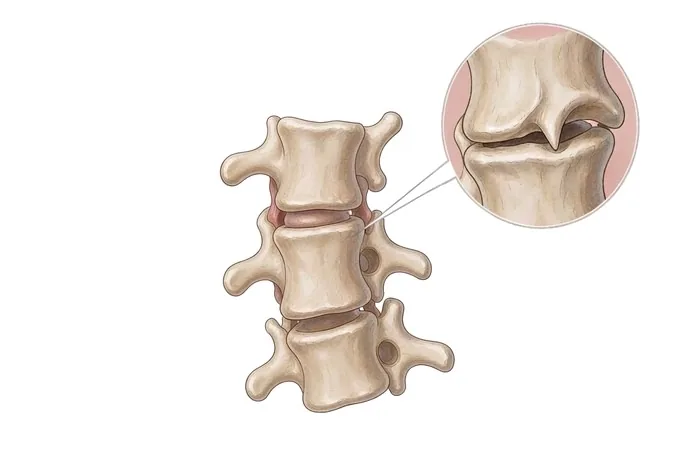
Cervical spondylosis is the wear that accumulates in the neck with age. The discs between the vertebrae lose water and height, the facet joints thicken, bony spurs form along the edges of the bones, and the ligament behind the spinal canal can buckle inward. It is not an illness that arrives on a particular day. It is a slow structural change, visible on imaging in most adults by the age of 50.
That leads to the most important point about this condition: a scan describes your spine, not how you feel. Imaging studies of adults with no neck symptoms at all routinely show disc bulges, narrowed nerve openings and contact with the spinal cord. A finding becomes a diagnosis only when it explains something a person is actually experiencing — pain running down one arm, clumsiness in the hands, or an unsteady walk.
Two look-alikes are worth separating first. Acute torticollis — a neck that locks and hurts after sleeping awkwardly — is muscular and settles within days. Ordinary muscle strain from posture or a long drive behaves the same way: uncomfortable, self-limiting, not structural. If your neck pain comes and goes with your pillow and your desk, that is where to look first. This condition belongs on the list when symptoms follow a nerve or the spinal cord, which are described in our guide to symptoms and warning signs.
One distinction shapes how quickly a case should move. Pressure on a nerve root is distressing but rarely dangerous, and most people improve without surgery. Pressure on the spinal cord — cervical myelopathy — is different, because cord tissue does not recover the way a nerve does. That is the form that should not be watched for months.
Six patterns, and why the pattern decides the plan
Cervical spondylosis is usually described by what it is pressing on. The labels matter more than they appear to, because each carries a different urgency and a different treatment.
| Pattern | What you notice | What it means for treatment |
|---|---|---|
| Axial (mechanical) | Aching and stiffness at the back of the neck and across the shoulders, often worse by the end of the day; no arm symptoms | Physiotherapy, activity adjustment and posture. An operation has no role. |
| Radiculopathy (nerve root) | Shooting pain, numbness or weakness following one arm, often into particular fingers; the reflex on that side may be reduced | Most settle over weeks to months. Non-surgical treatment first; surgery when weakness is progressive or pain does not settle. |
| Myelopathy (spinal cord) | Clumsy hands — buttons, chopsticks, handwriting; heavy or stiff legs; unsteady walking; urinary urgency | Needs timely assessment. Untreated it usually progresses, often in steps rather than a smooth decline. |
| Vertebrobasilar (vascular) | Dizziness or vertigo, visual disturbance, or a headache at the back of the head brought on by neck movement | Often a diagnosis of exclusion — inner-ear and blood-pressure causes are ruled out first. Usually managed without surgery. |
| Sympathetic | Palpitations, ringing in the ears, blurred vision, sweating or a sense of pressure, alongside neck discomfort | Described mainly in Chinese, Japanese and Korean practice; the symptoms overlap with many other conditions, so it is treated conservatively. |
| Mixed | A combination — most often nerve root and spinal cord involvement together | The plan is set by the most serious component present, not the average. |
International classifications are narrower: they recognise axial pain, radiculopathy and myelopathy, and treat the vascular and sympathetic labels as syndromes whose other causes must be excluded first. You will meet both ways of grouping in your records, and both shape how we assess you. Telling radiculopathy from myelopathy is an examination skill rather than something a scan report can settle alone — the difference is set out in our guide to treatment and surgical timing.
How severity is graded
Severity is not the same as how worn the X-ray looks: two people with near-identical images can have very different function. We therefore grade two things — how the spinal cord is working, and how much compression the imaging shows.
The functional measure is the modified Japanese Orthopaedic Association (mJOA) score — short, used internationally, and comparable over time by you and your own physician.
| What the score measures | Points |
|---|---|
| Movement of the arms and hands | 0–5 |
| Movement of the legs | 0–7 |
| Sensation in the hands | 0–3 |
| Bladder function | 0–3 |
The total runs from 0 to 18, where 18 is normal, and the usual grouping is mild (15–17), moderate (12–14) and severe (below 12). A change of about two points is generally taken as meaningful, which is why the score is measured rather than estimated.
| Grade | mJOA | How a case is usually handled |
|---|---|---|
| Mild | 15–17 | Non-surgical treatment with regular review. Surgery is considered if function begins to slip, or if the compression looks likely to progress. |
| Moderate | 12–14 | A surgical opinion is usually appropriate, weighed against age, general health and how fast the change has been. |
| Severe | Below 12 | Assessment is urgent. Delay in this group carries a real risk of function that does not come back. |
Imaging adds the second axis: how narrow the canal has become, whether the cord shows a T2 signal change — a marker of ongoing stress on cord tissue — whether one vertebra slides on another when you bend (instability), and whether the compression lies in front of the cord, behind it, or both. Front, back or both decides the direction of any operation.
How the neck is assessed
An assessment answers two questions rather than producing a scan report: is the spinal cord involved, and does the imaging explain the symptoms. Five things are used, in roughly this order; the full sequence is in our guide to diagnosis.
Where the pain travels, what makes it worse, how you walk, and how buttons and handwriting have been lately. The examination looks for signs that appear only when a nerve or the cord is under pressure: Spurling's test, Hoffmann's sign, reduced reflexes, and a sensory change that follows a nerve. The ten-second grip-and-release test is a simple and sensitive check of hand function.
Shows alignment, disc height and bony spurs, and whether one vertebra slides forward or backward when you bend your neck. That movement — instability — changes what an operation has to achieve.
The decisive study: discs, nerve openings and the spinal cord, and whether the cord carries a signal change from ongoing compression. If you have an MRI from home, our team re-reads it before anything is repeated.
Used when bone detail decides the plan — particularly surgical planning, and ossification of the ligament behind the vertebrae (OPLL), which is more common in East Asian populations and changes which operation is appropriate.
Nerve conduction studies and electromyography, with evoked potentials where needed, separate a neck problem from a peripheral one. Carpal tunnel syndrome, diabetic neuropathy and motor neuron disease can all imitate it, and require entirely different treatment.
Both hands becoming clumsy, dropping things, an unsteady walk, heaviness in the legs, or new urgency passing urine. These point to the spinal cord rather than a nerve root — not a reason for panic, but a reason to be assessed promptly rather than in a few months. Send your imaging for review instead of waiting for the next free appointment at home.
Why patients travel to China for cervical spine care
Six things come up most often when international patients weigh treatment here against treatment at home. All of them are checkable rather than promotional.
A surgeon assigned by subspecialty, not by who is free
Our spine department runs an official subspecialty assignment, so a cervical case is booked with the consultants who work on the neck. Four name it as a primary interest: Dr. Huang Kai (cervical spondylosis service lead), Dr. Chen Guangfu (cervical and lumbar disease), Dr. Wang Feng (cervical and thoracic spine) and Dr. Deng Ye (minimally invasive cervical surgery, including robot-assisted techniques). Dr. Long Yaowu, with more than four decades in practice, operates on every type of cervical spondylosis through the front and the back of the neck, and Dr. Zhao Xiaodong, the hospital's president, was among the earliest in China to perform keyhole microscopic cervical decompression.
Experience that has been turned into a checklist
The department's standing rests on a system rather than one celebrated name. Its founder, Dr. Xie Dazhi — the first physician in Foshan to receive the Chinese Physician Award — broke the work into 26 standardised procedural steps and a nine-stage post-operative rehabilitation assessment. Surgeons here do not operate independently until they have assisted in more than 200 cases and passed an assessment. The spine centre has performed over 30,000 procedures.
Conservative care is a real pathway, not a formality
Rehabilitation and pain medicine are departments with their own consultants, not a waiting room outside the operating theatre. Rehabilitation medicine runs inpatient, outpatient and therapy services — physiotherapy, graded exercise, manual therapy and orthotics among them — and its consultants list neck and back pain as a declared focus. The pain department, led by a chief physician with a doctorate in medicine and United States training, offers image-guided nerve root injections, radiofrequency and neuromodulation when pain has not settled. If your case does not need an operation, the recommendation will say so, with the reasons given in writing.
Four endoscopic platforms, and robotic guidance across the whole spine
The choice of instrument is the operation, and not every neck is approached the same way. The department works with four endoscopic platforms — discoscope, foraminoscope, microscope and unilateral biportal endoscopy (UBE) — alongside conventional anterior and posterior open techniques, so the approach is matched to the level and the pattern of compression. An orthopedic spinal surgery robot now in use supports planning, navigation and screw placement from the cervical to the sacral spine, and a 3D printing centre established with the team of Academician Dai Kerong is used to rehearse complex anatomy before an operation.
A date you can plan a journey around
Two practical things decide whether travelling for treatment is realistic: how quickly a date can be fixed, and how long you have to stay. We aim to return a written plan within 48 hours of receiving complete records and imaging, and to arrange an appointment or elective surgery within one week after that. Length of stay depends on the operation chosen rather than on the disease — the practical questions page sets out each pathway.
A hospital built for patients from outside China
Foshan Fosun Chancheng Hospital is one of Guangdong's first pilot hospitals for international medical services and serves patients from 124 countries and regions. Direct billing is in place with more than 30 international insurers, and the hospital was the first in Foshan designated under the Guangdong–Hong Kong–Macao medicine and device connect scheme, which has brought in 52 approved medicines and devices. An international medical centre coordinates appointments, admission and interpretation; the step-by-step journey explains what follows.










