


Breast Nodules Overview
Breast Nodules Overview
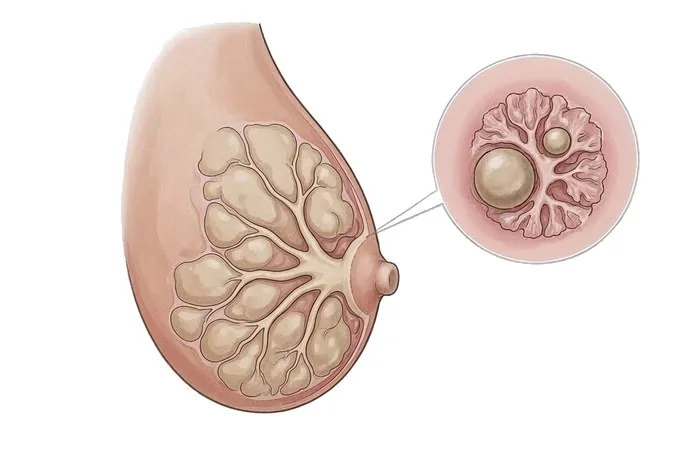
Finding a lump in the breast concentrates the mind, and the fear that arrives with it is usually the same one word. The first thing a breast specialist does is take that word off the table and replace it with a better question, because a nodule is not a diagnosis: it is a finding. It says that somewhere in the breast there is an area of tissue that is different from the tissue around it — felt differently by the hand, or looking different on an ultrasound or a mammogram. What it actually is has to be worked out, and the good news is that the process for working it out is one of the most orderly in medicine. Most of the answers are benign. Cysts, which are pockets of fluid that can appear over days and disappear as quickly; fibroadenomas, which are solid, smooth, mobile lumps of overgrown breast tissue common in the twenties and thirties; and fibrocystic change, which is not a single lump at all but a general lumpiness that rises and falls with the menstrual cycle. But a minority of nodules are, or turn out to be, cancer — and that minority is exactly why no nodule should be waved away and why every one deserves a definite answer. The sequence that produces that answer — examination, imaging chosen by age, and a needle biopsy where it is needed — is short, mostly non-invasive, and built so that the serious answers are found early and the benign ones are closed with confidence rather than with hope.
-
A nodule is a finding, not a diagnosis
the question is what it is, and the answer comes from a sequence, not a single look
-
Most are benign — as a conclusion, not an assumption
cysts, fibroadenomas and fibrocystic change are the common answers
-
Age decides the first test
ultrasound in younger women, mammography with ultrasound from about forty
-
48 hrs
from complete records to a personalised assessment plan
What a breast nodule is, and what it is not
The breast is a gland. Its tissue is built to change — with each menstrual cycle, through pregnancy and breastfeeding, and across the years of hormonal life that end at the menopause. Because the tissue responds to hormone signals, it does not stay perfectly smooth and even: some areas firm up, some fill with fluid, some form small knots of overgrown tissue. A nodule is simply the name for one of those areas that can be told apart from the tissue around it — by the hand that examines it, or by the scan that images it.
That is why the first thing to hold on to is that the word describes a finding, not a diagnosis:
- It does not say what the lump is. A cyst, a fibroadenoma, a patch of fibrocystic change, an area of infection or scarring — all of these arrive at the clinic looking the same from the outside: a lump.
- It does not say whether it matters. The great majority of nodules are benign, but the word is a conclusion that comes at the end of an assessment, and it is honest to say plainly that a minority of nodules are, or turn out to be, cancer.
- It does say that the question deserves an answer. A new lump that is never assessed carries the risk of being the serious kind without anyone knowing; a lump that is assessed properly ends either with treatment or with a confident, evidence-based plan to watch.
Why the breast produces so many nodules. The ducts and lobules that make up the gland are embedded in a mixture of fibrous and fatty tissue that is unusually sensitive to oestrogen and progesterone. In the second half of a menstrual cycle, tissue that is stimulated can swell and retain fluid; over the reproductive years, small pockets of fluid can form and persist as cysts, and local overgrowths of the lobule can form fibroadenomas. None of this is caused by anything the patient did wrong — it is what hormone-responsive tissue does.
What has changed in recent decades is not the nodules but their discovery. Between screening mammography, high-resolution ultrasound and simple breast awareness, nodules are found earlier and at smaller sizes than any previous generation experienced. Most women will have at least one in their lifetime. What makes the difference to health is not the finding but what follows it.
What a nodule usually turns out to be
The answers below cover the great majority of nodules that reach a breast clinic. They behave differently from one another, which is why telling them apart is the whole point of the assessment.
| What it turns out to be | What it is | How it typically behaves |
|---|---|---|
| Cyst | A pocket of fluid inside a duct that has become blocked or widened | Can appear within days, feels smooth and sometimes tender, and can be drained with a needle in the clinic; it may return, which is expected and not alarming |
| Fibroadenoma | A solid, benign overgrowth of a lobule and its supporting tissue | Feels smooth, rubbery and mobile; grows slowly if at all; commonest in the twenties and thirties; removed if large, growing or preferred out, watched otherwise |
| Fibrocystic change | A general pattern of nodularity, not a single lump, produced by normal hormone-driven swelling | Rises and falls with the cycle, affects both breasts, and settles after the menopause; reassured once confirmed and timed to the cycle |
| Other benign lumps | Intraductal papilloma, fat necrosis after an injury or surgery, scar tissue, a lipoma, or an abscess in infection | Each has its own behaviour and its own answer, from observation to drainage to removal |
| Not yet classified | A lump whose nature is still open after the first imaging, or whose imaging does not match what it feels like | Needs the next step of the sequence — usually a needle biopsy — before anything else is decided |
One boundary matters more than the rest. This cluster of pages is about benign nodules and the assessment that identifies them. When a biopsy does return a result that is not benign, the same assessment has done exactly its job: the cancer has been found early, and care continues in the breast cancer programme with its own, much larger set of options. The purpose of a nodule assessment is not to avoid hearing bad news; it is to make sure that whatever the news is, it arrives early and with a plan.
What moves a nodule up or down the urgency scale
Nodules are not all approached with the same tempo, and the tempo is set by a small number of readable factors rather than by how worried the patient feels.
| Factor | What it changes |
|---|---|
| The imaging category (BI-RADS) | The single strongest driver: categories 2 and 3 support observation with scheduled review; categories 4 and 5 lead to biopsy without a long wait |
| Growth and change | A lump that is enlarging, or that was previously stable and has changed, is reassessed rather than watched |
| The red-flag features | Skin dimpling or puckering, nipple retraction or blood-stained discharge, a fixed hard lump, or a lump in the armpit move the assessment forward urgently |
| Age and risk background | A new lump in a woman with a strong family history of breast cancer, or after a previous atypical biopsy, is treated with a lower threshold for biopsy |
What the urgency scale is not. It is not a scale of fear. A rapidly appearing, tender lump is usually a cyst or an infection — benign answers — and a quiet, painless lump is statistically more often benign too. Urgency follows the features that statistically matter, and the features are knowable: that is what the assessment is for.
How a breast nodule is assessed
The sequence is called triple assessment, and it earns the name by combining three independent ways of looking at the same lump. Each step answers a different question, and each step narrows what the next one needs to do.
| Step | The question it answers |
|---|---|
| Clinical examination | What does it feel like — smooth or irregular, mobile or fixed — and are the skin, nipple and lymph node areas involved? |
| Imaging, chosen by age | What does it look like — fluid or solid, well-outlined or not — read as a standard BI-RADS category? |
| Biopsy, where indicated | What is it made of — a tissue answer that does not depend on appearances? |
Why the three are read together. Every one of the three can be reassuring on its own and wrong on its own. A lump can feel classic for a fibroadenoma and look suspicious on ultrasound; an ultrasound can look benign while the mammogram shows microcalcification; a biopsy reconciles them all. When all three agree that a lump is benign, the conclusion is solid enough to build a watch-and-review plan on — and when they disagree, the disagreement itself is the finding that leads to the next test.
What patients usually ask for by name is the answer, not the sequence — but the sequence is what makes the answer trustworthy. Skipping steps saves hours and costs certainty; the whole design of triple assessment is that no lump is called benign on appearances alone.
Why patients travel to China for breast nodule assessment
A breast lump is a poor candidate for a long, anxious wait, and the international pathway is built to shorten it at every step.
The assessment is compressed, not rushed. Examination, ultrasound, mammography and needle biopsy are organised within the same facility, so what in many health systems stretches across weeks of separate appointments and separate waiting lists can be completed as one connected visit — with the imaging read while the patient is still there and the biopsy, where needed, taken without a second round of travel.
The answer arrives while the team that can act on it is present. Pathology results are chased, not waited for: when a biopsy shows a benign conclusion, the review plan is written before the patient flies home; when it shows anything else, the multidisciplinary conversation starts immediately instead of after another referral.
Records are read before arrival. Previous mammograms and ultrasound images — the images themselves, not only the reports — are reviewed in advance, so that the first appointment is spent on the questions that matter rather than on rediscovering what is already known.
Costs are clear before commitment. An itemised estimate for the assessment — and, where treatment turns out to be needed, for that too — is provided in advance, and international-desk staff coordinate directly with the patient and any insurer throughout.










