


Bone Metastasis Overview
Bone Metastasis Overview
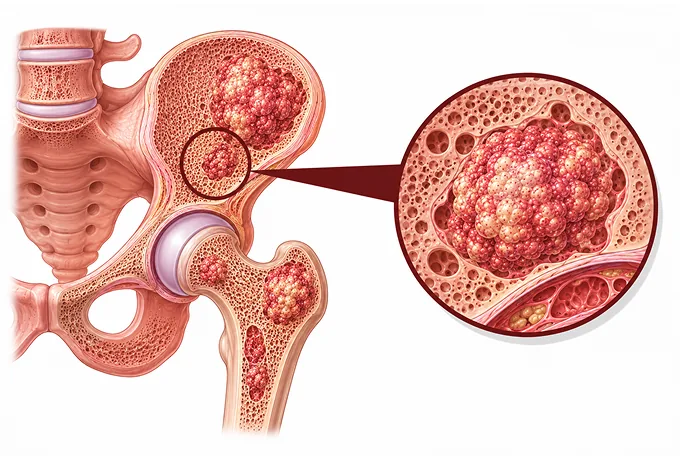
Bone metastasis means a cancer that began somewhere else in the body has spread to bone. It is not a new cancer, and it is not bone cancer: the cells in the bone are cells of the original tumour that travelled through the bloodstream and settled there. That single fact shapes everything — what the pain means, why the treatment of the original cancer remains the foundation, and why the skeleton itself has to be protected alongside it.
-
Not a new cancer
the cells in the bone belong to the original tumour — the treatment of that cancer stays central
-
Pain is the usual first sign
persistent, often worse at night or at rest, and felt at a point rather than spread across a region
-
Two emergencies
pressure on the spinal cord and a raised calcium level — both need same-day assessment, not a wait
-
48 hrs
from complete records to a personalized MDT plan
What bone metastasis is
Bone metastasis is cancer that began somewhere else and has spread to bone. The cells that make up a deposit in bone are cells of the original tumour — breast, lung, prostate, kidney, thyroid or another organ. They reached the bone through the bloodstream, settled in the bone marrow, and grew there. Two common misunderstandings follow directly from this, and both are worth correcting at the outset. Bone metastasis is not a new cancer: it is the original cancer, in a new place, and it is treated as such. And it is not bone cancer, which is a rarer disease that begins in the bone itself and behaves quite differently.
The importance of that distinction is practical rather than semantic. Because the cells are the original cancer's cells, the treatment that works against that cancer still works against its deposits in bone — a breast cancer deposit in the spine is treated with the drugs that treat breast cancer. And because the bone is a living tissue that is continuously broken down and rebuilt, a deposit interferes with that cycle: it can dissolve the bone around it, thicken it, or do both at once. The consequences are the ones patients feel — pain, a bone that breaks too easily, pressure on the spinal cord when a deposit sits in the spine, and a raised calcium level when the bone is being broken down faster than the body can handle.
The aim of treatment is therefore not the bone alone. It combines the treatment that is directed at the original cancer — hormonal treatment, targeted therapy, chemotherapy or immunotherapy, chosen by what that cancer is — with drugs that protect the skeleton, and with local measures such as radiotherapy, surgery or cement for the deposits that are causing a specific problem. Pain is treated properly and early rather than tolerated. The result is that bone metastasis is usually managed as a long-term condition, with the bone problem and the cancer problem handled together by one team.
Pain is the commonest reason a patient comes to a doctor, and it has a character that is worth knowing. It is usually persistent rather than intermittent, it is frequently worse at night or at rest than during the day, and it tends to be felt at a particular point rather than spread vaguely across a region. It does not settle with the measures that help ordinary muscular backache. That said, pain in a person who has had cancer is not automatically a sign of spread, and equally, pain that persists deserves to be looked at rather than explained away.
Two situations are emergencies and are treated as such. The first is pressure on the spinal cord by a deposit in the spine, which announces itself with back pain together with new weakness, numbness or tingling in the legs, difficulty walking, or a change in bladder or bowel control; if it is not relieved quickly, the weakness can become permanent. The second is a raised calcium level in the blood, which causes confusion, drowsiness, thirst, passing a lot of urine, nausea or constipation. Neither should wait for the next scheduled appointment, and both are reversible if they are dealt with early. A third situation — a bone that has broken, or is about to break — is urgent rather than emergent, and is usually anticipated and dealt with before it gives way.
Which cancers reach bone, and how the deposits behave
Bone is a well-supplied tissue, and many cancers can reach it. A small number of primary cancers account for most bone metastases, and knowing which one is involved matters because it is that cancer, and not the bone, that determines the drugs used:
| Common primary cancers | What is established |
|---|---|
| Breast | One of the cancers most likely to involve bone, and one where bone deposits often appear years after the original treatment; hormone receptor and HER2 status guide the systemic treatment |
| Prostate | Commonly involves bone, usually as dense rather than dissolving deposits, and is treated with hormonal therapy and with drugs that protect the skeleton |
| Lung | A frequent source, and one where the markers on the tumour — EGFR, ALK, PD-L1 — may open the door to targeted or immune treatment |
| Kidney | Produces deposits that tend to bleed and to dissolve bone, so surgery and embolisation are used more often than in other cancers |
| Thyroid | Involves bone in a proportion of patients and is treated with thyroid-specific systemic treatment where it is available |
| Others | Many other cancers can reach bone, including bowel, stomach, bladder and the blood cancers; in each case the treatment follows the primary |
Deposits are described by what they do to the bone, and that description is read on the imaging rather than assumed. A deposit that dissolves bone is called osteolytic and is the pattern typically seen with breast, lung, kidney and thyroid cancers. A deposit that thickens bone is called osteoblastic or sclerotic and is the pattern typical of prostate cancer. Many are mixed. The distinction matters for two reasons: it affects how the deposit looks on a scan and therefore how it is followed, and it affects the risk of fracture, since a bone that has been dissolved is mechanically weaker than one that has been thickened.
What should not be read into this list is that bone metastasis is a single disease with a single behaviour. A patient with one deposit in a rib and a patient with several deposits in the spine, pelvis and femur are in quite different situations, and they are treated differently — the first may need nothing more than the systemic treatment of the underlying cancer, and the second may need radiotherapy, protection of the skeleton, and possibly surgery. The plan is set by the whole picture, not by the diagnosis alone.
Extent: how much bone is involved, and where
There is no separate stage that describes a bone metastasis on its own. The cancer keeps the stage it already had, and the bone deposits are described by their extent and their distribution — how many bones are involved, which ones, and whether any of them threatens a specific structure. That description, together with the state of the original cancer, is what the treatment is built on:
| What is described | In plain terms | What it means for the plan |
|---|---|---|
| Distribution | Which bones are involved — spine, pelvis, ribs, upper femur, skull or elsewhere | Determines whether the whole body needs surveying and which areas need watching on follow-up imaging |
| Number of deposits | One deposit, a few, or widespread involvement of the skeleton | A limited number may be treated locally; widespread involvement is treated mainly with systemic treatment and skeletal protection |
| Structural risk | Whether a deposit has weakened the bone enough that it may break | The reason prophylactic surgery or fixation is considered before a fracture happens, rather than after |
| Cord and roots | Whether a deposit in the spine is touching or pressing on the spinal cord or nerve roots | Any contact with the cord moves the patient to urgent imaging and, if confirmed, to treatment without delay |
| Other disease | Whether the cancer is also present in organs such as the liver, lungs or lymph nodes | Bone is treated alongside the rest of the disease, not in isolation from it |
| Calcium | Whether the bone breakdown has raised the calcium in the blood | A raised level is corrected as a medical emergency and then kept under control |
What the tissue test of the original cancer adds
Treatment for bone metastasis is selected by what the original cancer is, not by the bone deposit as though it were a separate disease. That means the pathology of the primary tumour — and, where it is available, of a deposit — is what directs the systemic treatment:
| Marker | What it is | What it means in practice |
|---|---|---|
| Hormone receptors | Oestrogen and progesterone receptors, tested in breast cancer | When present, hormonal treatment is a mainstay and can control bone deposits for long periods |
| HER2 | A receptor that can be over-expressed in breast and some other cancers | When present, targeted treatment against HER2 is used, and it is effective against the deposits as well |
| EGFR / ALK | Driver changes found in a proportion of lung cancers | When present, targeted tablets can control the disease, including bone deposits, without chemotherapy |
| PD-L1 | A protein used to judge whether immune treatment is likely to help | Tested on tissue that already exists; it can open an immune-based route in several cancer types |
| PSA and hormones | The markers used in prostate cancer | Guide hormonal treatment, which is the backbone of treatment for prostate cancer in bone |
| Re-biopsy | A fresh sample of a deposit, where the disease has changed | Sometimes needed because a cancer can alter its markers over time, and the change alters the treatment |
Why patients come to China for bone metastasis care
The care of bone metastasis is decided by a set of capabilities that have to work together, and it is the combination rather than any single one that a patient comes for:
- A plan that treats the cancer and the bone together — medical oncology and the team managing the skeleton working from one plan, rather than a bone problem referred away from the cancer problem.
- Bone-modifying treatment given properly and monitored — a bisphosphonate or denosumab on a defined schedule, with calcium, vitamin D and kidney function and with dental assessment before treatment starts, since that is where the complications are prevented.
- Radiotherapy delivered promptly for pain and for the cord — a short course or a single treatment to a painful deposit, and urgent treatment to the spine where the cord is threatened, without waiting for a routine slot.
- Surgery that stabilises rather than removes — internal fixation, joint replacement, spinal decompression with instrumentation, and cement augmentation such as vertebroplasty or kyphoplasty, offered where the deposit is the problem rather than assuming it cannot be operated on.
- Interventional radiology where it helps — embolisation and ablation of deposits that bleed or resist other treatment, used in the types of cancer where that is established practice.
- Pain controlled by design — analgesia planned with the oncologist from the start, including adjuvants for nerve pain, rather than added when the patient complains.
- Rehabilitation that keeps people mobile — physiotherapy, bracing and a plan to prevent falls, together with attention to calcium and vitamin D, because staying on the feet is part of the treatment.
- One multidisciplinary review, and one written plan — the imaging, the pathology and the patient's priorities reviewed at the same meeting, with the plan set out in writing before treatment starts.
Because bone metastasis is usually managed over months and years rather than weeks, patients who live elsewhere commonly come for the assessment and an initial plan, then return home with a written schedule that a local team can follow, and come back when a specific problem needs treating. The records that make that possible are the original pathology report in full with any receptor and marker results, the imaging of the bone deposits with its reports and dates, the record of treatments already given for the original cancer, and the current medication list including any pain relief. Send those, and the written assessment is returned within 48 hours of the file being complete.










