


Axillary Hyperhidrosis Overview
Axillary Hyperhidrosis Overview
Excessive underarm sweating and underarm odour are usually spoken of as a single complaint, and they are not a single problem. One is about quantity: the sweat glands of the axilla are driven by the sympathetic nerves that supply them, and in the primary form those glands produce far more than the body needs. The other is about chemistry: the apocrine glands release an oily, protein-rich fluid that is odourless on its own, and the smell appears when bacteria living on the skin surface break it down. That separation matters, because it is the reason a treatment that reduces wetness does not necessarily reduce odour, and a treatment that removes odour does not change how much the rest of the body sweats. It also matters because of what the two problems are not. Neither is a failure of washing: the bacteria and the gland structure belong to the skin, and cleaning reduces the load without removing the source. And sweating does not clear anything from the body — the volume of waste removed in sweat is negligible, which is worth stating plainly because the opposite belief keeps people from seeking treatment they would otherwise want. Most cases begin after puberty, when the apocrine glands mature, and are harmless, running in families and settling to some degree with age. A minority are the visible sign of another condition, and the pattern that distinguishes them is one patients can recognise themselves: sweating that continues through sleep, or that affects the whole body rather than the underarms, is a reason to look further rather than to buy a stronger antiperspirant. Treatment is arranged from the reversible towards the permanent, and the first decision is which of the two problems the patient actually wants solved.
-
Wetness and odour are not the same complaint
one is how much the glands secrete; the other is what skin bacteria do to the apocrine fluid, so the measures that fix one need not fix the other
-
Neither is a hygiene problem
the bacteria and the gland structure belong to the skin, and cleaning reduces the load rather than the source
-
Sleep is the dividing line
sweating that stops during sleep points to the primary form; sweating that continues through the night, or affects the whole body, points to something else
-
48 hrs
from complete records to a written assessment plan
Why underarm sweat and underarm odour are two different problems
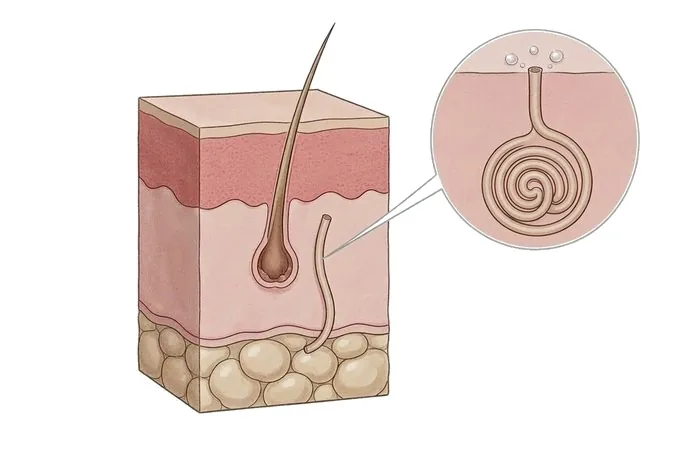
Underarm sweating and underarm odour arrive together so often that they are treated as one condition, and separating them is the single most useful thing a patient can do before choosing a treatment. Excessive sweating of the underarms — axillary hyperhidrosis — is a problem of secretion: the glands produce more sweat than the body needs, and the nerve supply that drives them is overactive. Underarm odour — axillary bromhidrosis, sometimes called osmidrosis — is a problem of what happens to that secretion after it reaches the skin. The apocrine glands of the axilla release a fluid rich in fats and proteins that has no smell of its own; bacteria living on the skin surface break it down, and the compounds they produce are what the nose detects.
- One is quantity, the other is chemistry. Reducing how much sweat reaches the skin reduces the raw material the bacteria have to work on; removing or deactivating the glands removes that raw material at its source. Neither automatically corrects the other, and a plan that does not say which is being treated will not produce what the patient expected.
- Neither is a cleanliness problem. The glands and the bacteria are part of the skin rather than something deposited on it. Washing reduces the bacterial load and the time the fluid spends in the crease, so it helps — but it does not remove the source, and anyone told that better hygiene is the answer has been told the wrong thing.
- Sweating is not the body clearing itself of anything. The quantity of waste removed in sweat is negligible compared with what the kidneys and liver handle. This matters practically, because the belief that sweating is a form of detoxification stops people from treating a problem that interferes with their daily lives.
What treatment can and cannot do. Treatment can reduce sweating substantially, with injections of botulinum toxin that act for months and with devices that damage the glands for a longer period; it can reduce odour directly by removing the apocrine glands, which is a permanent step; and it can control both together in many patients by combining measures. What no treatment does is change the reason the nerves are overactive, and the permanent options are permanent — including their consequences, such as sweating that appears elsewhere. That is why the sequence runs from reversible to irreversible, and why the first appointment is about working out which of the two problems costs the patient most.
The patterns this problem presents in
The complaint sounds the same from patient to patient and the underlying pattern does not. Establishing which pattern applies decides whether the answer is a stronger antiperspirant, an injection, a device or a search for another diagnosis.
| Pattern | What is happening | What it means for treatment |
|---|---|---|
| Primary focal hyperhidrosis of the axilla | Sweating of both underarms, similar on each side, beginning after puberty, present through the waking day and absent during sleep | The common form, and the one that responds to measures aimed at the glands: antiperspirants, injections, devices and, in selected patients, surgery |
| Secondary hyperhidrosis | Sweating that continues during sleep, affects the whole body rather than one area, or appears with weight loss, fevers or a racing heart | A sign of something else. The priority is to find and treat the underlying condition, and local measures are held back until it has been addressed |
| Apocrine bromhidrosis | Odour as the main complaint, often with less sweating than the patient expected, arising from the apocrine glands and the bacteria acting on their secretion | Measures that reduce sweat help only indirectly. The treatments that act on the apocrine glands, or on what the bacteria are given, are the relevant ones |
| Sweat and odour combined | Both complaints present and both interfering with daily life, with the patient usually unable to say which came first | Both are addressed, and the order is chosen deliberately rather than by habit — often a reversible measure first, so that the response can be judged |
| Involvement beyond the axilla | The palms, the soles or the face affected in the same way, which is common in the primary form and often more disabling than the underarms | The additional sites are assessed at the same time, since treating the axilla alone may leave the complaint that matters most untouched |
Why the pattern is established before anything is prescribed. The same degree of wetness means entirely different things depending on when it happens and where it appears. Sweating that stops when sleep begins is a statement about the nerve supply; sweating that does not is a question about the rest of the body, and answering it may be the whole of the treatment.
What makes underarm sweating more or less urgent
Nothing in this condition is dangerous, and the assessment is about how much it interferes and whether another cause is hiding behind it. That changes the question from how much sweat there is to what the sweating is costing.
| Feature | Why it changes the plan |
|---|---|
| Whether the sweating stops during sleep | The single most useful question in the history. Sweating that stops when sleep begins points to the primary form and to treatment of the glands; sweating that continues through the night points elsewhere |
| Whether it is confined to the underarms | Sweating limited to the axilla, the palms, the soles and the face is characteristic of the primary form; sweating that involves the trunk or the whole body sends the assessment in a different direction |
| Whether it accompanies weight loss, fevers or a racing heart | These are the features that make a secondary cause worth looking for, and where they are present the investigations come before any local treatment |
| How far it interferes with daily life | The measure on which treatment decisions are actually made: avoiding certain clothes, changing garments during the day, difficulty with work, sport or closeness to others. A record of this is what makes a response to treatment visible |
| Whether the skin is breaking down | Prolonged moisture irritates the crease and leaves it open to infection. This is simple to treat and unpleasant to leave, which is why the skin itself is examined at every visit |
What urgent means in this condition. Mostly it does not: the primary form is not dangerous, it is intrusive, and treatment is arranged around what suits the patient. The exception is the secondary pattern, where the sweating is a message rather than a disease, and where the timescale set by the underlying condition is the one that matters.
How sweating and odour are assessed
The assessment answers four questions in order — is this the primary form, how severe is it, is the skin affected, and is there another cause — and each step exists to make the next decision precise.
| Step | The question it answers |
|---|---|
| History and pattern | Is this the primary form, and which complaint matters most? Age at onset, whether sleep is interrupted, which sites are involved, the family history and the response to what has already been tried identify the pattern |
| Structured severity scoring | How much does it interfere? A standard questionnaire records the effect on daily activities and is repeated after treatment, so that benefit is measured rather than remembered |
| Quantifying the sweat and mapping the area | How much is produced, and by which part of the skin? Weighing paper gives a figure that can be compared over time, and an iodine and starch test shows the distribution, which is what treatment is planned against |
| Examination of the skin | What has the moisture done to the crease? Maceration, irritation, staining and secondary infection are looked for directly, because each changes what can be applied and when |
| Testing for a secondary cause where indicated | Is something else driving this? Thyroid function, blood glucose, a blood count and a review of medication are used where the history suggests it, and are not needed where the pattern is clearly primary |
Why the order matters. The pattern decides whether the patient is being treated at all or investigated first; the scores and the measurements make the complaint a quantity that can be shown to have changed; the skin examination determines what can safely be applied; and the search for a secondary cause is triggered by the history rather than performed on everyone.
Why patients travel to China for underarm sweating and odour
This is a condition treated over time and in steps, and the difficulty is rarely the technique — it is deciding which measure to use first and recognising when the problem is not local at all. What an international pathway offers is that both questions are settled in one place, with the measurements to support them.
The assessment and the treatment decision happen together. The pattern is taken, severity is scored, the sweat is quantified and the area is mapped, the skin is examined, and the relevant tests are drawn — in one facility and usually within a day or two. A patient leaves knowing which of the two problems is being treated first and why, rather than holding several options and no order.
Both sides of the problem are available in the same plan. The measures that reduce sweating and the measures that reduce odour act on different things, and a clinic that offers only one of them tends to recommend what it has. Because injections, energy-based devices and surgical removal of the apocrine glands are all part of the same assessment here, the recommendation follows the complaint rather than the equipment list.
Where the problem is not local, that is found first, and the plan is written for the patient going home. Sweating that continues through sleep or affects the body as a whole is investigated before any local treatment — the part of the assessment that most often changes what happens. Which pattern was found, which measure was chosen and why, what the response should look like and when to judge it, and what the next step would be if it is not enough are all provided in English, with the international desk coordinating with the patient, any insurer or assistance company, and the treating team at home.










