


Asthma Overview
Asthma Overview
Asthma is a long-term inflammation of the airways in which the narrowing comes and goes but the inflammation does not. Almost everything that follows — why the preventer is taken on good days, why a normal examination means little, why an attack can be seen coming — comes out of that fact. The guide is built around the distinction most people have never been taught: control and severity are two different measurements.
-
Two labels, not one
control is how the asthma is behaving now; severity is how much treatment it takes to keep it that way
-
Four questions
night waking, daytime symptoms, reliever use and activity limitation are what control is measured by
-
Technique is treatment
a medicine that does not reach the airway has not been given, however good the prescription
-
Since the hospital was founded
our traditional Chinese medicine department, which includes a dedicated lung disease clinic
What asthma is — a twitchy airway, not a weak one
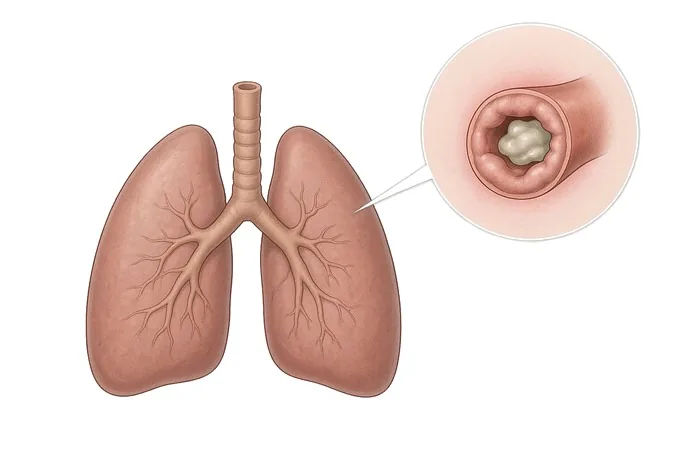
Asthma is a long-term inflammatory condition of the breathing tubes, and two things happen in it at once. The lining of the airways stays inflamed and unusually reactive, narrowing far more than it should in response to things that would barely register in someone else. And from time to time the muscle around the tubes tightens, the lining swells and mucus collects, so the tube narrows and air moves through it less easily. That narrowing is variable and reversible, which is why asthma behaves so differently from a fixed obstruction of the airway.
The information that changes everything else is that the inflammation does not switch off when the symptoms do. Between episodes the airway is not normal; it is quiet, but it is still inflamed. This is why treatment is taken on good days as well as bad ones, and why stopping a controller after a calm month feels harmless at the time and turns out not to have been. A person whose symptoms are quiet because a controller is working has a treated airway; a person whose symptoms are quiet because the controller was stopped has an untreated one.
| What is happening | What it explains |
|---|---|
| Inflammation of the airway lining | Why a controller is taken continuously, and why the disease is still there in a symptom-free month |
| Airway hyperresponsiveness — narrowing too much and too easily | Why exercise, cold air, smoke and allergens set symptoms off, and why that is information about control rather than fragility |
| Variable, reversible narrowing | Why symptoms fluctuate from day to day, and why spirometry before and after a bronchodilator is how it is shown |
It follows that asthma is not an infection, so antibiotics do not treat it — though infection is one of the commonest things that sets an episode off, which is why the two are confused so often. Nor is it weakness or a nervous chest: the airway behaves as it does because of inflammation. And it is not something that simply resolves; some children stop having symptoms, while many continue into adult life.
The types of asthma, and why the type matters less than the label
Asthma is described by pattern rather than divided by a single line. The descriptions are worth knowing because each points at what to look at next — what to avoid, what to test for, which add-on might suit. They rarely decide, on their own, which medicine is used.
| Pattern | What defines it | What it changes |
|---|---|---|
| Allergic (atopic) asthma | Symptoms track with allergen exposure, and testing shows sensitisation to dust mite, pets, mould or pollen | Points towards avoidance that works, allergy testing if not yet done, and immunotherapy in selected cases |
| Non-allergic asthma | No clear allergic trigger; symptoms follow infections, cold air, exercise, smoke or strong smells | Makes the four-week control assessment matter more, since no single exposure can be removed |
| Cough variant asthma | A dry cough that is the only symptom — no wheeze, no breathlessness, a normal chest | Changes the differential: it is usually treated as recurrent bronchitis or a throat problem first |
| Exercise-induced bronchoconstriction | Symptoms during or shortly after exertion, worse in cold, dry air | Turns exercise into a treatment target rather than something to give up, and usually marks imperfect control |
| Occupational asthma | Symptoms that improve on days away from work and return on return, with a plausible workplace exposure | Makes the exposure history a priority, because removing the exposure changes the long-term course |
| Aspirin-exacerbated respiratory disease | Asthma with nasal polyps and a reaction to aspirin or other anti-inflammatory drugs | Means those medicines are avoided, with alternatives planned in advance rather than found in an emergency |
The labels that actually change treatment are not on that list. They are control, which is how the asthma has behaved over the last four weeks, and severity, which is how much treatment it takes to keep it behaving that way. Severity is a statement about treatment, made after the fact. Someone fully controlled on a high-intensity regimen has severe asthma; someone who has a bad night every fortnight and takes nothing has poorly controlled asthma whose severity has not yet been measured.
The pattern has one further use: it decides which add-on is considered when inhaled treatment alone is not enough — as set out on the treatment page.
Control and severity are two different measurements
Control is a description of the last four weeks. It is not how you feel at this moment, and it is not how you compare with a year ago. Four questions establish it, and they are the same four whether the asthma is mild or severe.
| Question, over the last four weeks | What controlled looks like | Why it is asked |
|---|---|---|
| Daytime symptoms more than twice a week? | Two days a week or fewer | Frequency, not intensity, separates a quiet month from a busy one |
| Woken at night by asthma? | Not at all | The most specific of the four, and the one people most often leave out |
| Reliever needed more than twice a week? | Twice a week or less, not counting doses before exercise | A crude but honest measure of how much narrowing is happening |
| Has asthma limited what you can do? | Not at all | The question people most often answer with a compromise |
Read together, those four produce the same conclusion every time: severity cannot be read off how a person feels, in either direction. The usual error is the first — symptoms are mild, so less treatment should do. The quieter one is the second: today is awful, therefore this is severe asthma. Neither is a measurement. Severity is answered by one question only — how much treatment is required to hold control — and that answer arrives after the treatment has been tried.
It follows that feeling well is not the same as being well controlled. The target is no night waking, symptoms on two days a week or fewer, no limit on what you can do and a reliever you seldom need. Many people settle for less — going from daily symptoms down to twice a week is an improvement, and it is not the target — and the compromise usually shows up at night.
One pattern deserves its own paragraph: the reliever-only habit. Using a reliever when symptoms come, and more of it in a bad week, treats the sensation and leaves the inflammation running underneath. Reliever use rising week after week is a warning, not a solution, and it is the pattern most often found when preventable attacks are reviewed afterwards.
Attacks can be recognised before they are emergencies
An attack does not begin at the moment a person cannot breathe. It usually begins days earlier, with a reliever used more often, a chest tight at night, a cough that will not settle after a cold, or a peak flow below its usual range. That early phase can be acted on, and a plan exists to make the decision while it is still small.
| Zone | What you notice | What to do |
|---|---|---|
| Green — control is holding | No night waking, reliever twice a week or less, nothing given up | Continue the controller as prescribed and review at the planned interval. Nothing needs to change on a good day, and nothing should be reduced on one either. |
| Yellow — control has slipped | Reliever needed more often and not lasting as long; night waking with cough or tightness; symptoms after a cold; peak flow below your threshold | A written plan tells you what to increase, and for how long. If it has not settled within the time the plan states, contact your treating team rather than continuing alone |
| Red — this is an emergency | Reliever not working, or lasting minutes rather than hours; speaking in single words; unable to lie flat; neck and rib muscles pulling in with each breath; lips grey or blue; drowsiness or confusion | Emergency care now, and keep using the reliever while help is arranged. The inhaler is not something to hold back until you arrive |
Three things turn a treatable episode into a crisis. Time matters, because an airway narrowing for two days is harder to open than one narrowing for two hours, and it closes further the longer the episode runs. Judgement is the third: waiting to see whether the reliever works one more time is the commonest reason a manageable episode becomes an emergency. A plan removes that judgement by attaching an instruction to the signs. What a plan should contain is covered on the living-with-it page.
What a full assessment contains
An assessment has three jobs: establish the diagnosis with objective evidence, describe the inflammation well enough to choose treatment, and measure control. A consultation that produces a prescription without those three has skipped what makes it appropriate.
| Test | The question it answers |
|---|---|
| Spirometry before and after a bronchodilator | Is there obstruction, and does it reverse? The most informative single test, provided reversibility is documented rather than assumed |
| Peak flow twice daily for two weeks, or a bronchial challenge test | Does the airway vary across the day and across days, and does it react more than it should? Variability is the signature of asthma, and a diary shows what one measurement cannot |
| FeNO, blood eosinophils and total IgE | What kind of inflammation is this, and is it active now? These figures describe the pattern, which matters when add-ons are considered |
| Skin prick testing or specific IgE | Which allergens is this person sensitised to? Useful for avoidance advice and, in some cases, immunotherapy |
| Chest imaging, where the picture is atypical | Is something else going on — a structural problem, an infection, or another cause? |
| A watched check of inhaler technique, and control against the four questions | Is the drug reaching the airway, and is the disease actually controlled? The technique check is the most frequently skipped test in asthma |
What changes management is the combination, not any single figure: obstruction with documented reversibility, variability across a fortnight, an inflammation marker that explains the pattern, and a technique check confirming the medicine gets in. A prescription delivered through a device used incorrectly gives the same result as no prescription, except that nothing looks wrong on paper.
Pulmonary function testing and its reversibility manoeuvre are performed by our respiratory and critical care medicine department, and the trace is read with your history rather than on its own. Where the picture is atypical, the same department has radial-probe ultrasound bronchoscopy and CT- or ultrasound-guided lung biopsy. The appointments that carry this out, and the interval at which they are repeated, are written into your plan; what can be established before travel is discussed is on the practical questions page.
Why patients come to China for asthma care
What international patients come for is almost never a medicine unavailable at home — the drugs for asthma are the same everywhere. It is the assembly, and in asthma the assembly is where outcomes are usually lost: a diagnosis with the reversibility documented rather than inferred; control assessed against the four questions; inhaler technique watched and corrected on the device you own; a written action plan with names, doses and a threshold for calling; and a stepped plan with review dates.
Our hospital is a Class A tertiary general hospital with more than sixty years behind it. Its traditional Chinese medicine department has been in place since the hospital was founded and includes a dedicated lung disease clinic whose scope covers asthma, chronic bronchitis and emphysema, using root-cause and symptomatic approaches. Our Guoyi Hall is where senior physicians recognised at national and Guangdong provincial level see patients. Integrated Chinese and Western medicine is a designated specialty in Chancheng district, oriented towards sub-health and preventing recurrence in long-term conditions. Acupuncture and tuina, including royal tendon therapy and Qing-dynasty bone-setting methods, draw patients from Europe, North America, Hong Kong, China and Macao, China, and one-finger Zen massage is national intangible cultural heritage.
Where a patient wants a combined approach, the position we would state is the one we would want stated to us. It is an addition to the inhaled treatment, not a substitute: the measurements continue unchanged, so any effect is visible rather than assumed, and anything taken has to be known to the clinician managing the asthma, because herbs and supplements can interact with prescribed medicines.
On the respiratory side, the assessment is carried out in-house by our respiratory and critical care medicine department, whose published capabilities include pulmonary function testing, radial-probe ultrasound bronchoscopy, CT- and ultrasound-guided lung biopsy, sleep studies and mechanical ventilation. It is a vice-chair unit of the Fosun Medical respiratory specialty alliance and of the Foshan Medical Association respiratory branch, and it holds national accreditation for drug clinical trials and for residency training in internal medicine. Biologic treatment for severe eosinophilic asthma is offered where a person's inflammatory pattern fits it.
Most of the assessment can be established before travel is arranged. Sending the spirometry report with its reversibility figures, a peak flow diary if one exists, FeNO and eosinophil results, allergy testing, the exact devices and doses in use, and the history of attacks and steroid courses lets a clinician say whether the diagnosis is secure, whether the treatment matches the control being described, and which missing test is worth doing where you are.










