
2025-10-16
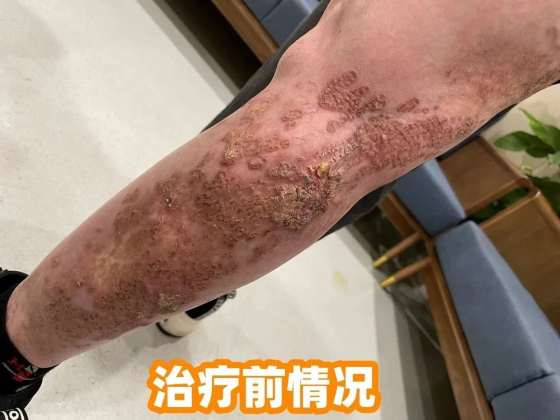
After a childhood burn, she lived with skin nodules, rashes, and itching for over 40 years...
In the last three years, her symptoms worsened significantly, even developing ulceration, pus, scabbing, itching, and pain.
Recalling Director Lu Qiuxia who had spared no effort to help her in the past, Ms. Gan came to the Foshan Chancheng Hospital (Foshan Zen Hosp?) Tumor Precision Diagnosis and Treatment Center for consultation and was diagnosed with Bowen's disease.
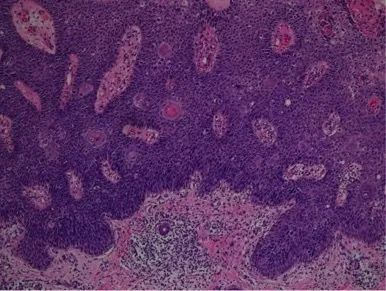
Pathology of Bowen's Disease
Bowen's disease (BD), also known as squamous cell carcinoma in situ, is a relatively rare cutaneous malignancy, commonly found on sun-exposed skin of middle-aged and elderly patients. It typically presents as erythematous patches with scales or crusts, or slightly elevated plaques.
The term "in situ" means the tumor cells are confined to the epidermal layer and have not invaded deeper layers, thus it is a very early-stage skin malignancy.
Itchy, Ulcerated Skin
Unable to Forget the Skilled Doctor from Years Ago
"Director Lu, Director Lü, back then due to my family's financial situation, I had to stop treatment and didn't pay much attention to it. But over the years, the condition on my left foot seems to have gotten worse and worse. I'm really terrified!" Ms. Gan showed the doctors the affected area on her foot, explaining her difficulties. The foot problem had caused her many inconveniences in daily life, making her feel utterly distraught.
It turned out that Ms. Gan had been a patient of Director Lu Qiuxia 10 years ago. The treatment progress was quite promising initially, and she was on the verge of completing it, but had to discontinue due to family reasons. Director Lu had always felt very sorry for her situation.
Ms. Gan, whose condition had improved significantly back then, was well aware and had always remembered Director Lu's professionalism and meticulous care. After her left leg condition severely worsened recently, Director Lu was the first person she thought of, so she immediately came to the Foshan Chancheng Hospital (Foshan Zen Hosp?) Tumor Center for consultation.
Forming a Specialized Team
Targeted Treatment for Higher Efficiency
After understanding the situation of her "old acquaintance," Director Lu realized her skin problem had recurred and promptly referred her to Director Lü Xinzhi, who has extensive experience in managing skin tumor cases.
Director Lü Xinzhi, with over 30 years of medical experience, is especially skilled in the diagnosis and treatment of various benign/malignant skin tumors, superficial tumors, rectal tumors, urogenital tumors, sarcomas, etc.
Having encountered numerous complex cases, he found Ms. Gan's symptoms and condition relatively uncommon. After inquiring in detail about her medical history and conducting a careful physical examination, Director Lü had a clear understanding.
Director Lü patiently reassured Ms. Gan, telling her not to worry excessively. He mentioned having encountered many similar cases, and past cases had recovered well. Given Ms. Gan's current condition, the situation was relatively optimistic.
Hearing the doctor's encouragement, Ms. Gan's anxious mood gradually eased, and she expressed willingness to actively cooperate with the treatment.
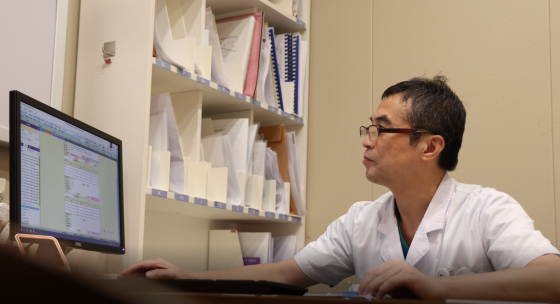
Director Lü Xinzhi of Foshan Chancheng Hospital (Foshan Zen Hosp?) Tumor Precision Diagnosis and Treatment Center
Subsequently, Director Lü received Ms. Gan's skin biopsy results, which confirmed the diagnosis of Bowen's disease.
After thorough communication with the patient and considering her personal wishes and family situation, Director Lü decided to employ radiotherapy, using electron beam irradiation, divided into two parts for the left lower limb.
After Electron Beam Radiotherapy
Lichenification Disappeared, New Skin Grew
The center quickly formed a specialized team with Directors Lu Qiuxia and Lü Xinzhi as the primary physicians, and Head Nurse Cheng Hongying and Nurse Huang Jia as the designated care nurses. For Ms. Gan's case, they meticulously refined and adjusted the radiotherapy plan and nursing care plan.
The final localized radiotherapy plan was determined as follows: Radiotherapy would be conducted in two parts. The first session involved electron beam radiotherapy for the lesions above the knee joint (planned dose 2.75Gy X 24 fractions); the second session involved radiotherapy for the lesions on the left lower leg (planned dose 2.75Gy X 24 fractions).
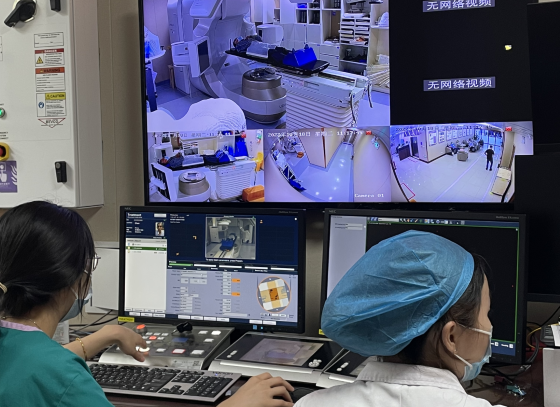
During radiotherapy, due to the skin ulceration and pus, meticulous nursing care was essential to prevent infection and ensure the radiotherapy's effectiveness. The nursing team carefully taught Ms. Gan professional nursing techniques so she could manage simple care at home.
After undergoing the two radiotherapy sessions, the lesions on Ms. Gan's left lower limb were basically resolved. The skin condition improved significantly, with the ulceration and pus markedly disappeared, replaced by new skin. During follow-up visits, she appeared more energetic and her complexion was much rosier.
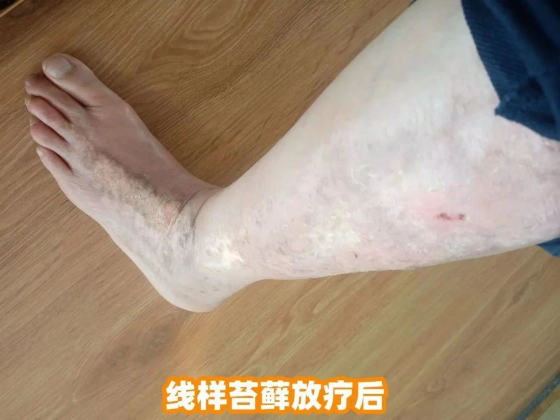
Although Ms. Gan's persistence with active treatment in the later stages laid the foundation for a good prognosis, Director Lü from the Foshan Chancheng Hospital (Foshan Zen Hosp?) Tumor Center still hopes to use this case as a reminder:
When unexplained rashes, itching, or even ulceration appear on the body, it is necessary to seek medical treatment early and not let it develop unchecked. If tumor diseases can be detected early, enabling timely diagnosis and early treatment, patients can be spared the pain of severe disease, avoid missing the best treatment window, and the prognosis can be relatively ideal.
What is Bowen's Disease?
Bowen's disease (BD), also known as squamous cell carcinoma in situ, is a relatively rare cutaneous malignancy, commonly found on sun-exposed skin of middle-aged and elderly patients. It typically presents as erythematous patches with scales or crusts, or slightly elevated plaques.
Bowen's disease can easily be misdiagnosed as eczema. The skin may show slight scaling and crusting, and it can gradually enlarge or merge into plaques. As the disease progresses, symptoms like those experienced by Ms. Gan, such as ulceration, pus, itching, and pain, can appear.
Clinical symptoms: Lesions are usually solitary but can be multiple. They appear as well-defined, dark red patches of varying sizes and irregular shapes, covered with scales or crusts. Removing the crust reveals a moist, uneven erosion. Some lesions may develop verrucous nodules.
Common sites: Lesions can occur on any skin area but are most common on the head and face (about 2/5 of cases) and proximal limbs (about 1/3 of cases). They can also be found on the oral mucosa, conjunctiva, nail bed, vulva, glans penis, anus, urinary tract, etc.
Its etiology is not entirely clear, but it is primarily associated with factors like sun exposure, HPV (papillomavirus), exposure to arsenic, carcinomatous change of pre-existing nevus cells, genetics, and trauma.