
2025-11-13
Case Study: Early-Stage Lung Cancer or Pulmonary Oligometastases
A 65-year-old male patient with esophageal cancer with lung metastases refused surgery due to physical reasons. After learning about the precise radiotherapy technology of Foshan CyberKnife, he sought out the team of Director Lu Qiuxia at the Foshan Fosun Chancheng Hospital Tumor Precision Diagnosis and Treatment Center, which specializes in lung cancer treatment.

Director Lu (center) and Vice President Liu Rong reviewing patient data.
After further evaluating the condition and referencing the consensus of the "Guidelines for Stereotactic Body Radiotherapy for Early-Stage Non-Small Cell Lung Cancer", Director Lu determined that for patients who cannot undergo or refuse surgery, CyberKnife (SBRT) treatment could be used. This approach delivers high-dose radiotherapy to the lung metastases, achieving a tumor-ablative effect comparable to surgical resection.
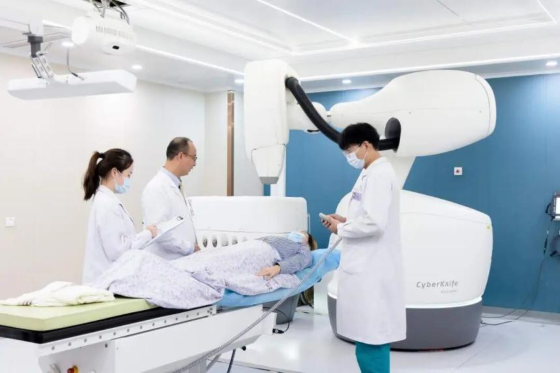
Foshan CyberKnife treatment is relatively comfortable, requiring only lying still.
The treatment does not affect the patient's lung function, safeguarding their normal life and social activities. The treatment process is relatively comfortable; the patient simply lies still on the treatment couch. The CyberKnife can automatically track the tumor lesion, preventing targeting errors caused by respiration.
Subsequently, the patient successfully underwent one course of CyberKnife treatment, with a single fraction dose of 11
Gy, for a total of 5 fractions.
CyberKnife Treatment Plan
Prescription Dose: 11 Gy X 5 Fractions
Prescription Isodose Line: 63%
Radiotherapy Plan:
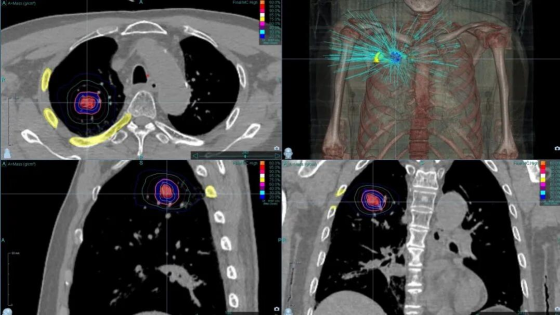
After completing just 5 treatment sessions, the patient's condition improved significantly. A follow-up examination one month after radiotherapy showed the original lung tumor had disappeared.
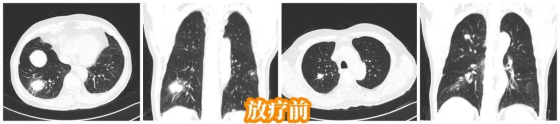
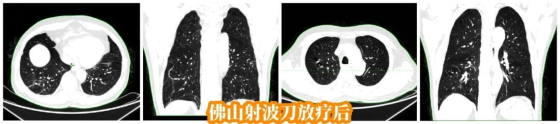
Advantages of CyberKnife for Lung Cancer
CyberKnife is the first and only system that, during tumor treatment, can overcome tumor displacement caused by patient breathing, coughing, or organ movement. It automatically detects and corrects for position, providing continuous real-time tracking and locking onto the tumor lesion, delivering sub-millimeter precision treatment non-stop.

For patients with malignant nodules, surgical resection is an option, but ablative irradiation via CyberKnife is also possible. It is completely non-invasive, especially beneficial for elderly lung cancer patients. Phase III clinical trials have already proven that CyberKnife can achieve treatment standards comparable to surgery.
CyberKnife provides a validated non-surgical option for treating early-stage, inoperable non-small cell lung cancer, tumors in challenging anatomical locations (such as central lung tumors surrounded by sensitive structures and lung tumors near the chest wall), and inoperable peripheral lung tumors.