
2025-11-04
Recently, a special patient visited our department. He is a highly educated individual, a retired Chief Physician of Gastrointestinal Surgery, diagnosed with high-risk prostate cancer. After carefully weighing the pros and cons and considering his personal health condition, he decided to undergo CyberKnife treatment. The treatment proceeded smoothly with good results. He wrote a letter to Professor Han Liangfu and Professor Yang Jun of the Foshan Chancheng Hospital Tumor Precision Diagnosis and Treatment Center's Prostate Cancer Team. This letter, detailed and heartfelt, also deeply moved our tumor center team. With the patient's consent, we are sharing it.
Based on information from the 10th National CyberKnife and International Professional Conference, and through multiple referrals and inquiries, including recommendations from Director Lu Qiuxia, Director Yun Hongyan, Director Lu, and other industry experts, the patient came to know Professor Han Liangfu and Professor Yang Jun. The patient holds great admiration and trust for these two professors, stemming from their thematic reports at these conferences. He earnestly hoped that experts Han and Yang could treat his illness.
Patient's Basic Information:
Male, 78 years old, High-Risk Prostate Cancer, cT2c, N0, M0, Gleason Score 4+4=8 (ISUP Grade Group 4), PSA 11.2 ng/ml. Considering the choice of next treatment step.
Patient's Account
1 After the Prostate Cancer Diagnosis
Nearing eighty and having practiced medicine all my life, upon learning of my prostate cancer diagnosis, my feelings were mixed, yet my thoughts were exceptionally rational.
This disease of mine is one of the most common among middle-aged and elderly men. Prostate cancer is the sixth leading cause of cancer death among Chinese males. In the United States, its incidence even ranks first among male malignancies. After decades of international research, conclusions as early as 1998 indicated that with early diagnosis and treatment, prostate cancer is not fearsome.
I already had numerous health issues: hypertension, diabetes for over twenty years, lacunar cerebral infarction, coronary heart disease, lifelong severe insomnia, Meniere's syndrome, etc.
After retirement, I merely drank tea, took walks, read, practiced calligraphy, and summarized and reflected on the research projects I undertook.

The patient's own calligraphy work
Considering my underlying diseases, age, the series of risks and complications of surgery—no one understands these better than me, an old surgeon who spent his entire career in a top-tier hospital—I hesitated repeatedly about radical prostatectomy surgery.
Why was I so conflicted? What treatment method should I ultimately choose?...
2 I Decided on CyberKnife Treatment
Starting this Spring Festival, because of my illness, multiple family gatherings turned into family meetings, all discussing the choice of treatment method.
Several family members are gynecologists or surgeons, and my wife is a pathologist. Opinions differed, leading to intense debates and arguments, but they were all genuinely concerned for my well-being. This highlighted both the limitations of perspectives from doctors in different specialties regarding prostate cancer specifics, and the priceless value of family affection. Having them wholeheartedly advise me, I felt immensely gratified. This life is worth it!
Finally, with my family's support, I made the following decisions:
Rule out surgery.
Use Androgen Deprivation Therapy (ADT), planned for 2-3 years.
Seek treatment from the Foshan Chancheng Hospital Tumor Precision Diagnosis and Treatment Center Prostate Cancer Specialist Team: treated primarily by Professor Han Liangfu, with quality control by Professor Yang Jun, puncture localization and marking by Director Lü Xinzhi, and joint treatment by Director Lu Qiuxia and Dr. Li Sida.
Adopt the Foshan CyberKnife SBRT (Stereotactic Body Radiotherapy) hypofractionated regimen: 7.25Gy x 5 fractions (8Gy x 5 fractions to the tumor site).
As a surgeon myself, ultimately not choosing surgery may puzzle many, but this was the result of my meticulous, 'comparison-shopping' approach to selecting both the treatment method and the treatment team.
On one hand, I held a deep-seated obsession and hope: I wished that regardless of the treatment, it could buy me a few more years to complete the project I'm currently working on. Time is extremely precious to me; this project embodies decades of my effort. Stopping it abruptly would be a lifelong regret...
On the other hand, CyberKnife radiotherapy, compared to surgery, carries smaller risks, requires no incision or anesthesia, and its effectiveness is not inferior to surgery. This was a treatment method acceptable to both my mind and body. Incidentally, the name "CyberKnife" refers to its radiation effect being as precise as a scalpel, but without actual cutting.
3 Why I Chose Foshan CyberKnife
My Considerations
During this period, my family, relatives, classmates, mentors, and friends all offered advice and assistance. After comprehensively comparing various options, I chose Foshan CyberKnife.
Specialization matters. I consulted many urology experts. While none explicitly stated I was contraindicated for surgery, they recommended a cardiovascular evaluation, potentially placing a cardiac stent, requiring stabilization for half a year or a year before radical prostatectomy surgery. For me, this approach firstly caused delay, and secondly, even with a cardiac stent, the risks of cerebrovascular accident and surgical site bleeding remained high.
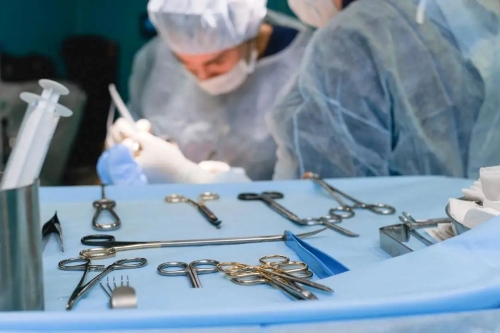
Secondly, my family and I reviewed many specialized texts, professional literature, and diagnostic and treatment guidelines. According to the 2018 and 2022 Chinese Prostate Cancer Treatment Guidelines, for localized prostate cancer, two key treatment methods are specifically mentioned: radical external beam radiotherapy and radical surgery. Comparing the two, the ten-year survival rate and biochemical recurrence-free rate show no difference; this greatly contrasts the common perception in China that radiotherapy is less effective than surgery! The guidelines indicate that SBRT radiotherapy can be used for both intermediate-risk and high-risk groups, differing only in the duration of concomitant ADT.
Regarding my pathological grade, although there were differing conclusions, the risk level happened to fall between intermediate and high risk. Fortunately, however, the guidelines show that for localized prostate cancer without extracapsular extension, whether intermediate or high risk, the radiotherapy regimen is the same: SBRT combined with ADT, except that high-risk requires 2-3 years of ADT, while intermediate-risk only requires 4-6 months.
At this point, I had largely made up my mind. The next step was finding a hospital with excellent radiotherapy technology, requiring further consultation.
Without delay, I promptly sought consultations through classmates, friends, and relatives: first, visiting the director in charge of prostate cancer treatment in the Radiotherapy Department at Sun Yat-sen University Cancer Center; and also visiting and consulting the team at the Foshan Chancheng Hospital Tumor Precision Diagnosis and Treatment Center. The former developed a linear accelerator-based 5-fraction hypofractionated radiotherapy plan for me. The latter, Professor Yang Jun, Director of the Tumor Center, recommended two options for my consideration:
Option One: Use CyberKnife for 5-fraction hypofractionated radiotherapy, without irradiating the pelvic lymph node drainage area. This is essentially similar in principle to the linear accelerator 5-fraction plan from Sun Yat-sen University Cancer Center, but CyberKnife offers greater precision.
Option Two: Use a linear accelerator for 25 fractions irradiating the prostate and pelvic lymph node drainage area, combined with CyberKnife delivering 3 fractions to the prostate/seminal vesicle lesion.
Upon understanding the details, my first reaction was that my body couldn't withstand 28 fractions of radiotherapy. By comparison, Option One seemed good, especially as it coincided with an idea I had just the day before!
The day before, I had visited the prostate cancer team experts in the Radiotherapy Department at the Chinese Academy of Medical Sciences Cancer Hospital, Shenzhen Hospital. I presented my thoughts, expressing great concern about hematogenous metastasis; hoping to save time by first focusing on treating the primary lesion, temporarily leaving the pelvic lymph nodes aside... After studying this, the team replied two days later: "This idea has merit." Therefore, I leaned more towards Option One proposed by Dr. Yang.
On one hand, considering that Shenzhen's CyberKnife was newly introduced and not yet fully operational, and on the other hand, considering that Professor Yang Jun, a returnee, had over 20 years of experience practicing CyberKnife therapy in the United States, with a renowned reputation, serving as quality control director for CyberKnife at over thirty hospitals in North America; coupled with Foshan introducing the latest sixth-generation CyberKnife; plus another returnee, Professor Han Liangfu, former President of Boao International Hospital, specializing in radiotherapy for prostate and breast cancer.
These two returnee scholars, Professor Yang Jun and Professor Han Liangfu, have gathered multiple domestic and international disciplinary oncology experts, imaging/puncture localization/marking experts, radiation physicists, and therapists; they personally established a strong professional team, ranking among the top domestically!
If I chose treatment in Foshan, I could also avoid the difficulties of being unfamiliar with another city. It wouldn't require hospitalization; I could return home after each treatment, which suited me very well.
Option One, the 5-fraction hypofractionated regimen proposed by Professor Yang, is relatively advanced domestically. Currently, in the US, the tendency is also towards not irradiating the pelvic lymph node drainage area. This aligns with the Sun Yat-sen University Cancer Center's linear accelerator 5-fraction plan, and also with the idea supported by the experts I consulted in Shenzhen. This convergence from four aspects suited my age and physical condition well, promising fewer side effects.
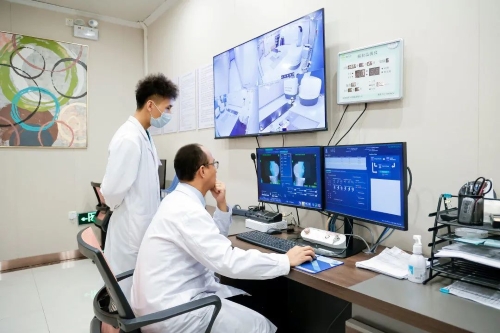
Dr. Yang Jun's quality control of the CyberKnife treatment plan.
Professor Han Liangfu from the Foshan Chancheng Hospital Tumor Precision Diagnosis and Treatment Center has long been deeply involved in the diagnosis and treatment of prostate cancer, especially skilled in the full-process management of prostate cancer, thoroughly grasping the essence of multidisciplinary diagnosis and treatment from high-level US cancer centers. Learning of my concerns, he repeatedly calculated using the MSKCC (Memorial Sloan Kettering Cancer Center, ranked #2 in cancer care) pre-prostatectomy prediction formula: probability of extracapsular extension 90%, probability of pelvic lymph node metastasis 51%, probability of seminal vesicle invasion 55%.
Based on such high probability data, Professor Han's recommendation for the linear accelerator 28-fraction plan was very comprehensive and responsible, potentially alleviating my concerns about the high risk. However, I had many factors to balance, especially my high sleep requirements preventing inpatient treatment. Therefore, I ultimately firmly chose the CyberKnife 5-fraction hypofractionated plan.
Professor Han understood my perspective. With a doctor's compassion and openness, he agreed to proceed with the CyberKnife plan for my radiotherapy, while also proposing genetic analysis methods to prepare for potential subsequent chemotherapy or immunotherapy for recurrence prevention. This plan can be considered comprehensive! With such a preparatory strategy, what reservations could I possibly have?
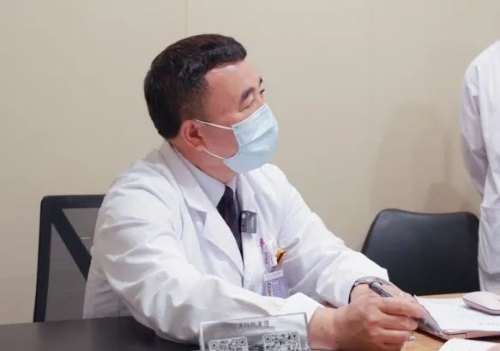
Professor Han Liangfu during the consultation process.
This was my thought process leading to the final decision to undergo CyberKnife treatment at the Foshan Chancheng Hospital Tumor Precision Diagnosis and Treatment Center. I am fully aware that besides tumor recurrence and metastasis, factors like hypertension, diabetes, cerebral infarction, and fractures caused by ADT can also be life-threatening. These competing risks of death cannot be eliminated!
Therefore, no matter what, no one can live forever. As they say, the length of one's life is not solely determined by heaven; the blessing of proper care can "prolong" one's years.
Being able to receive radiotherapy close to home, with less suffering, no hospitalization, and the ability to return home, satisfies me greatly.
4 Post-Treatment, Normal Indicators
I Feel Happy and Energetic
The treatment process was quite smooth: Five CyberKnife sessions within seven days, each requiring only lying still for about half an hour as arranged by the doctors. Apart from the pre-existing urinary urgency and frequency, after radiotherapy, I experienced reactions like painful urination and fatigue, but the pain disappeared after half a month, and then things gradually returned to normal.
Now, one month post-treatment, my various indicators have normalized. For example, the Prostate-Specific Antigen (PSA), which was 11.27 at diagnosis, has now dropped to 0.01 after treatment, below the standard for biochemical recurrence-free status.
Currently, my life is as before: walking, drinking tea, practicing calligraphy. Especially, I can continue my project research; the previous anxiety has swept away! I feel happy and energetic!
With such ideal results, how could I forget the shock, dismay, regret, anxiety, and sorrow felt upon diagnosis on March 9th—that complex mix of emotions?!
In this moment of phased success and joy, reflecting on the cause and effect, the most important factors are: benefiting from the unit's annual health check-ups, especially the PSA screening for the elderly, and resolutely relying on the elite team of doctors and nurses at the Chancheng Hospital Tumor Precision Radiotherapy Center!
Of course, it's also related to my personal character of being open to learning, willing to research, thoughtful, deliberate, resolute, and decisive; and also related to the collective wisdom, sincere enthusiasm, timely assistance, and help in time of need from relatives, classmates, teachers, friends, and colleagues!
The combined effect of these factors allowed me to enjoy internationally first-class medical outcomes right at my doorstep. Lacking any one element, today's outcome wouldn't be possible!
5 Two Points of Praise
Praise One:
The Chancheng Precision Radiotherapy Center has established an International Multidisciplinary Team (MDT) remote consultation platform. Every Tuesday, senior clinical doctors and physicists from multiple disciplines in both China and the US hold joint online consultations to discuss complex cases!
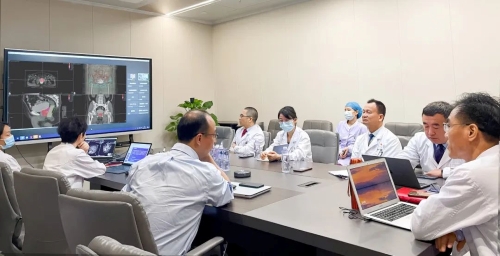
International MDT consultation session.
I find this highly admirable! Should my condition change or become complex in the future, right at my doorstep, without needing to seek far, I can again access world-class diagnostic and treatment services!
Praise Two:
To address doubts and questions for me and my family, the center also established a WeChat consultation group including the attending doctor and multiple experts. This is a very important innovation.
Imagine, even for me, an old doctor, the process of seeking medical opinions, choosing methods and teams over two months was so tortuous. If it were an ordinary patient, how difficult this path would likely be! Patients and families lack medical knowledge and need timely education; this group chat is extremely important!
As for cumbersome medical insurance procedures, communicating with Head Nurse Cheng Hongying in the group quickly led to solutions. For elderly patients like me, while mobile phone payments avoid queues, they are troublesome to operate. Also in the group, the assigned nurse Wu Dan handled it, making it very convenient!
These two innovations enable full communication between doctors and patients, multidisciplinary exchange among doctors, avoiding working in silos. In the fight against cancer, this threat to human health, striving for consensus is very, very beneficial!
The best policy: Etiological prevention!
Early diagnosis & treatment: Optimal strategy;
Mid-stage diagnosis & treatment: Race against time;
Late-stage diagnosis & treatment: Avoid detours.
Undoubtedly, the Chancheng Hospital Tumor Precision Radiotherapy Center, with its such advanced and exquisite technology, thoughtful and meticulous service, and satisfactory humanistic care, is bound to benefit a vast number of cancer patients!
Our entire family is sincerely grateful and will remember this in our hearts!
6 Outlook
Practice is the sole criterion for testing truth. The long-term outcome ultimately depends on what practice reveals.
Hereafter, I need to continue ADT treatment, persist with regular check-ups, always monitor and address any changes in my condition, and hope for the long-term efficacy reported in the literature.