
2025-11-04
Central Lung Cancer
Central lung cancer originates in the area from the segmental bronchi to the main bronchi, near the lung hilum. The main types of central lung cancer include squamous cell carcinoma, small cell lung cancer, and adenocarcinoma, among which squamous cell carcinoma and small cell lung cancer are more common. These types are relatively sensitive to radiotherapy and chemotherapy, but the prognosis is often relatively poor.
How is Central Lung Cancer Treated?
1. Surgical Treatment
For early-stage and some mid-stage patients, surgery is the primary treatment option. Surgical methods include lobectomy, sleeve lobectomy, pneumonectomy, etc., accompanied by lymph node dissection.
2. Radiotherapy and Chemotherapy
Radiotherapy is suitable for postoperative adjuvant therapy, locally advanced cases where surgery is not possible, and for palliating symptoms in advanced stages. Chemotherapy is used as neoadjuvant therapy before surgery, postoperative adjuvant therapy, or as palliative treatment for advanced patients.
3. Molecular Targeted Therapy
If the tumor has specific genetic mutations, molecular targeted therapy provides a more precise treatment approach.
4. Immunotherapy
Immunotherapy works by activating the patient's own immune system to fight the tumor, offering a new treatment option for patients with advanced lung cancer.
Treatment Efficacy for Central Lung Cancer
The survival rate for central lung cancer is closely related to the pathological type, stage, and treatment method. Patients diagnosed early and treated promptly have a better prognosis and a higher 5-year survival rate. For advanced patients, although treatment is more challenging, multidisciplinary comprehensive therapy can still prolong survival and improve quality of life.
Below is a follow-up record of an advanced central lung cancer case treated with CyberKnife.
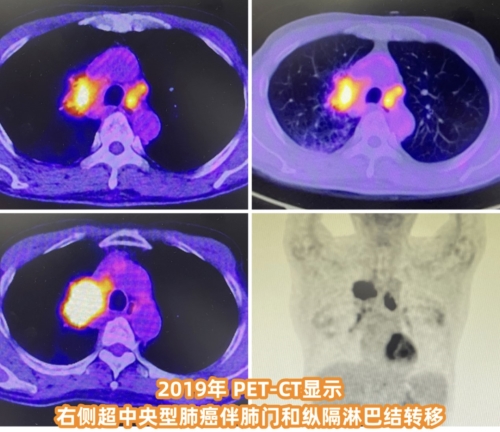
71-year-old Mr. Li (a pseudonym) underwent a lung CT scan due to a persistent cough, which revealed a tumor in his right lung. A PET-CT scan indicated central-type lung cancer in the right upper lobe with bilateral hilar and mediastinal metastasis; the pathology was non-small cell lung cancer. Mr. Li's daughter, Xiao Li (a pseudonym), head of a department at a local hospital, understood deeply what this report meant. Consequently, she sought opinions from several renowned hospitals with her father's medical records, but the responses were almost unanimous: advanced lung cancer, inoperable, limited to chemotherapy and radiotherapy, with a limited survival period.
Feeling helpless but unwilling to give up easily, Xiao Li learned by chance that Professor Wang Enmin, also an alumnus, specialized extensively in CyberKnife tumor treatment in Shanghai. After some effort, she contacted Professor Wang. Upon learning that lung cancer could also be treated with CyberKnife, she went to Shanghai for a consultation without hesitation.
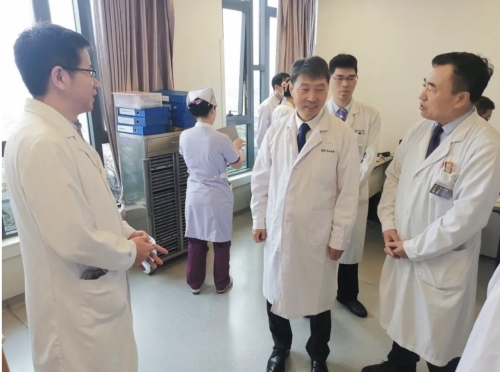
Professor Wang detailed how CyberKnife treats lung cancer and its unique advantage of automatically tracking tumors. He also shared considerable experience using special techniques combining CyberKnife with targeted drugs for lung cancer patients without genetic mutations. Following high-dose CyberKnife irradiation, approximately 20% of tumor cells become sensitive to targeted drugs. Therefore, the combination of CyberKnife and targeted therapy has yielded surprisingly good results in treating lung cancer without gene mutations.
After carefully studying Mr. Li's medical records, Professor Wang provided a professional and encouraging prediction: he was confident in treating the central lung cancer and, based on past experience, believed Mr. Li could survive for at least 5 years. This assessment instantly boosted Xiao Li's confidence.
Although somewhat skeptical, given most experts predicted only 1-2 years survival, and considering Mr. Li's strong resistance to chemotherapy, radiotherapy remained their only viable option. After repeatedly weighing the pros and cons, Xiao Li decided to proceed with the CyberKnife treatment plan.
Professor Wang devised an ingenious CyberKnife plan for Mr. Li: first, irradiate the tumor area with a larger field, then narrow the focus for precise irradiation. Additionally, following CyberKnife treatment, oral targeted drugs (Tarceva or Tagrisso) would be administered.
The CyberKnife treatment process proceeded exceptionally smoothly, with Mr. Li experiencing almost no severe side effects. He did experience a period of worsened coughing after the treatment, but this symptom quickly resolved with combined hormone and antibiotic therapy. After taking oral targeted drugs for about a month at home, he discontinued them due to significant side effects and switched to Traditional Chinese Medicine for regulation.
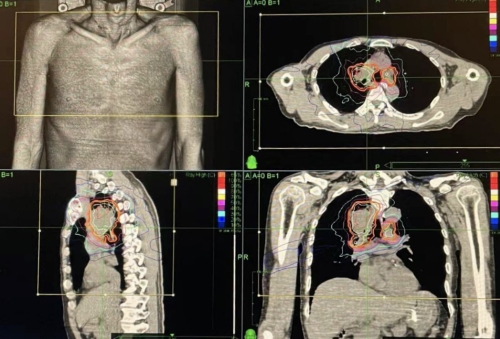
2019 CyberKnife Treatment Plan Diagram: Simultaneous CyberKnife treatment of the right lung cancer and lymph nodes. A larger field was irradiated for 5 sessions, followed by a narrowed field for 4 sessions. The patient experienced mild coughing symptoms after CyberKnife treatment.
Time passed quickly. By June 2021, a follow-up PET-CT scan showed that the irregular nodule near the hilum of the right upper lobe had become blurred, with surrounding cord-like high-density shadows visible. The metabolic activity of the tumor was extremely low. All indications pointed to one conclusion: the tumor was dead! The lymph node metastases had also completely disappeared!
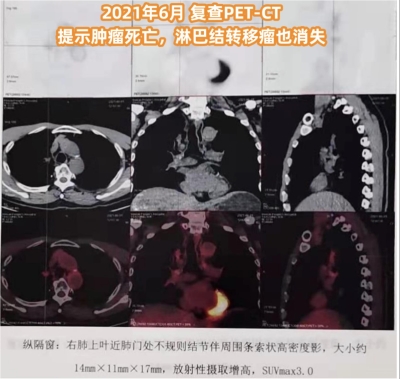
Xiao Li was moved to tears, knowing this was a great victory brought by CyberKnife treatment. Mr. Li, as if reborn, not only successfully weathered the challenge of COVID-19 in 2022 but also lived a life no different from a healthy person.
During a check-up in September 2024, a lung CT indicated a slight increase in the tumor size, causing Xiao Li's heart to sink again. Professor Wang reviewed the report and recommended a PET-CT scan, which revealed it was a false alarm: The original tumor and hilar lymph nodes were already dead, showing very low FDG metabolism. The new nodule in the right lung was just a benign small nodule with low metabolic activity.
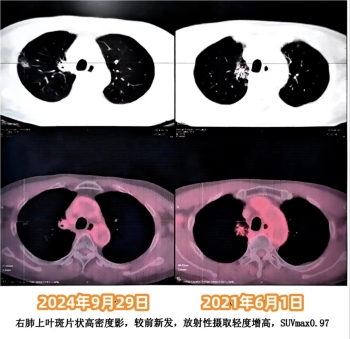
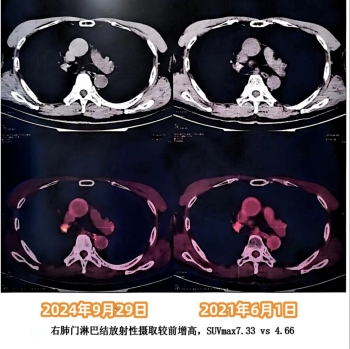
Furthermore, Mr. Li was in very healthy condition, completely asymptomatic, showing no signs of being a lung cancer patient. The plan was to closely observe the right lung nodule and repeat a lung CT scan in 3 months.

Professor Wang's Commentary
Elderly central lung cancer with hilar and mediastinal lymph node metastasis, especially when lacking genetic mutations, is a difficult-to-treat cancer. Although chemotherapy combined with immunotherapy and radiotherapy is an option, the side effects for elderly patients are often significant, and survival periods tend to be short.
The advent of CyberKnife has revolutionized the treatment of various lung cancers. Through low-dose, multi-fraction, staged irradiation, CyberKnife reduces radiation damage to the trachea. By increasing the dose within the tumor to kill cancer cells, and combined with TCM regulation, it has achieved remarkable efficacy.
We adopt personalized treatment plans for central lung cancer. One patient has maintained high-quality survival for 12 years and is currently in very good condition, and another patient has also achieved high-quality survival for 8 years.