
2026-02-10
At the start of 2026, the Department of Respiratory Medicine and Endocrinology at Guangdong Pharmaceutical University Guangzhou Fuxing Chancheng Hospital (Guangzhou Xinshi Hospital) actively responded to the hospital's call for high-quality development, designating this year as a "Year of Deepening Learning and Technological Breakthrough." While continuing to strengthen core competencies in critical care ultrasound, continuous renal replacement therapy, pulmonary rehabilitation, advanced ventilatory support, bronchoscopic interventions, and chronic disease management, the department has also boldly expanded its diagnostic and therapeutic boundaries. Recently, it successfully took the lead in performing transcatheter arterial chemoembolization for tumors, offering additional minimally invasive treatment options for oncology patients with complex underlying cardiopulmonary conditions. This marks a solid step forward in the department's comprehensive diagnostic and therapeutic capabilities for respiratory system-related tumors.
Recently, with strong support from the Interventional Radiology Department, the team successfully performed highly difficult transcatheter arterial chemoembolization for two elderly patients with head and neck tumors complicated by multiple severe underlying diseases, earning high praise from both patients and their families.
Multidisciplinary Collaboration Overcomes Challenging Oral Cancer in an Elderly Patient
Ms. Chen, a 73-year-old patient, had suffered from oral cancer for two years. Due to tumor progression, she was unable to eat and was in poor nutritional status, with recurrent pneumonia. She had previously undergone endotracheal intubation and mechanical ventilation at another hospital due to heart failure and respiratory failure—a testament to the complexity and severity of her condition. This time, she was admitted to our department with a 20-day history of cough and productive sputum. After her pulmonary infection was controlled, her family expressed an urgent desire for oral cancer treatment. The Respiratory and Endocrinology team did not retreat; instead, they promptly initiated a multidisciplinary consultation mechanism and invited Dr. Huang Xuxin, Director of the Interventional Radiology Department, for an emergency consultation.
With a strong sense of responsibility and extensive experience, Dr. Huang conducted a comprehensive assessment of the patient's cardiac insufficiency, arrhythmia, and overall condition. He concluded that interventional therapy was a feasible approach to control the tumor and improve quality of life. After thorough communication with the Respiratory and Endocrinology team and meticulous perioperative planning, Dr. Huang personally performed the procedure. Leveraging his exceptional technical skills and steady operative technique, he successfully completed the transcatheter arterial chemoembolization for Ms. Chen.
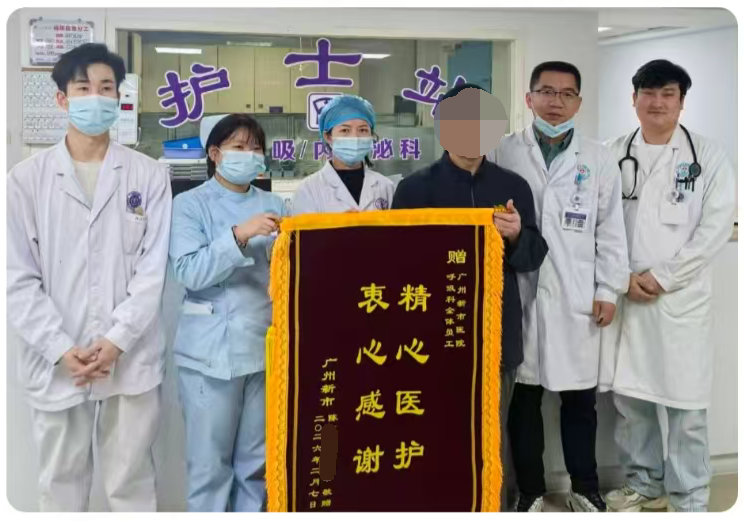
The procedure went smoothly. Postoperatively, the tumor's blood supply was effectively occluded, and the patient experienced only minimal adverse reactions. Her family was deeply grateful and specially presented a banner to express their appreciation to Dr. Huang and the entire Respiratory and Endocrinology team for their comprehensive and meticulous management throughout the process.
Precision Technique Relieves Airway Compromise in a Patient with Laryngeal Cancer
Mr. Shao, a 78-year-old patient with laryngeal cancer, had also endured a two-year course of illness. Although he had previously undergone surgical resection, the tumor recurred and progressively enlarged, severely compressing his airway and necessitating a tracheostomy. He had suffered long-term distress and had been repeatedly admitted to our department for recurrent pneumonia. When his family expressed a strong desire for active anti-tumor therapy, Dr. Huang Xuxin of the Interventional Radiology Department once again stepped forward without hesitation.
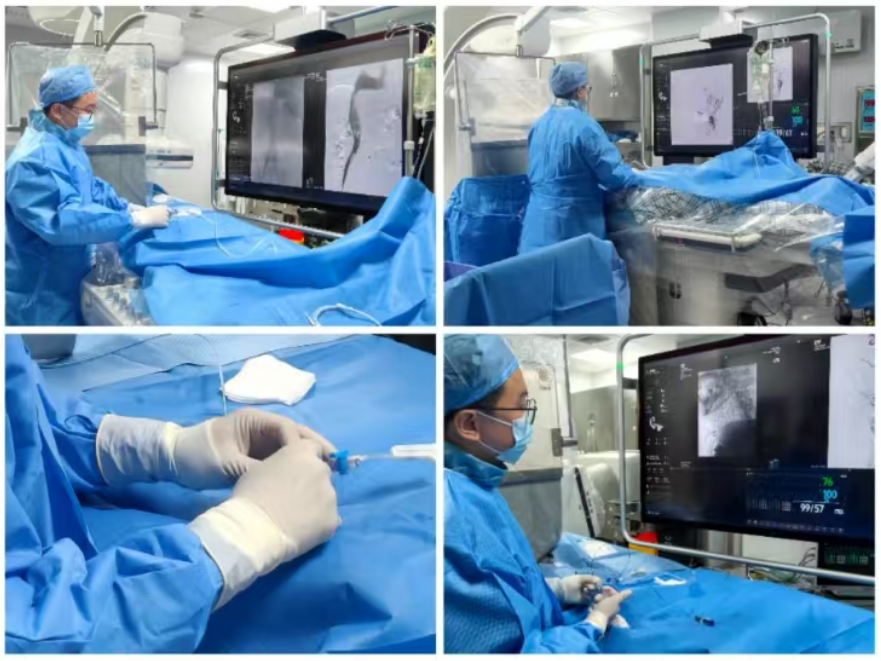
Confronted with challenges including complex tumor vascular supply, proximity to critical structures, and the patient's compromised airway, Dr. Huang demonstrated exceptional professionalism and a spirit of accountability. He meticulously planned the procedural approach and, under imaging guidance, performed precise chemoembolization of the tumor's feeding arteries. The critical moments of the procedure lay in the superselective catheterization of the target vessels and the precise delivery of embolic agents—achieving maximal tumor devascularization while preserving surrounding normal tissues. The procedure was a complete success, securing a valuable opportunity for subsequent treatment and significantly improving the patient's quality of life. His family expressed sincere and heartfelt recognition.
A Milestone in Multidisciplinary Integration and Commitment to Excellence
The successful completion of these two high-difficulty procedures not only brought renewed hope to the patients but also greatly inspired the entire Respiratory and Endocrinology team. It fully demonstrates the department's robust capabilities in comprehensive assessment, perioperative management, and multidisciplinary collaboration when managing complex oncological cases superimposed on respiratory diseases.
More importantly, it exemplifies the courage, accountability, and surgical excellence of Dr. Huang Xuxin from the Interventional Radiology Department, as well as the seamless collaboration and team spirit shared between our two departments. Despite the patients' numerous underlying conditions and extremely poor cardiopulmonary reserve, the two departments worked in close coordination—rigorous preoperative evaluation and optimization, and stable intraoperative performance—ensuring the safety and success of both procedures. This stands as a model of effective multidisciplinary teamwork.
The successful introduction and implementation of transcatheter arterial chemoembolization for tumors represents a significant achievement in the department's implementation of the 2026 "Year of Learning" plan, the strengthening of disciplinary development, and the expansion of its diagnostic and therapeutic scope. It not only lays a solid foundation for our department in the field of minimally invasive interventional therapy for lung cancer and other respiratory system-related tumors but also injects renewed vitality into the hospital's efforts to enhance its tertiary hospital connotation and promote the development of PCCM.
Looking ahead, the Department of Respiratory Medicine and Endocrinology will continue to uphold the spirit of "learning, innovation, collaboration, and dedication." It will deepen cooperation with fellow departments, continuously introduce and optimize advanced diagnostic and therapeutic technologies, and strive to provide higher-quality, more standardized medical services to an increasing number of critically and complexly ill patients—contributing to the hospital's high-quality development.