


Profile
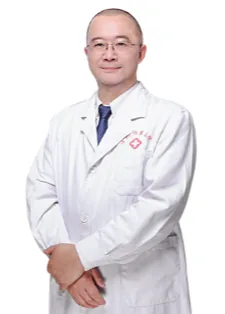
Dr. Tang Changjiang is one of the experts in Shenzhen who has performed a high volume of thyroid nodule ablation surgeries. He is also one of the pioneers in China to systematically perform a significant number of near-total ablation surgeries for hyperthyroidism. He has successfully completed nearly 2,000 minimally invasive ablation procedures for thyroid and breast conditions and possesses over ten thousand instances of precision puncture operation experience. Dr. Tang is a leading figure in hyperthyroidism ablation therapy in China and was the lead author and developer of the Chinese "Expert Consensus and Operational Guidelines for Hyperthyroidism Ablation Therapy." He also serves as the lead lecturer for the hyperthyroidism ablation specialization training program on standardized ablation therapy under the Chinese Medical Doctor Association.
Positions
· Committee Member, Tumor Ablation Expert Committee, Chinese Society of Clinical Oncology (CSCO)
· Committee Member, Tumor Ablation Professional Committee, Chinese Anti-Cancer Association
· Committee Member, Ablation Branch, Committee on Tumor Minimally Invasive Interventional Therapy, Chinese Anti-Cancer Association
· Committee Member, Committee on Minimally Invasive Treatment and Multidisciplinary Comprehensive Treatment of Liver Cancer, Chinese Anti-Cancer Association
· Standing Committee Member, Committee on Tumor Minimally Invasive Interventional Therapy, Guangdong Chapter, Chinese Anti-Cancer Association
· Standing Committee Member, Professional Committee on Minimally Invasive Tumor Therapy, Haixi District, Cross-Strait Medical and Health Exchange Association
Speciality
Hyperthyroidism, thyroid nodules, and pinhole-level ultra-minimally invasive ablation surgery for thyroid cancer.
Characteristic Techniques:
1. Routinely performs one-time large-scale near-total microwave ablation of both thyroid lobes and the isthmus for primary hyperthyroidism, eliminating the need for multiple sessions.
2. Routinely performs minimally invasive ablation surgeries for thyroid nodules (including adenomas and cysts) and micro thyroid cancers, allowing patients to be operated on and discharged on the same day.
3. Routinely performs near-total ablation surgery for severe (Grade III) hyperthyroidism.
Recently, the Chinese "Expert Consensus and Operational Guidelines for Thermal Ablation Therapy of Primary Hyperthyroidism (2022 Edition)," led and authored by Tang Changjiang and his minimally invasive interventional therapy team, with Professor Fan Weijun and Professor Xu Dong as corresponding authors, was officially published in the Chinese Journal of Internal Medicine. This document represents the condensed culmination of years of experience in minimally invasive ablation therapy for thyroid diseases by Tang Changjiang's team and is the first edition of its kind in China.
From first encountering minimally invasive ablation therapy to leading and drafting the expert consensus and operational guidelines for hyperthyroidism ablation, Tang Changjiang and his team have journeyed nearly 10 years.
In 2014, Dr. Tang Changjiang received an opportunity to visit and study minimally invasive ablation therapy at the Chinese People's Liberation Army General Hospital (301 Hospital). At that time, the focus was predominantly on ablation therapy for liver cancer, lung cancer, and uterine tumors. Ablation therapy for thyroid nodules was just beginning, and ablation for hyperthyroidism was still in its infancy. With a solid surgical foundation, he resolved to deeply engage in the field of minimally invasive ablation therapy.
In 2015, upon returning from his studies, Tang Changjiang led his team in Shenzhen to begin microwave ablation therapy for thyroid diseases. Starting with specialized techniques for minimally invasive ablation of thyroid adenomas (benign nodules), cysts, micro papillary carcinoma, and related conditions, and with advancements in ablation equipment and accumulated experience, he gradually began specializing in ablation therapy for hyperthyroidism.
At the time, the industry believed ablation was not ideal for treating hyperthyroidism. Tang Changjiang redesigned and developed a method for near-total thyroid ablation for hyperthyroidism from a surgical perspective, overturning the previous conclusion that inadequate ablation range led to poor outcomes and redefining the efficacy of near-total thyroid ablation for hyperthyroidism.
Director Tang Changjiang explained: "Minimally invasive ablation therapy for hyperthyroidism involves planned complete ablation referencing the extent of near-total surgical removal of hyperthyroid gland tissue, aiming to achieve a therapeutic effect that avoids both hyperthyroidism and hypothyroidism." After years of research and follow-up, he confirmed that this treatment method is minimally invasive, features short procedure time, no bleeding, and no surgical scars. This new treatment offers a new option for many hyperthyroidism patients who fear traditional surgery or are ineligible for it.
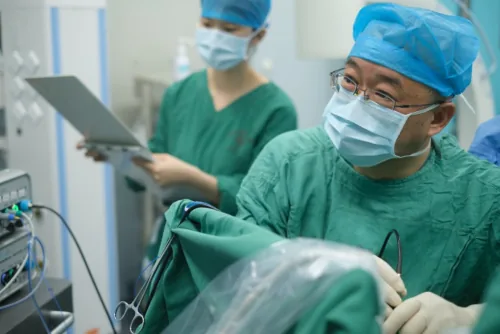
Tang Changjiang, Director of Thyroid and Breast Surgery and Minimally Invasive Interventional Department at Shenzhen Hengsheng Hospital, performing an ablation surgery.
In April this year, a patient from Yinchuan City, Ningxia, sought out Director Tang Changjiang. Having suffered from hyperthyroidism for 10 years, she had sought treatment at several local Grade III Class A hospitals. Some hospitals recommended traditional open bilateral subtotal thyroidectomy, while others suggested iodine-131 therapy. However, traditional surgery is highly invasive and carries risks of hypothyroidism, triggering thyroid storm, nerve damage leading to hoarseness, coughing while drinking water, and other complications. Iodine-131 therapy has a high probability of resulting in hypothyroidism and also carries a risk of recurrence. She wished to avoid both options. In recent years, as her neck swelling became increasingly pronounced and was accompanied by Graves' eye disease (exophthalmos), her anxiety grew. After extensive consultation, she learned that Director Tang Changjiang at Shenzhen Hengsheng Hospital performs microwave ablation for hyperthyroidism—using an ablation needle less than 2mm to insert into the thyroid tissue, inactivating the tumor in situ, acting as a "needle" instead of "knife," with no post-operative scarring and quick recovery. The patient immediately flew specially from Ningxia to Shenzhen for Director Tang's microwave ablation procedure.
Director Tang developed a comprehensive plan for her, and the surgery took less than an hour. Post-operatively, the patient was delighted to see her significantly reduced neck swelling. Due to the minimal damage from the minimally invasive surgery, the patient could eat, get out of bed, and call her family on the same day as the surgery. A friend joked, "You don't look like someone who just had surgery at all!"
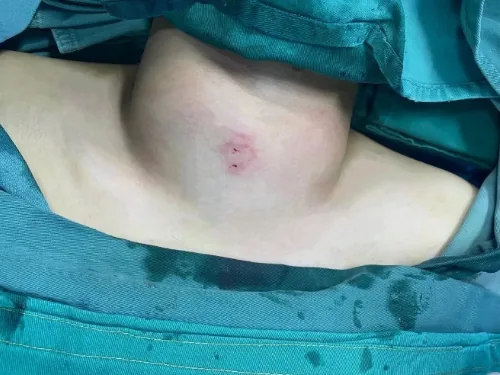
Immediate post-operative view of the patient's wound.
Transitioning from traditional surgery to minimally invasive intervention, throughout his 40-year clinical career, Tang Changjiang has embodied the essence of a "medical innovator" through his actions. Today, he remains active in the operating room, at academic forums, and in science education live streams, continuing to write the legend of "medical marvels on the tip of a needle."