2026-07-31
Aggressive pituitary tumors demonstrate resistance to standard therapies (surgery and radiotherapy) and are divided into two broad categories. They may remain confined to the skull base and cause morbidity through locally destructive behavior, or they may metastasize, in which case they are termed pituitary carcinomas. Owing to their locally destructive behavior, aggressive pituitary adenomas can lead to disability. From a mass‑effect perspective, these tumors cause symptoms by triggering headaches—often migraine or trigeminal autonomic cephalalgias—and cranial neuropathies. Through suprasellar extension, they may produce classic bitemporal hemianopia or asymmetric binocular visual loss due to eccentric compression of the optic chiasm/optic apparatus. In addition, locally invasive pituitary tumors can impair monocular vision from unilateral optic nerve compression. Diplopia is another frequent complication of aggressive growth through the cavernous sinus affecting cranial nerves III, IV, and VI. Besides causing eye depression and abduction deficits, dysfunction of cranial nerve III leads to pupillary dilation and ptosis, which can progress to complete eyelid closure and loss of visual function. V1 and V2 are also located within the cavernous sinus, so numbness and paresthesia may occur in the upper two‑thirds of the face, although this is typically a late manifestation.
Aggressive pituitary tumors should be detected early, and a tailored treatment plan should be outlined. In most cases, we tend to consider early repeat surgery with the aim of maximizing safe tumor resection—to achieve long‑term visual preservation in non‑functioning adenomas and biochemical remission in functioning adenomas. Whenever possible, the goal is to preserve normal pituitary function and avoid radiotherapy, thereby reducing the long‑term incidence of hypopituitarism and minimizing radiation exposure. Patients often tolerate repeat surgery better than conventional fractionated radiotherapy. In most non‑functioning adenomas, the recurrence rate is low and the recurrence‑free interval is relatively long, so surgery may be deferred until obvious regrowth is observed.
Considering the low cure rates of non‑surgical treatment for functioning adenomas (except for prolactinomas), repeat surgery offers a better chance of endocrine remission. Residual tumor should be targeted using thin‑slice MRI and (functional) PET imaging, and an extended approach should be used if necessary to achieve remission. If reoperation fails or there is no evidence of residual tumor on imaging, stereotactic radiosurgery (SRS) may be considered.
Aggressive pituitary tumors often require multimodal treatment and repeated salvage interventions. Temozolomide may be increasingly used, and earlier in the disease course. However, surgery plays a key role in reducing tumor burden and preserving neurological function, although repeat pituitary surgery remains challenging.
A Case Example from an INC French Professor
A 37‑year‑old French woman was found to have a 9‑mm centrally located pituitary adenoma within the sella turcica. She underwent an endoscopic endonasal single‑nostril resection using the now‑popular "chopsticks technique" with a neuroendoscope, which allowed complete tumor removal. She is currently undergoing relevant endocrine therapy. Three years after surgery, there is no sign of recurrence and no other complications.
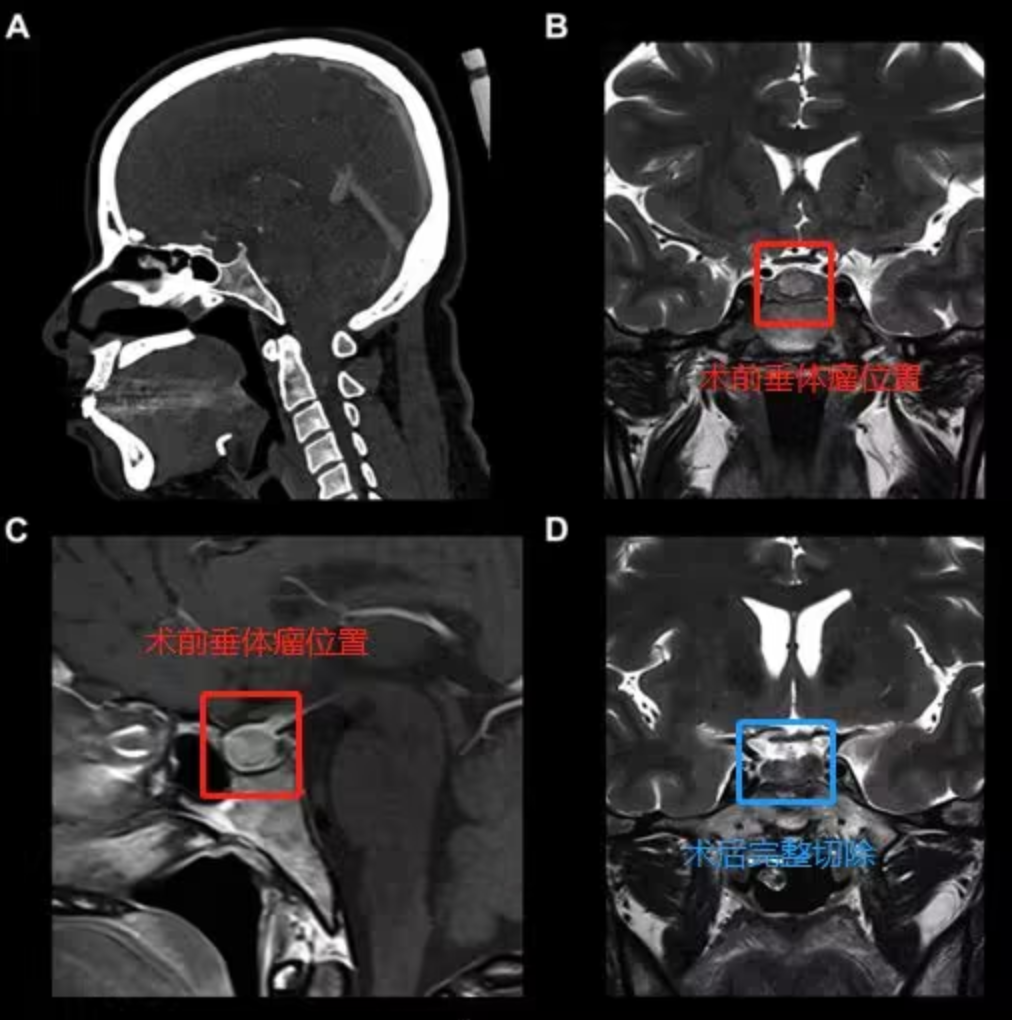
Preoperative (red areas): A and C show a 9‑mm pituitary microadenoma in the center of the sella. B indicates computed tomography showing perisphenoidal pneumatization of the sphenoid sinus.
Surgical procedure: A wide sphenoidotomy was performed using the chopsticks technique, with blood cleared from the surgical field and the pseudocapsular plane dissected, enabling en bloc tumor resection (without piecemeal removal to prevent residual tumor).
Postoperative (blue area): D shows gross‑total resection of the pituitary adenoma under direct vision, and endocrine therapy has been completed.