2026-07-14
Crisis of Giant Intracranial Pituitary Adenoma in an 18-Year-Old Girl with Amenorrhea
Eighteen-year-old Mira initially presented solely with amenorrhea. She assumed it was merely an endocrine disorder, yet her physician recommended referral to the neurosurgery department. Magnetic resonance imaging (MRI) yielded alarming results: her pituitary gland was compressed and displaced by an enlarging tumor. Further blood tests revealed drastically elevated prolactin levels, confirming a diagnosis of prolactinoma.
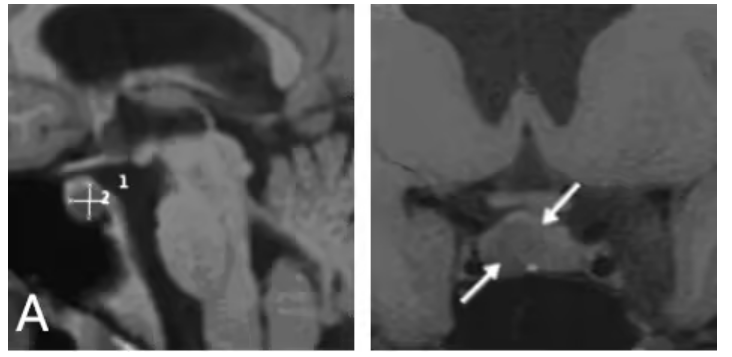
MRI scans identified a small mass within the sella turcica, displacing normal pituitary parenchyma to the left.
Prolactinomas are common pituitary neuroendocrine tumors (PitNETs) originating from prolactin (PRL)-secreting cells. The resultant hyperprolactinemia leads to hypogonadism and infertility. This tumor predominantly affects young women, frequently accompanied by galactorrhea and amenorrhea. Prolactin microadenomas (maximum diameter < 10 mm) are the most prevalent subtype, rarely progressing to macroadenomas (≥ 10 mm). Giant prolactinomas (> 40 mm) remain extremely rare. Standard therapeutic modalities for pituitary prolactinomas include dopamine agonists (DAs) and surgical resection.
Mira immediately commenced DA therapy, yet the tumor failed to regress and continued to expand, threatening her visual function and hormonal homeostasis.
Professor Henry W.S. Schroeder, former Chair of the Endoscopy Committee of the World Federation of Neurosurgical Societies (WFNS) and a member of the World Advisory Neurosurgical Group (WANG) under INC International Neurosurgeons Group, performed neuroendoscopic endonasal transsphenoidal resection to completely remove the tumor.
One-year postoperative MRI follow-up confirmed total tumor resection with intact pituitary function. Endocrine assays verified normalized serum prolactin and unaltered levels of all other pituitary hormones.
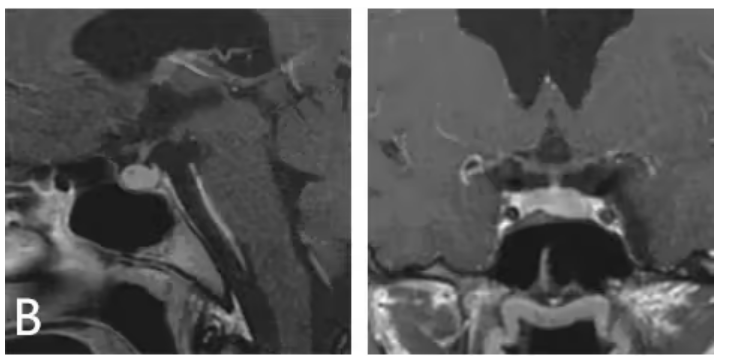
Postoperative MRI demonstrated gross total resection of the adenoma. Prolactin levels returned to baseline, and pituitary endocrine function remained normal without the need for hormone replacement therapy.
Perspectives from INC: Core Controversies in Prolactinoma Management
Dopamine agonists effectively lower PRL concentrations and reduce tumor volume in most patients, while research has elucidated molecular mechanisms underlying DA resistance in subsets of cases. Potential adverse effects of DAs encompass cardiac valvular remodeling and impulse control disorders. Despite the invasive nature of surgery, recent meta-analyses suggest superior long-term remission rates relative to pharmacotherapy.
Controversy 1: Definition and Prevalence of Dopamine Agonist Resistance
Multiple subjective definitions of DA resistance exist in clinical practice. Most experts adopt the criteria proposed by Molitch: failure to normalize serum PRL and achieve ≥50% tumor shrinkage despite maximal standard DA dosing.
Approximately one-quarter of patients treated with bromocriptine (BCR) fail to attain normoprolactinemia; 10–15% of cabergoline (CAB) recipients show persistent hyperprolactinemia.
One-third of bromocriptine-treated patients cannot achieve ≥50% tumor volume reduction, compared to 10–15% for cabergoline.
Surgical resection represents the first-line intervention for DA-resistant prolactinomas, delivering rapid relief from mass-effect-related symptoms. Transsphenoidal surgery (TSS) is indicated for resectable lesions managed by experienced neurosurgeons. Accumulated evidence also demonstrates that debulking surgery improves subsequent therapeutic responsiveness to DAs.
Controversy 2: The Role of Surgical Resection in Prolactinoma Treatment
Transsphenoidal surgery (TSS) is the gold standard for surgical management of microadenomas and most macroadenomas. Craniotomy is reserved for tumors inaccessible via the transsphenoidal corridor, a scenario now exceedingly uncommon.
Expanded surgical indications include complications of prolactinomas, specifically emergent management of symptomatic pituitary apoplexy and surgical repair of cerebrospinal fluid (CSF) rhinorrhea. CSF leaks may arise from tumor invasion into the sphenoid sinus or rapid tumor shrinkage induced by DA treatment. A recent systematic review reported over 90% of CSF rhinorrhea cases linked to DA administration, with a median interval of 3.3 months between treatment initiation and leak diagnosis. Such complications may also emerge during long-term maintenance therapy.
Key prognostic determinants of successful prolactinoma treatment include neurosurgical expertise, moderately elevated baseline PRL (<200 ng/mL), tumor size, and invasive grade (Knosp classification).
The international consensus statement Diagnosis and management of prolactin-secreting pituitary adenomas: a Pituitary Society international Consensus Statement, co-authored by 36 scholars across Germany, the United States, Spain, Italy, the Netherlands, Brazil, France, Japan, Israel, the United Kingdom and Australia, acknowledges that while DA resistance is uncommon, additional therapeutic strategies are required to address unmet clinical needs in this patient subgroup.
Surgical Indications Based on International Consensus Statement
Microprolactinomas and well-circumscribed macroprolactinomas (Knosp Grade 0 & 1): Surgical resection yields high cure rates, cost-effectiveness, and eliminates lifelong DA dependency (Level of evidence: Strong).
Acute vision deterioration secondary to sellar mass effect or pituitary apoplexy: Surgical decompression is recommended (Level of evidence: Weak).
Long-term DA intolerance or confirmed DA resistance: Surgery may be considered (Level of evidence: Weak).
Young female patients electing to avoid chronic DA medication: Surgical resection is a viable option (Level of evidence: Weak).
Macroprolactinomas in patients pursuing pregnancy: Surgery is advised to mitigate risks of symptomatic tumor enlargement during gestation (Level of evidence: Weak).
Spontaneous CSF rhinorrhea: Surgical dural repair is mandatory (Level of evidence: Strong).
Controversy 3: Management of Prolactinomas During Pregnancy and Reproductive Years
Reproductive planning is a critical consideration in prolactinoma care. Surgery performed by a seasoned neurosurgeon may be offered to fertility-seeking patients with curable lesions. Patients receiving DA therapy must utilize mechanical contraception until MRI confirms tumor regression.
Serial surveillance for tumor enlargement is mandatory throughout gestation; non-contrast unenhanced MRI (gadolinium-free) is the preferred imaging modality. Routine serum prolactin monitoring is not recommended. In the event of symptomatic tumor expansion:
DA therapy may be reinstated if previously discontinued;
Mid-trimester surgical decompression is reserved for refractory cases with urgent visual compromise.
Technical Advances and Unresolved Challenges in Neuroendoscopic Skull Base Surgery
Neuroendoscopic endonasal resection of skull base tumors has undergone remarkable evolution over the past two decades. Nevertheless, core technical challenges persist: balancing maximal safe tumor resection with reliable intraoperative skull base reconstruction to minimize complications including CSF leakage secondary to dural defects, intracranial infection, and sinonasal morbidity.
Pathogenesis and Prophylaxis of Perioperative Complications
Prompt, early intervention for severe surgical complications drastically reduces permanent adverse sequelae. High-volume neurosurgeons with specialized endoscopic training have drastically lowered complication incidence and can reliably prevent severe adverse events; delayed management of advanced complications carries a high risk of refractory morbidity.