2026-06-11
Many patients who present with facial numbness or facial pain ultimately receive a diagnosis of trigeminal schwannoma. Upon hearing the word "tumor," many patients instinctively associate it with cancer and experience considerable anxiety and distress. So — is a trigeminal schwannoma a form of cancer?
Trigeminal schwannomas arise from the Schwann cells of the nerve sheath of the trigeminal nerve and may involve the main trunk, the Gasserian (semilunar) ganglion, and the cavernous sinus. In fact, trigeminal schwannomas are uncommon, with an incidence approximately 3–4% that of vestibular schwannomas. The majority arise from the Gasserian ganglion in the middle cranial fossa, forming middle fossa tumors; some originate from the postganglionic nerve root and present as posterior fossa tumors, while others straddle the middle and posterior cranial fossae to form a dumbbell configuration. The symptomatic period of trigeminal schwannomas is longer than that of vestibular schwannomas, typically exceeding one year, and in one-third of patients extends to 10–14 years.
The initial symptoms of trigeminal schwannomas are trigeminal neuralgia, facial numbness, and masticatory muscle atrophy. In later stages, cerebellar and facial nerve symptoms may emerge, and intracranial hypertension may develop. The specific clinical presentation varies according to the direction of tumor growth:
1. When the tumor is located in the posterior cranial fossa, symptoms referable to CN VI, CN VII, and CN VIII may gradually appear, including diplopia, peripheral facial palsy, and progressive hearing loss. In advanced cases, cerebellar symptoms, raised intracranial pressure, and lower cranial nerve deficits may occur. This presentation is easily confused with that of a vestibular schwannoma.
2. When the tumor is located in the middle cranial fossa, visual disturbance, oculomotor nerve palsy, and ipsilateral exophthalmos may develop progressively. Subsequent compression of the medial temporal cortex may give rise to olfactory hallucinations and temporal lobe seizures. In advanced stages, involvement of midline structures such as the third ventricle and the cerebral aqueduct may cause hydrocephalus.
3. When the tumor straddles the middle and posterior cranial fossae, its medial surface lies in close proximity to the cerebral peduncle and the internal carotid artery, and may give rise to contralateral hemiplegia, raised intracranial pressure, and cerebellar symptoms.
Trigeminal schwannomas are not cancer. They are benign tumors, accounting for approximately 8% of all intracranial schwannomas. The condition predominantly affects middle-aged individuals around the age of 40, with a higher prevalence in women. The presenting complaint is most commonly "toothache" or "facial pain." Given the slow progression of symptoms, the diagnosis is frequently overlooked or misattributed, and by the time the correct diagnosis is established, the tumor has often grown to a considerable size, substantially increasing the difficulty and risk of treatment.
Imaging Findings of Trigeminal Schwannomas
The diagnosis of trigeminal schwannomas is based primarily on the clinical features of trigeminal nerve impairment in conjunction with characteristic imaging findings. In cases of progressively worsening or refractory trigeminal neuralgia, cranial MRI is recommended to exclude a trigeminal schwannoma. The specific imaging findings are as follows:
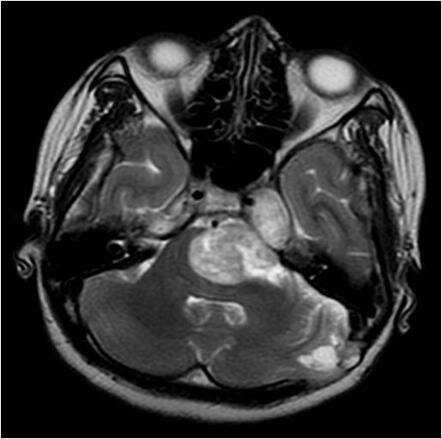
CT findings: The tumor is iso- or hypodense, or cystic in appearance, with homogeneous or ring enhancement and smooth, well-defined margins. It most commonly arises in the middle cranial fossa and/or the posterior cranial fossa. The morphology is typically round or ovoid; when both fossae are simultaneously involved, a dumbbell shape is produced. Small tumors produce no mass effect. Larger tumors may cause expansion of the middle cranial fossa, with flattening of the ipsilateral suprasellar cistern; posterior fossa tumors may result in displacement of the fourth ventricle. Osseous erosion of the petrous apex is visible on bone window settings. Perilesional edema is typically absent. Accordingly, isodense tumors may be easily missed on unenhanced imaging.
MRI findings: Trans-fossa tumors spanning the middle and posterior cranial fossae demonstrate long T1 and long T2 signal characteristics. Small lesions can be precisely characterized based on their relationship to the trigeminal nerve.
How Are Trigeminal Schwannomas Treated?
The choice of initial treatment for trigeminal schwannomas is of paramount importance: an ill-chosen modality will not only fail to resolve the patient's symptoms but will also increase the difficulty of subsequent management. The treatment strategy is determined primarily by the patient's age, the type and severity of symptoms, and tumor size.
Early detection and early treatment are equally critical, as tumor enlargement increases surgical difficulty and causes progressive compression of surrounding structures, leading to additional symptoms such as facial palsy, gait instability, and hearing loss.
1. For small tumors (generally less than 2 cm) presenting with facial numbness or mild-to-moderate pain, and in elderly patients, radiotherapy may be considered.
2. For larger tumors (>2.5 cm), radiotherapy generally cannot provide immediate pain relief or achieve meaningful tumor volume reduction within a short timeframe. Furthermore, the development of radiation necrosis may cause further tumor enlargement, resulting in more severe compressive symptoms. In such cases, surgical resection is the superior treatment option.
For large trigeminal schwannomas, surgery remains a significant technical challenge, inherent to the anatomical characteristics of the trigeminal nerve. As noted above, the trigeminal nerve originates from the brainstem, traverses multiple skull base foramina, and is distributed deeply within the cranium in close proximity to the brainstem, cavernous sinus, internal carotid artery, and multiple cranial nerves. Surgical approaches for trigeminal schwannomas include anterior, lateral, and posterior approaches, as well as subdural, extradural, and interdural approaches. The operative technique is complex and must be individualized based on tumor size and location, placing high demands on the institutional surgical infrastructure and the technical expertise of the operating surgeon.
The surgical objective is the most complete resection achievable while ensuring patient safety. The operating surgeon must maintain precise command of the operative risks and technical demands — resecting the tumor with meticulous technique while simultaneously avoiding injury to the trigeminal nerve and preventing postoperative complications including facial nerve palsy, CSF leak, and intracranial hematoma.
INC is an international neurosurgical group dedicated to academic exchange among experts in the field of neurosurgery. Its affiliated advisory body, the World Advisory Neurosurgical Group (WANG), is a purely international faculty comprising specialists from distinct subspecialty domains within neurosurgery, including more than ten professors from Germany, Japan, France, Canada, and other countries in Europe and Asia. These experts possess highly refined operative techniques and extensive successful experience in challenging high-grade resections of large trigeminal schwannomas and similar lesions — with certain cases representing textbook-level demonstrations of surgical excellence. Patients in China who wish to seek consultation with internationally recognized surgical specialists for high rates of resection and optimal surgical outcomes are welcome to arrange a remote consultation through INC International Neurosurgery.
Reference: https://www.incsg.com/sanchaqiaoliu/89.html