2026-06-11
Trigeminal schwannomas are rare tumors, accounting for 1–2% of all intracranial schwannomas. They most commonly present in the fourth to sixth decades of life and are slightly more prevalent in women. These are benign tumors with an indolent clinical course. They most frequently arise in the cisternal segment of the trigeminal nerve and tend to grow slowly along the nerve's anatomical pathway. Clinically, patients present with trigeminal nerve dysfunction; facial pain is the most common symptom. Trigeminal neuralgia is a distinct pain syndrome, defined by the International Association for the Study of Pain as "a sudden, usually unilateral, severe, brief, stabbing, recurrent pain in the distribution of one or more branches of the trigeminal nerve." Other common clinical manifestations include numbness or a burning sensation distributed along the nerve or one of its branches.
Can Surgery Cure Trigeminal Schwannomas? What Are the Risks?
Surgical resection is the preferred treatment for trigeminal schwannomas. Gross total resection should be the surgical objective; however, for larger tumors or those in which the capsule is adherent to surrounding vasculature and cranial nerves, only subtotal resection may be feasible.
Trigeminal schwannomas are located at the skull base in close proximity to the brainstem, cranial nerves, and major vascular structures, making surgery technically demanding and gross total resection rates relatively low. The surgical approach is selected based on tumor location.
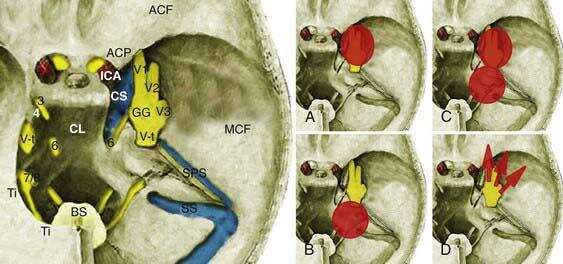
Surgical Approach Selection for Trigeminal Schwannomas
The choice of surgical approach is dictated by tumor location and the direction of growth. The subtemporal intradural middle cranial fossa floor approach is the most commonly employed and is indicated for tumors originating from the trigeminal ganglion with predominantly middle cranial fossa involvement, as well as for tumors straddling the middle and posterior cranial fossae that do not extend below the internal auditory canal. When necessary, the free edge of the tentorium cerebelli may be divided and the superior petrosal sinus ligated. The standard suboccipital approach is indicated for tumors confined entirely to the posterior cranial fossa. Dumbbell-shaped tumors extending ventrally toward the lower brainstem and below the internal auditory canal orifice may be addressed via a combined approach or a transpetrosal approach. For large middle cranial fossa tumors, orbitozygomatic resection may be performed to expose the cavernous sinus and minimize retraction of the temporal lobe.
For large trigeminal schwannomas, surgery remains a significant technical challenge. Specific operative strategies include anterior, lateral, and posterior approaches, as well as subdural, extradural, and interdural approaches. The surgical technique is complex and must be tailored to factors including tumor size and location; correspondingly high demands are placed on the institutional surgical infrastructure and the technical expertise of the operating surgeon.
INC International Neurosciences advises that the risk of recurrence of trigeminal schwannomas is related to both tumor location and the extent of surgical resection. Dumbbell-shaped tumors present the greatest surgical challenge; straddling the petrous apex across both the middle and posterior cranial fossae with extension both intracranially and extracranially, complete intraoperative resection is rarely achievable, and postoperative recurrence rates are correspondingly higher. Postoperative complications include cranial nerve injury, cerebrospinal fluid leak, meningitis, and hydrocephalus. Many patients experience persistent trigeminal nerve dysfunction of varying severity following surgery. Preexisting neurological deficits, however, may show improvement postoperatively. Newly acquired cranial nerve deficits following surgery — such as abducens nerve (CN VI) and oculomotor nerve (CN III) palsies — typically resolve within four months.