2026-06-11
Trigeminal schwannomas (TSs) are benign, slow-growing tumors arising from the peripheral nerve sheath of the trigeminal nerve. Although the trigeminal nerve is the second most common intracranial site for schwannomas after the vestibular nerve, TSs are rare tumors. Schwannomas account for approximately 8% of intracranial tumors, and TSs account for 0.8% to 8.0% of all intracranial schwannomas, corresponding to 0.07% to 0.36% of all intracranial tumors. A higher incidence has been observed in the fourth and fifth decades of life. TSs are slightly more common in women. Dixon (1846) and Smith (1849) were among the earliest authors to describe primary tumors arising from the Gasserian ganglion. Frazier performed the first successful resection of a TS in 1918, and a clinical series was reported by Cuneo and Rand in 1927. Hundreds of cases have since been reported. Early studies described low gross total resection rates and high mortality and morbidity. However, the introduction of microsurgical and skull base techniques has substantially improved outcomes. Today, TSs can be reliably diagnosed using non-invasive techniques, and in benign cases, gross total surgical resection can be achieved with near-zero mortality and low long-term morbidity. Over the past several decades, radiosurgery has also been established as an effective adjuvant therapy for residual or recurrent tumors, or as a primary treatment modality in carefully selected cases.
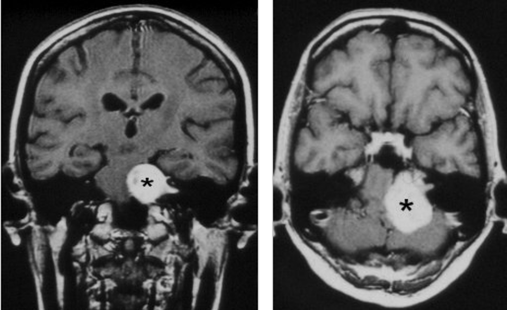
Can Trigeminal Schwannomas Be Cured?
Most patients present at the onset of their clinical course with trigeminal nerve dysfunction, most commonly manifesting as reduced sensitivity in the ophthalmic (V1), maxillary (V2), and mandibular (V3) distributions. The gradual onset of sensory loss is consistent with the slow-growing nature of these tumors. One of the primary concerns is involvement of the V1 segment, which reduces corneal sensitivity and may lead to keratitis. Pain may also be part of the clinical presentation, particularly in the Gasserian ganglion subtype; it was identified in more than 40% of patients in the early series by Day and Fukushima. Wanibuchi et al. published a surgical series of 105 patients with trigeminal schwannomas, in which facial sensory deficit was the most common preoperative presentation, occurring in more than 65% of patients. Facial pain was identified in approximately 23% of cases, followed by diplopia associated with oculomotor nerve palsy in 17%, headache in 14%, and ataxia/vertigo in 10%. The presence of persistent pain of prolonged duration without specific triggering factors, accompanied by poor response to carbamazepine or other anticonvulsant medications, is characteristic of atypical facial pain and invariably raises the hypothesis of a secondary cause of trigeminal neuralgia.
Low Risk of Recurrence Following Gross Total Resection of Trigeminal Schwannomas
Given the benign and relatively slow-growing nature of these tumors, multiple treatment options are available. The most conservative approach is surveillance with imaging follow-up, recommended every 6 to 12 months, and is primarily indicated for small tumors or elderly patients in whom the surgical risk outweighs the risk posed by tumor growth. Stereotactic radiosurgery is indicated for patients in whom serial imaging follow-up demonstrates a tendency toward tumor growth.
Microsurgical or endoscopic endonasal resection constitutes the definitive treatment for trigeminal schwannomas. When gross total resection is achieved, the risk of recurrence is low. When subtotal resection is performed to preserve neurological function, adjuvant radiotherapy is recommended.
Bilateral trigeminal schwannomas are a distinct entity, occurring exclusively in patients with NF2. In such cases, surgery is recommended only for the symptomatic side. The contralateral asymptomatic tumor may be managed with observation or stereotactic radiosurgery.
Surgical Approaches for Trigeminal Schwannoma Resection
Retrosigmoid Approach
The extended retrosigmoid approach is indicated for root-type tumors of the cerebellopontine angle. The suprameatal tubercle is located immediately superior to the internal auditory canal and posterior to the trigeminal nerve. Dural stripping over the suprameatal tubercle and drilling of the tubercle ensures adequate exposure of the trigeminal nerve and the structures superior to it. Although useful in selected cases, this maneuver is rarely required.
Orbitozygomatic and Subtemporal Approaches
The orbitozygomatic approach is best suited for schwannomas arising from the individual branches of the trigeminal nerve within the cavernous sinus. A more detailed discussion can be found in the chapter on the "Orbitozygomatic Approach." When the surgeon requires improved exposure for V1 tumors, the optic canal should be unroofed and an extradural anterior clinoidectomy performed. The modified extradural subtemporal approach is particularly well suited for this tumor type.
This approach facilitates entry into the posterior fossa through Meckel's cave via the middle fossa. If the diameter of Meckel's cave is insufficient for posterior fossa access, the dura superior to Meckel's cave, contiguous with the superior petrosal sinus, must be incised to expand the exposure. The posterior fossa component of the tumor can be resected through extracapsular and intradural dissection.
This approach also permits entry into the cavernous sinus through its lateral wall and is indicated for resection of large trigeminal schwannomas situated entirely within the cavernous sinus. It is important to identify the petrous segment of the internal carotid artery to allow proximal control of the cavernous segment of the ICA during tumor dissection. During dissection within the cavernous sinus, gentle handling of the surrounding cranial nerves is essential to prevent postoperative nerve palsies. Intratumoral debulking should be performed first; only after the tumor capsule has been adequately decompressed and relaxed should the capsule wall be mobilized. With careful dissection, this approach allows separation of the capsule wall from the adjacent trigeminal nerve roots. Trigeminal nerve roots involved by tumor are resected.
Frontotemporal Approach
The frontotemporal or pterional approach is indicated for small trigeminal schwannomas.
Anterior Petrosectomy Approach
The extradural subtemporal anterior petrosectomy approach is best suited for large, multiloculated trigeminal schwannomas involving both the middle and posterior fossae.
Postoperative Considerations Following Trigeminal Schwannoma Surgery
Due to surgical manipulation of the nerve, patients will experience trigeminal nerve dysfunction in the early postoperative period; function will gradually recover over time. Particular attention must be paid to the loss or diminution of the corneal reflex—if overlooked postoperatively and appropriate eye care is not instituted, keratitis may develop.
Surgery within the cavernous sinus frequently causes disturbance to cranial nerves III, IV, and VI. Postoperative diplopia resulting from palsy of one or all three of these nerves is not uncommon. These nerve palsies are typically transient and generally resolve within three months postoperatively.
Novel Drugs and Emerging Therapies for Trigeminal Schwannomas
The Hospital for Sick Children in Toronto, where Professor James T. Rutka—President of the World Academy of Neurological Surgery—is based, is home to a research team of several thousand personnel, with many faculty members running their own independent laboratories. Professor Rutka's laboratory, for example, has made significant advances in elucidating the mechanisms of brain tumor growth and invasion, and has achieved promising results in the areas of targeted therapy and nanotechnology for brain tumors. Patients who travel abroad for treatment may also access novel drugs and emerging therapies available at their chosen institution, and may in some cases be eligible to participate in clinical trials.
INC International Neurosurgery Group: Improving neurological symptoms, preserving cranial nerve function, and controlling the mass effect of the tumor are the primary goals of trigeminal schwannoma management. A personalized management strategy and a dedicated skull base team are essential, and represent the patient's best opportunity to achieve these goals. As a physician group focused on academic exchange among experts in the field of neurosurgery, INC facilitates consultations between domestic patients with brain tumors in need and internationally recognized neurosurgical teams, providing patients with access to improved outcomes.
Reference: https://www.incsg.com/sanchaqiaoliu/151.html