2026-06-09
Trigeminal schwannoma is the most common schwannoma after vestibular (auditory) lesions, possessing distinctive clinical, radiological, and anatomical characteristics that are of critical importance for accurate diagnosis and appropriate surgical planning. Compared with other lesions in this region, surgery for trigeminal schwannoma requires unique operative considerations.
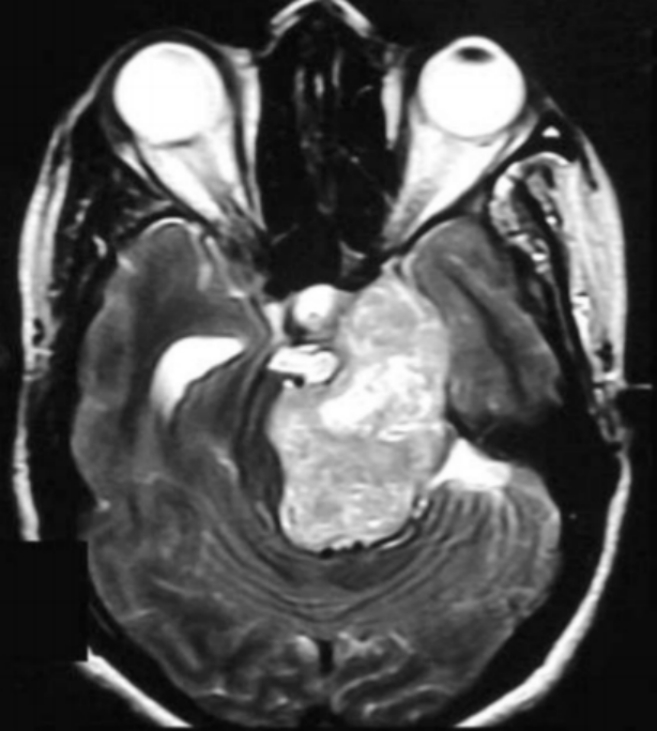
What Is a Trigeminal Schwannoma?
Trigeminal schwannomas are rare, slow-growing encapsulated tumors composed of Schwann cells, most commonly arising from the trigeminal nerve root. They are the second most common intracranial schwannomas, far less frequent than vestibular schwannomas, and follow a predominantly benign growth pattern. As a trigeminal schwannoma gradually enlarges, it typically produces ipsilateral facial sensory loss (numbness); a minority of patients present with pain that later transitions to numbness as the disease advances. Progressive tumor enlargement with extension toward the parasellar cavernous sinus gives rise to ocular motility disturbances. Extension to the upper clivus may result in brainstem compression with contralateral long tract signs (spastic paralysis). The tumor may also straddle the petrous apex and extend into the posterior cranial fossa, involving the auditory nerve and producing tinnitus or hearing loss. Surgical resection is currently the treatment of choice for trigeminal schwannoma; however, surgery carries substantial difficulty given the tumor's location in the region adjacent to the central cranial axis, where critical surrounding structures — including the brainstem, trigeminal nerve branches, oculomotor nerve, trochlear nerve, abducens nerve, facial nerve, auditory nerve, basilar artery, superior cerebellar artery (SCA), and posterior cerebral artery (PCA) — render inadvertent intraoperative injury potentially severe or even life-threatening.
Gross Total Resection of Trigeminal Schwannoma Can Be Curative
Internationally, many neurosurgeons have emphasized the importance of radical surgery, stressing that only gross total resection can achieve "cure." Subtotally resected trigeminal schwannomas carry a substantial risk of recurrence — particularly cystic tumors, which recur at a higher rate than vestibular schwannomas.
INC International Neurosurgery notes that trigeminal schwannoma is predominantly a benign tumor, and that complete resection is curative, enabling patients to return to normal life following gross total resection. However, in cases of greater severity, postoperative neural injury following trigeminal schwannoma surgery may produce a range of manifestations depending on the division involved: injury to the ophthalmic branch (V1) may lead to ocular paresthesia, impaired lacrimation, corneal ulceration, and ultimately blindness; injury to the maxillary branch (V2) may result in numbness of the midface; and injury to the mandibular branch (V3) may produce numbness of the cheek in addition to masticatory impairment affecting the patient's ability to eat. If the main trunk of the trigeminal nerve is involved, symptoms across all three divisions may potentially be present.
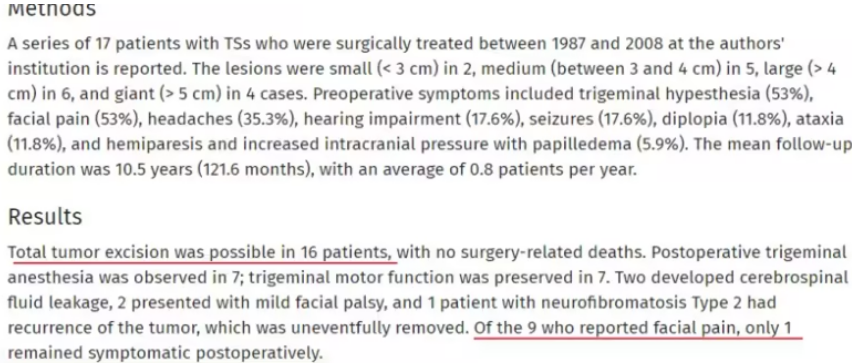
A literature review analyzed 17 patients who underwent microsurgical resection between 1987 and 2008. Tumor size was small (less than 3 cm) in 2 patients, medium (3–4 cm) in 5, large (greater than 4 cm) in 6, and very large (greater than 5 cm) in 4. Preoperative symptoms included trigeminal hypoesthesia (53%), facial pain (53%), headache (35.3%), hearing disturbance (17.6%), seizures (17.6%), diplopia (11.8%), ataxia (11.8%), hemiparesis, and raised intracranial pressure (ICP) with papilledema (5.9%). Mean follow-up was 10.5 years (121.6 months). Gross total resection was achieved in 16 patients; one patient with NF-2 could not undergo complete resection due to intracavernous adhesions. There were no surgery-related deaths. Postoperatively, trigeminal nerve anesthesia was present in 7 patients; trigeminal motor function was preserved in 7 patients. Cerebrospinal fluid leakage occurred in 2 patients, mild facial nerve palsy in 2 patients, and tumor recurrence in 1 patient with neurofibromatosis type 2 — all of whom were managed successfully. Of the 9 patients who had reported preoperative facial pain, only 1 remained symptomatic postoperatively.
Reference: Ramina R, Mattei TA, Sória MG, et al. Surgical management of trigeminal schwannomas. Neurosurgical Focus. 2008;25(6):E6.
Complication-Free Gross Total Resection: The Highest Standard to Pursue
Surgical resection remains the ideal treatment for trigeminal schwannoma. While gross total resection of trigeminal nerve tumors is no longer an insurmountable challenge with current operative techniques, achieving complete resection without any complications remains technically demanding. Preservation of each individual branch of the trigeminal nerve continues to pose a challenge — and it is the occult neural injury that is not immediately apparent (unlike the post-vestibular schwannoma facial palsy that is evident at a glance) that demands the greatest surgical attention and effort.
Currently, among the members of the International Neurosurgical Advisory Group (WANG) — the academic consulting body under INC International Neurosurgeon's Circle — several internationally recognized brain tumor surgeons excel in gross total resection of trigeminal schwannomas, including Professor James T. Rutka, President of the World Academy of Neurological Surgery; Professor Sebastien Froelich, Chairman of the Skull Base Surgery Committee of the World Federation of Neurosurgical Societies (WFNS); and Professor William T. Couldwell, President of the World Academy of Neurological Surgery (WANS). These professors not only achieve high rates of gross total resection but also develop individualized treatment plans tailored to each patient's specific condition, selecting the optimal surgical approach for each case. Under their meticulous operative technique, most patients sustain no significant neurological deficits postoperatively, and quality of life following surgery is substantially improved relative to the preoperative state.
INC International Neurosurgery wishes to remind patients that improvement of neurological symptoms, preservation of cranial nerve function, and control of mass effect are the primary treatment objectives for trigeminal schwannoma. To achieve these goals, selecting the right physician and the right institution is essential. As an international academic physician group dedicated to fostering neurosurgical exchange among leading global experts, INC provides patients with brain tumors — including trigeminal schwannomas, vestibular schwannomas, meningiomas, pituitary adenomas, and gliomas — with access to remote consultations and in-person surgery from an internationally qualified team of neurosurgical specialists.
Reference: https://www.incsg.com/sanchaqiaoliu/129.html