2026-06-09
A 38-year-old male presented with facial pain and numbness accompanied by mild hypoalgesia and hypoesthesia in the V2 and V3 distributions. Workup revealed a rare trigeminal schwannoma. Imaging studies demonstrated a dumbbell-shaped right-sided skull base lesion, with the larger component situated in the middle cranial fossa and extending into the posterior cranial fossa. The lesion was highly enhancing and further extended anteriorly into the cavernous sinus and the posterior aspect of the brainstem. Imaging also revealed a significant degree of bony erosion of the petrous bone. The patient presented with facial pain and numbness, hypoalgesia, and hypoesthesia in the V2 and V3 distributions. The clinical and radiological features were consistent with a diagnosis of trigeminal schwannoma rather than neurofibroma; neurofibromas may involve the cavernous sinus but generally do not extend posteriorly beyond Meckel's cave. Surgical intervention was performed to achieve complete tumor resection.
Trigeminal schwannomas are rare benign lesions, accounting for 0.07% to 0.5% of all intracranial tumors and 0.8% to 10% of all schwannomas. They originate from Schwann cells of the nerve sheath and may therefore be located anywhere along the course of the nerve. According to the reported literature, 20% of trigeminal schwannomas arise from the posterior (cisternal) segment of the nerve, 50% from Meckel's cave, and 5% from the distal intracranial branches. On MRI, schwannomas typically appear as hypointense or isointense on T1-weighted imaging, hyperintense on T2-weighted imaging, and demonstrate homogeneous or rim enhancement on contrast-enhanced sequences.
Operative Technique
The surgical approach for this tumor is determined by the individual patient's anatomy; selection of the appropriate approach is of critical importance for achieving gross total resection, improving preoperative neurological deficits, and minimizing postoperative neurological morbidity (Figure 1). Trigeminal schwannomas frequently involve the cavernous sinus and extend into the posterior fossa. Skull base approaches therefore offer several advantages in their management, including a shortened working distance to the lesion, elimination of brain retraction, facilitation of the subtemporal working corridor, and preservation of draining veins beneath the intact dura. In particular, the extradural zygomatic middle fossa approach enables resection of large dumbbell-shaped trigeminal schwannomas and provides multiple working angles to access subtemporal, intracavernous, intraorbital, or intraorbital extensions of the tumor as well as the cavernous sinus. Furthermore, the component extending into the posterior cranial fossa and compressing the brainstem can also be accessed through the enlarged Meckel's cave (Figure 2).
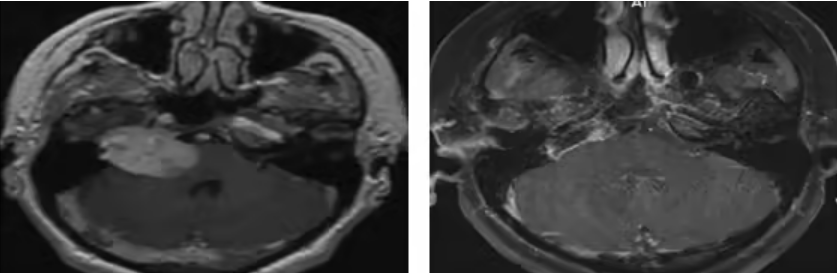
Figure 1: (a, b) Axial contrast-enhanced MRI demonstrating a trigeminal schwannoma extending into Meckel's cave and expanding in a dumbbell configuration into the middle and posterior cranial fossae. (a) Preoperative image. (b) Postoperative image confirming gross total resection.
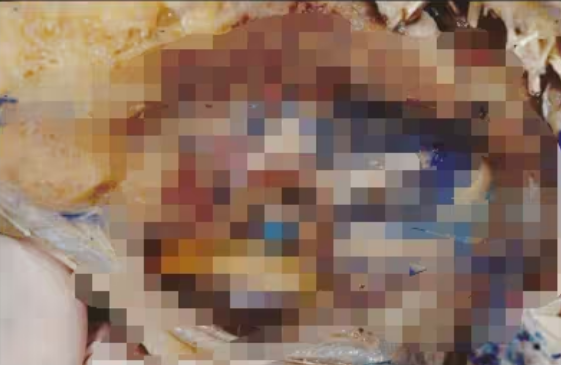
Figure 2: Anatomical model photograph of the dumbbell-shaped tumor, with tumor extension into Meckel's cave compressing the trigeminal nerve root and ganglion.
The patient is positioned supine with the ipsilateral shoulder elevated and the head rotated to the contralateral side, with the zygoma oriented nearly parallel to the floor. The skin incision is made 1 cm anterior to the tragus, curved posteriorly along the hairline to the superior temporal line. The superficial temporal artery and the frontotemporal branch of the facial nerve are preserved. The skin flap is first incised anteriorly, after which the areolar tissue is dissected from the pericranial flap. At this stage, in order to protect the facial nerve, a parallel incision is made 1 cm posterior along the zygomatic arch, preserving the nerve between the superficial and deep temporal fasciae and the fat pad. Both fasciae and the fat pad are reflected anteriorly with the skin flap. Subperiosteal dissection of the temporalis muscle is performed; the muscle is incised posterior to the superficial temporal artery and advanced anteriorly from the root of the zygoma to preserve the middle temporal artery.
The zygoma is separated at its B1 attachment via an oblique anterior osteotomy carried through the zygomatic eminence, through the root, and posteriorly. The temporalis muscle is divided at the level of the superior temporal line and reflected inferiorly together with the zygomatic arch to the level of the middle fossa floor. Burr holes are placed at the level of the temporal fossa floor to design the temporal craniotomy, and the bone flap is elevated. The surgeon should identify the critical anatomical landmarks of the middle fossa to prevent injury to neurovascular structures. The middle fossa dura is exposed from the elevated temporal fossa floor, and the middle meningeal artery is divided at the foramen spinosum in a posterior-to-anterior and lateral-to-medial direction in order to prevent injury to the greater superficial petrosal nerve (GSPN), which would result in facial palsy. This nerve exits from the facial hiatus, courses anteromedially in its groove along the middle fossa floor, passes beneath Meckel's cave to the foramen lacerum, and there joins the deep petrosal nerve to form the vidian nerve. The GSPN also serves as an important landmark for identifying the petrous segment of the internal carotid artery and achieving proximal control of the intracavernous ICA.
The foramen rotundum and the maxillary (V2) branch of the trigeminal nerve are located lateral and posterior to the superior orbital fissure. The foramen ovale lies 1 cm posterior and lateral to the foramen rotundum and transmits the mandibular (V3) branch of the nerve. The extradural dura overlying the trigeminal nerve branches is elevated to expose the inferior cavernous sinus and dissected medially to expose the tumor at this site. The lesion may be accessible between or posterior to the ganglionic divisions. Given the soft consistency of the tumor, it is carefully debulked by suction and then delivered posteriorly through the enlarged Meckel's cave. Once the tumor is decompressed, meticulous dissection is performed from the root, ganglion, and individual divisions to preserve any nerve fascicles uninvolved by tumor.
Drilling of the petrous apex or incision of the tentorium is not required, as the enlarged Meckel's cave provides a natural corridor between the middle and posterior cranial fossae through which the lesion can be followed into the posterior fossa. If necessary, the opening into the superior petrosal sinus can be incised superiorly to enlarge the access, which may require coagulation and division of its more anterior portion. Within the posterior fossa, provided that an intradural arachnoid dissection plane is maintained, the lesion can be safely separated from the brainstem, fine nerve rootlets, and basilar artery. Tumor fragments may be present within the infratemporal and pterygoid fossae and can be resected after removing the middle fossa floor between the foramen ovale and the foramen ovale defect. Fragments along the superior orbital fissure can be removed by excising the middle fossa floor between the foramen rotundum and the superior orbital fissure. If the middle fossa floor has been drilled, reconstruction with a vascularized temporalis muscle flap can be performed to prevent cerebrospinal fluid leakage.
Because this lesion is benign, it displaces rather than invades neural and vascular structures. Through microsurgical technique, the tumor can be separated from the trigeminal nerve fibers, thereby preserving and improving neurological function (75% improvement in facial pain and 80% improvement in trigeminal motor function). The use of skull base approaches for trigeminal schwannoma has the potential to yield excellent clinical outcomes with low morbidity. During skull base surgery, intraoperative neurophysiological monitoring provides the surgeon with additional confidence when resecting lesions involving or displacing cranial nerves. More specifically, this form of monitoring enables the surgeon to localize the involved cranial nerves, thereby confirming their functional integrity during surgery and permitting assessment of the operative outcome.
Higher Resection Rate Correlates with Better Prognosis in Trigeminal Schwannoma
In a previously reported series, investigators (O.A.) analyzed microsurgical gross total resection in 25 cases of trigeminal schwannoma, of which 24% involved the middle fossa alone and 76% involved both the middle and posterior fossae. All tumors involved the cavernous sinus. Following surgery, preoperative deficits involving all cranial nerves — not merely the trigeminal nerve — and all brainstem and cerebellar symptoms were relieved. Improvement was observed in 75% of patients with facial pain, 80% of patients with trigeminal motor weakness, and 44% of patients with facial numbness. Recurrence occurred in only 13% of lesions, and trigeminal nerve function deteriorated or new deficits emerged in 12% of patients. The mean age of patients at the time of treatment was 44 years.
A further study reported 18 patients, among whom 50% had Jefferson classification trigeminal schwannomas; only two patients had tumors smaller than 2 cm. The authors reported one recurrence and one subtotal resection, with tumor disappearance in 16 patients at 134 months of follow-up. Zhou and colleagues described 57 cases of dumbbell-shaped Jefferson classification trigeminal schwannomas (50% with a diameter exceeding 40 mm and 26% exceeding 50 mm). They reported an overall gross total resection rate of 87%, with only one recurrence over a mean follow-up of 10 years. Cranial nerve function improved in 93% of patients with facial numbness, trigeminal motor function deteriorated in 83%, CN VI and CN VII palsy improved in 80% of patients, CN IX and CN X palsy and cerebellar or brainstem signs improved in 75% of patients. Among 38 patients treated with Gamma Knife radiosurgery followed for 65 months, tumor volume decreased in 83%, remained stable in 5.7%, and increased in 8.6%, with trigeminal nerve function deteriorating in the latter group. The authors also reported 4 patients with incomplete surgical resection in whom residual tumor demonstrated no growth on long-term follow-up; only one case (25%) showed growth after five years and required further treatment.
A high resection rate is the preferred strategy in the management of trigeminal schwannomas. Improvement of neurological symptoms, preservation of cranial nerve function, and control of mass effect are the primary treatment objectives. An individualized management strategy delivered by a dedicated skull base team is essential and represents the best opportunity for patients to achieve these goals. As an academic physician group dedicated to expert exchange in the field of neurosurgery, INC will facilitate access for domestic brain tumor patients in need — including those with trigeminal schwannomas, vestibular schwannomas, meningiomas, pituitary adenomas, gliomas, and other conditions — to an internationally qualified neurosurgical team for surgery, ensuring better prognoses for these patients.
Source: Jun 20, 2016 | Posted by admin in NEUROSURGERY | Comments Off on Management of Trigeminal Schwannoma: Microsurgical Removal vs. Radiosurgery
Reference: https://www.incsg.com/sanchaqiaoliu/96.html