2026-06-09
Introduction: Schwannomas account for 8% of all primary brain and central nervous system tumors. They represent the third most common histological type in the 20-to-44 age group. The incidence of schwannomas is 1.57 per 100,000, ranking third among non-malignant tumors, behind meningiomas (7.33 per 100,000) and pituitary tumors (3.12 per 100,000). However, schwannomas arising from the intracranial portion of the trigeminal nerve are uncommon, accounting for only 0.07% to 0.36% of all intracranial tumors and 0.8% to 8% of all intracranial schwannomas.
The management of trigeminal schwannomas typically encompasses the following options: observation, microsurgical resection, radiosurgery, fractionated conformal radiotherapy, or a combined surgical and radiotherapeutic approach. The selection of an appropriate management strategy is based on a thorough understanding of the natural history and treatment outcomes of the condition, as well as the specific clinical presentation. The present case illustrates a challenging clinical scenario in which all relevant factors — natural history, current symptoms, and anatomical and functional risks — were carefully weighed in order to optimize treatment.
Microsurgical Resection of a Large Trigeminal Schwannoma: A Case Report
Clinical History
A 28-year-old male presented with a three-month history of progressive headache, dizziness, loss of balance, reduced sleep, and cognitive impairment with associated psychiatric symptoms. On physical examination, the patient's mental status was intact; however, he demonstrated difficulty with tandem gait, truncal ataxia, and mild left abducens nerve (CN VI) palsy with diplopia. Mild left-sided facial sensory diminution was present across all three divisions of the trigeminal nerve, with intact corneal reflexes.
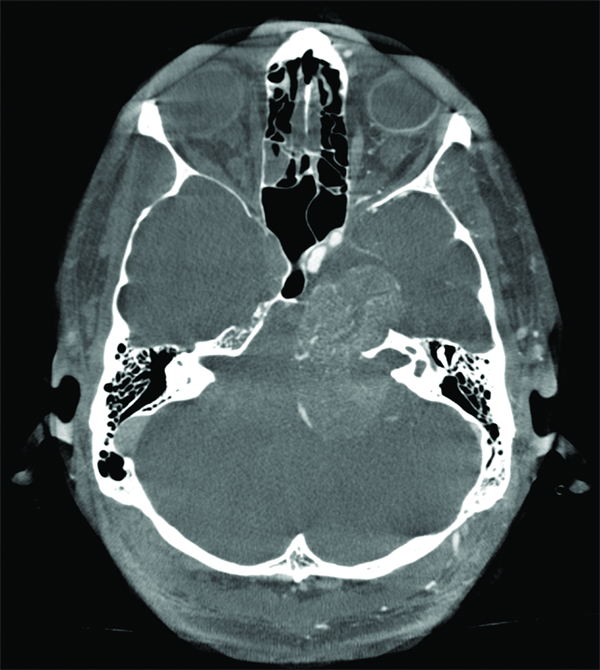
CT: Initial computed tomography revealed a middle and posterior cranial fossa mass with marked petrous bone remodeling (Figure 1).
Figure 1: Preoperative CT. Axial computed tomography (bone window) demonstrating a left-sided lesion at the level of Meckel's cave with associated petrous bone remodeling.
MRI: Magnetic resonance imaging demonstrated an enhancing T1 hypointense and fluid-attenuated inversion recovery (FLAIR) hyperintense mass in the left middle and posterior cranial fossae (Figure 2).
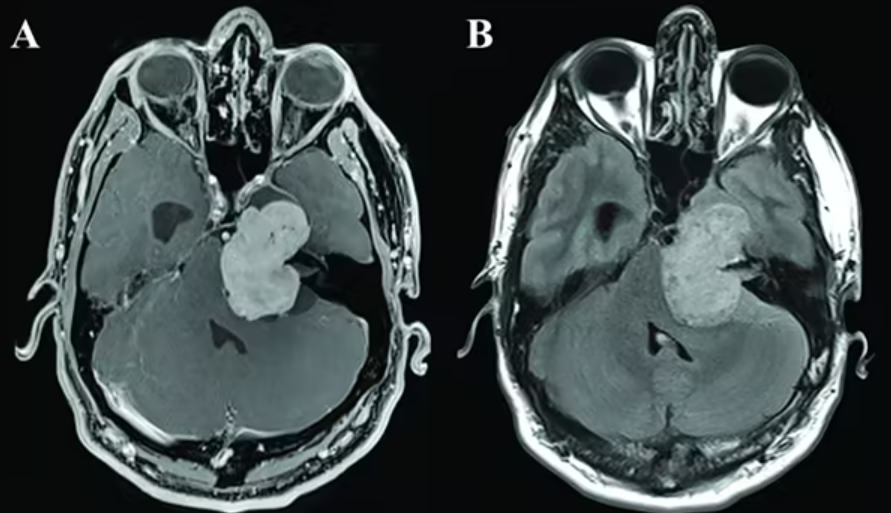
Figure 2: Preoperative MRI. (A) Axial T1-weighted MRI with gadolinium demonstrating a homogeneously enhancing extra-axial lesion with significant mass effect on the brainstem, fourth ventricle, and left temporal lobe, with enlargement of the right temporal horn. (B) Axial FLAIR-weighted MRI demonstrating absence of edema in the brainstem, cerebellum, and left temporal lobe.
The extra-axial lesion extended from Meckel's cave along the trigeminal nerve to the left cavernous sinus, measuring approximately 4.3 × 3.1 × 4.5 cm (39.50 cm³). It produced significant mass effect on the pons and fourth ventricle, resulting in obstructive hydrocephalus, with mild additional mass effect on the medial temporal lobe.
Microsurgical Resection with Gradual Resolution of Hydrocephalus
Given that the patient's hydrocephalus was secondary to the mass effect of this large lesion, microsurgical resection of the large posterior fossa component of the tumor was recommended. The patient underwent a straightforward retrosigmoid craniotomy with resection of the posterior fossa tumor component and partial resection of the middle fossa component. Pathological examination confirmed the diagnosis of trigeminal schwannoma. Three-month follow-up imaging demonstrated reduction of the obstructive hydrocephalus and a decrease in the residual lesion volume (12.27 mL), which further decreased by 69.7% at one-year follow-up (3.72 mL) (Figure 3).
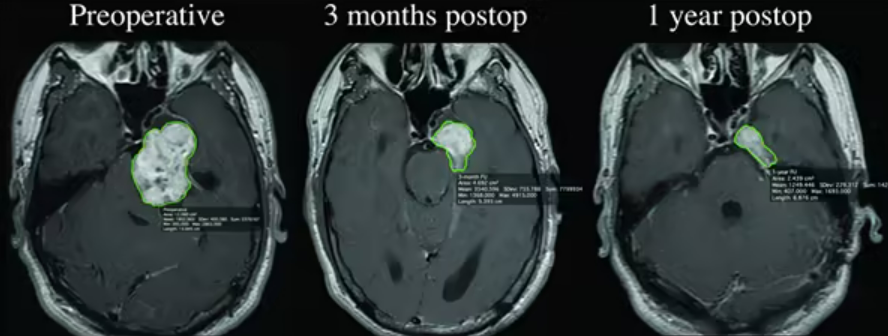
Figure 3: Postoperative imaging. Representative axial T1-weighted post-gadolinium images used for volumetric analysis demonstrating progressive reduction in tumor volume following surgery: preoperative; three months postoperative; one year postoperative.
Postoperative Course
The patient reported transient facial numbness postoperatively; however, cognitive function improved steadily, with return to baseline within three months.
Case Discussion
Given the typically slow growth of trigeminal schwannomas, the usual clinical course involves gradual onset of cranial nerve involvement — including trigeminal sensory hypoesthesia, facial pain, and hearing loss — along with headache. However, presentation with symptoms attributable to obstructive hydrocephalus is an uncommon initial manifestation; to our knowledge, this case report is among the first to highlight such a presentation. In this clinical context, the patient's young age, tumor size, mass effect on the brainstem, and resultant obstructive hydrocephalus precluded the options of radiosurgery or watchful waiting.
A middle fossa microsurgical approach is generally advocated for lesions of this nature. However, in the present case, the severity of brainstem compression with hydrocephalus and the risk of further deterioration from temporal lobe involvement led to the selection of a retrosigmoid posterior fossa approach. In this context, the relatively conservative approach yielded subtotal resection but allowed for relief of brainstem compression and resolution of hydrocephalus, restoring the patient's baseline cognitive function. Furthermore, during follow-up, the residual middle fossa component demonstrated spontaneous regression with measurable volumetric reduction. Accordingly, additional treatment — such as stereotactic radiosurgery or a separate middle fossa approach — has not yet been undertaken. We consider that the primary surgical objectives, namely definitive pathological diagnosis, brainstem decompression, resolution of hydrocephalus, and restoration of cognitive function, were adequately achieved through the posterior fossa approach alone.
Professor William T. Couldwell — President of the World Academy of Neurological Surgery (WANS) and a member of the International Neurosurgical Advisory Group (WANG) under INC International Neurosurgeon's Circle — has authored Skull Base Surgery of the Posterior Fossa, which provides a comprehensive and contemporary overview of surgical approaches to posterior fossa lesions. The volume serves as a resource for neurosurgeons and otologists managing patients with tumors and vascular disorders of the posterior fossa, offering a concise review of operative strategies addressing major pathologies affecting this region. The surgical strategies discussed are richly illustrated with photographs. All chapters are authored by recognized experts with internationally acknowledged contributions in their respective fields, making the text a valuable reference for neurosurgeons, otorhinolaryngologists, and radiation therapists.
The precise natural history of schwannomas remains incompletely understood, as untreated tumors may grow in some cases, remain dormant for many years, or even regress spontaneously in others. Spontaneous regression of vestibular schwannomas without treatment has been reported in approximately 6% to 26% of patients; however, the natural history of residual trigeminal schwannomas following surgery has rarely been characterized. Some studies report that subtotal resection is associated with high rates of tumor recurrence, while others report no evidence of recurrence following subtotal resection. Nevertheless, only a small number of cases of postoperative regression have been reported in the literature. The present report describes a case of spontaneous regression of a trigeminal schwannoma following subtotal resection. The mechanism underlying this spontaneous postoperative tumor regression is not fully understood; however, we hypothesize that partial devascularization of the lesion and subsequent ischemic degeneration may contribute to this favorable outcome.
INC International Neurosurgeon's Circle commentary: This is a case of trigeminal schwannoma presenting with obstructive hydrocephalus. The case illustrates that a near-total resection strategy focused on decompression of the tumor's mass effect and relief of obstructive hydrocephalus is a valuable approach in the management of complex schwannomas, and that some degree of postoperative tumor regression may occur. Favorable surgical outcomes can thus be correlated with meticulous preoperative surgical planning and neurosurgical technical expertise.
INC is a physician group dedicated to fostering expert academic exchange in the field of neurosurgery. It has been consistently committed to promoting collaboration and the exchange and advancement of neurosurgical techniques between China and the international community, while providing consultation services for patients with high-demand clinical needs and particularly challenging surgical cases.
Reference: https://www.incsg.com/sanchaqiaoliu/80.html