2026-06-08
What Is a Trigeminal Schwannoma?
Trigeminal schwannomas occur predominantly in young and middle-aged adults and represent the most common schwannoma after vestibular schwannomas in terms of incidence. The tumor grows along the course of the fifth cranial nerve and may involve the cisternal segment of the nerve and/or its portion within Meckel's cave at the petrous apex, as well as the cavernous sinus segment. The principal clinical symptoms include trigeminal neuralgia, facial numbness, and hearing disturbance.
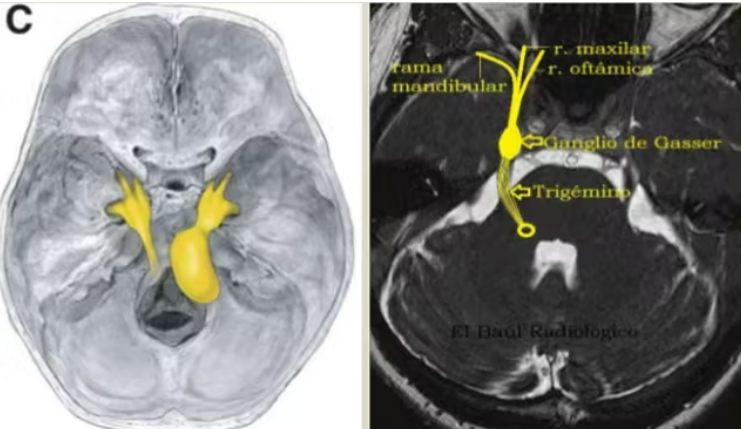
How Are Trigeminal Schwannomas Classified?
Trigeminal schwannomas arise at the Gasserian ganglion and may simultaneously extend toward the trigeminal nerve root. They are commonly classified into three types: the middle cranial fossa type, the straddling (transfossa) type, and the posterior cranial fossa type. On MRI, middle fossa and posterior fossa tumors are typically round or ovoid in shape. Tumors that simultaneously occupy the parasellar region and the cerebellopontine angle present as a "dumbbell" configuration, reflecting transfossa growth. Characteristic imaging features include trigeminal nerve thickening continuous with the tumor, enlargement of Meckel's cave, petrous bone resorption or destruction, and a straddling growth pattern across the middle and posterior cranial fossae.
What Investigations Confirm the Diagnosis of Trigeminal Schwannoma?
1. General investigations
2. Neurophysiological studies
3. Imaging studies
(1) Plain radiography (X-ray): Invasion of the anteromedial petrous bone with disappearance of the petrous apex and smooth, non-sclerotic margins (distinguishing it from primary malignant bone lesions) may be observed, along with possible involvement of the middle cranial fossa floor and enlargement of skull base foramina.
(2) MRI (Magnetic Resonance Imaging): The tumor appears T1 hypointense or isointense and T2 hyperintense, and may undergo cystic degeneration. Post-contrast enhancement may be homogeneous, ring-shaped, or irregular. A characteristic finding in tumors straddling the middle and posterior fossae is loss of the normal ipsilateral petrous apex fatty signal, or ipsilateral enlargement and deformity of Meckel's cave. Small tumors may demonstrate focal cisternal widening with a visible intracisternal tumor component.
(3) CT: Tumors most commonly arise from the trigeminal ganglion within Meckel's cave and grow across the middle and posterior cranial fossae; a minority originate from the nerve root in the posterior fossa or from the orbital apex region. On unenhanced CT, the tumor appears as a round, ovoid, or dumbbell-shaped mass in the middle and/or posterior cranial fossa, which may be hyperdense, hypodense, isodense, of mixed density, or cystic. Bone window settings may reveal petrous apex destruction. The tumor may extend extracranially or into the orbit via the foramen ovale, foramen rotundum, or superior orbital fissure, producing corresponding enlargement or destruction of these foramina and fissures. Post-contrast imaging demonstrates homogeneous or ring enhancement with sharp, well-defined margins.
(4) Cerebral angiography: Inferomedial displacement of the petrous segment of the carotid artery proximal to its entry into the cavernous sinus suggests tumor origin within the middle cranial fossa or Meckel's cave. Posterior fossa tumors may cause superior and medial displacement of the posterior cerebral and superior cerebellar arteries, posterior and contralateral displacement of the basilar artery, and superior displacement of the petrosal vein.
Based on the characteristic clinical presentation, tumor location, typical schwannoma imaging features, and petrous apex bony destruction described above, the diagnosis is generally not difficult to establish.
Differential Diagnosis of Trigeminal Schwannoma
(1) Meningioma: On CT, meningiomas are typically slightly hyperdense, frequently contain calcification, and are associated with focal hyperostosis of the adjacent bone. On MRI, they demonstrate isointense signal on both T1WI and T2WI; T2WI signal intensity is relatively lower than that of trigeminal schwannoma and declines rapidly with increasing echo time. Meningiomas are generally smaller than trigeminal schwannomas. Post-contrast imaging characteristically shows homogeneous enhancement with a dural tail sign.
(2) Vestibular schwannoma: The imaging appearances of vestibular schwannomas and trigeminal schwannomas may be indistinguishable. The key differentiating features are thickening of the vestibulocochlear nerve continuous with the tumor and enlargement of the internal auditory canal.
(3) Temporal lobe and pontine gliomas: T2WI signal intensity is lower than that of trigeminal schwannoma; enhancement is mild or absent and is commonly associated with surrounding cerebral edema. Differentiation is straightforward when CT and MRI findings are evaluated in combination.