2026-06-08
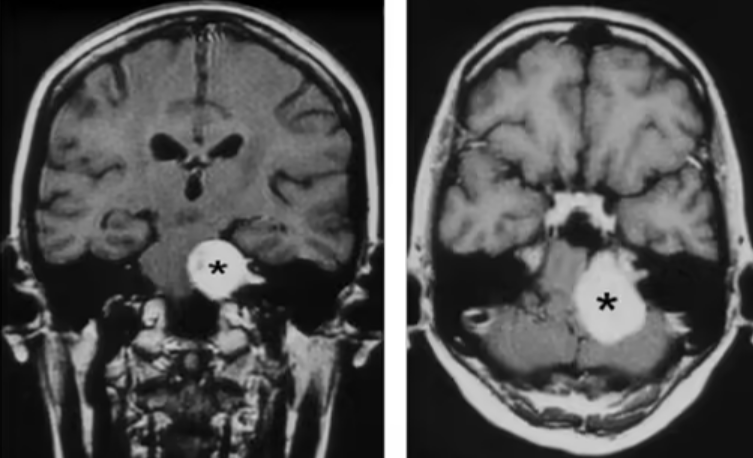
Trigeminal schwannomas are less common than vestibular schwannomas (acoustic neuromas), accounting for 0.8% to 8% of all schwannomas and 0.2% to 0.4% of all intracranial tumors. They arise primarily from the Gasserian ganglion, with Schwann cells as the cell of origin. These tumors are slow-growing and most commonly present clinically with facial pain, which patients typically describe as burning in quality. When the tumor enlarges to involve the motor division of the nerve, dysfunction of the masticatory muscles may occur. Involvement of the sensory division may result in sensory paresthesia and diminished corneal reflexes. Intracavernous tumor growth leads to dysfunction of the oculomotor, trochlear, and abducens nerves, while enlargement within the cerebellopontine angle cistern may produce clinical symptoms related to compression of the facial nerve, vestibulocochlear nerve, and glossopharyngeal nerve.
How Difficult Is Surgery for Trigeminal Schwannoma?
For large trigeminal schwannomas, surgery remains highly challenging — a consequence of the anatomical characteristics of the trigeminal nerve itself. As described above, the trigeminal nerve originates from the brainstem, traverses multiple skull base foramina, and has a deeply situated distribution in close proximity to the brainstem, cavernous sinus, internal carotid artery, and numerous cranial nerves. Surgical approaches for trigeminal schwannoma include anterior, lateral, posterior, subdural, extradural, and interdural routes. The selection of operative technique is complex and must be individualized according to tumor size, location, and other relevant factors, placing high demands on both the surgical infrastructure of the treating institution and the technical expertise of the operating neurosurgeon.
How Can the Success Rate of Trigeminal Schwannoma Surgery Be Improved?
The choice of initial treatment for trigeminal schwannoma is of paramount importance. An ill-considered treatment strategy will not only fail to alleviate the patient's condition but will also substantially increase the complexity of subsequent management. Treatment planning is guided primarily by the patient's age, the nature and severity of symptoms, and tumor size.
Early detection and early treatment are also critical: as a trigeminal schwannoma enlarges, surgical difficulty increases, and progressive compression of surrounding structures produces additional symptoms such as facial palsy, gait instability, and hearing loss.
For small tumors (generally less than 2 cm in maximum diameter) presenting with facial numbness or mild-to-moderate pain, and for elderly patients, radiotherapy may be considered.
For larger tumors (greater than 2.5 cm), radiotherapy generally cannot provide immediate relief of pain symptoms or achieve meaningful tumor volume reduction within a short timeframe; indeed, radiation necrosis may paradoxically cause further tumor enlargement, resulting in more severe compressive symptoms. In such cases, surgical resection is the superior treatment option.
Surgical Approaches for Trigeminal Schwannoma Resection
Retrosigmoid Approach
The extended retrosigmoid approach is indicated for root-type tumors of the cerebellopontine angle. The suprameatal tubercle is located immediately superior to the internal auditory canal and posterior to the trigeminal nerve. Dural stripping over the suprameatal tubercle followed by drilling of the tubercle ensures adequate exposure of the trigeminal nerve and the structures superior to it. Although useful in select cases, this maneuver is rarely required.
Orbitozygomatic and Subtemporal Approach
The orbitozygomatic approach is best suited for schwannomas arising from the individual branches of the trigeminal nerve within the cavernous sinus; a more detailed discussion is provided in the chapter on the orbitozygomatic approach. When improved surgical exposure of V1 tumors is required, the optic canal should be unroofed and an extradural anterior clinoidectomy performed. The modified extradural subtemporal approach is particularly well suited for this tumor type.
This approach facilitates entry into the posterior fossa from the middle fossa via Meckel's cave. If the caliber of Meckel's cave is insufficient to allow posterior fossa access, the dura superior to Meckel's cave along the superior petrosal sinus must be incised to expand the exposure. Extracapsular and intradural dissection enables resection of the posterior fossa component of the tumor.
This approach also allows entry into the cavernous sinus through its lateral wall and is appropriate for resecting large trigeminal schwannomas situated entirely within the cavernous sinus. It is essential to identify the petrous segment of the internal carotid artery to facilitate proximal control of the cavernous segment of the ICA during tumor dissection. During intracavernous dissection, gentle handling of the surrounding cranial nerves is imperative to prevent postoperative nerve palsy. Intratumoral decompression should be performed first; once the tumor capsule is adequately relaxed, the capsular wall is then mobilized. This approach allows careful dissection to separate the capsular wall from the adjacent trigeminal nerve roots. Trigeminal nerve roots involved by tumor are resected accordingly.
Frontotemporal Approach
The frontotemporal or pterional approach is appropriate for small trigeminal schwannomas.
Anterior Petrosectomy Approach
The subtemporal extradural anterior petrosectomy approach is best suited for large, multicystic trigeminal schwannomas involving both the middle and posterior cranial fossae.
Currently, among the international neurosurgical faculty affiliated with the INC International Neurosurgical Advisory Group (WANG) — the academic consulting body of INC (International Neurosurgeon's Circle) — several world-renowned experts in brain tumor surgery excel in gross total resection of trigeminal schwannomas. These include Professor James T. Rutka, President of the World Academy of Neurological Surgery; Professor Sebastien Froelich, Chairman of the Skull Base Surgery Committee of the World Federation of Neurosurgical Societies (WFNS); and Professor William T. Couldwell, President of the World Academy of Neurological Surgery (WANS). These professors not only achieve high rates of gross total resection but also develop individualized treatment plans tailored to each patient's specific condition, selecting the optimal surgical approach for each case. Under their meticulous operative technique, most patients sustain no significant neurological deficits postoperatively, and quality of life following surgery is substantially improved relative to the preoperative state.
INC International Neurosurgery wishes to remind patients that improvement of neurological symptoms, preservation of cranial nerve function, and control of mass effect are the primary treatment objectives for trigeminal schwannoma. To achieve these goals, selecting the right physician and the right institution is essential. As an international academic physician group dedicated to fostering neurosurgical exchange among leading global experts, INC provides patients with brain tumors — including trigeminal schwannomas, vestibular schwannomas, meningiomas, pituitary adenomas, and gliomas — with access to remote consultations and in-person surgery from an internationally qualified team of neurosurgical specialists.
Reference: https://www.incsg.com/sanchaqiaoliu/234.html