2026-06-08
Trigeminal schwannomas are the most common non-vestibular schwannomas, accounting for 1% to 8% of all intracranial schwannomas and 0.1% to 0.5% of all intracranial tumors. The peak incidence occurs between the ages of 30 and 40, though the tumors may arise at any age, including in young children. Trigeminal schwannomas may develop anywhere along the trigeminal nerve, from its root to the distal extracranial branches. Clinical presentation is determined by tumor location and size. Common symptoms include facial numbness, facial pain, dizziness, and ataxia.
Careful evaluation of high-quality preoperative magnetic resonance imaging (MRI) will typically characterize the type of trigeminal schwannoma, quantify tumor volume, and define the tumor's relationship to surrounding neural and vascular structures. These parameters help guide management strategy. In the setting of large tumors, computed tomography (CT) scanning may demonstrate widening of the superior orbital fissure, foramen ovale, or foramen rotundum, as well as erosion of the middle fossa floor and petrous apex. Preoperative angiography is generally unnecessary, as trigeminal schwannomas are typically of intermediate vascularity.
Classification Systems for Trigeminal Schwannomas
Based on the version of Jefferson's classification system as modified by Day and Fukushima, trigeminal schwannomas may be divided into four types. Jefferson's original classification distinguished three types:
• Type A: Tumors of the intracranial ganglion in the middle cranial fossa
• Type B: Tumors of the trigeminal root in the posterior fossa
• Type C: Tumors occupying both the middle and posterior fossae simultaneously
Day and Fukushima subsequently added a fourth category, Type D, to encompass tumors with extracranial extension arising from the branches of the trigeminal nerve. More recently, a further subclassification has been proposed based on tumor characteristics, location, and relationship to the brainstem, introducing a system of six distinct tumor types:
• Type P: Posterior fossa tumor in the subdural space
• Type M: Middle fossa tumor in the interdural space
• Type E: Extracranial tumor in the extradural space (subdivided into E1: orbital tumors; E2: tumors of the pterygopalatine and infratemporal fossae)
• Type MP: Dumbbell-shaped tumor spanning the middle and posterior fossae
• Type ME: Dumbbell-shaped tumor spanning the middle fossa and extracranial space
• Type MPE: Tumor involving the posterior fossa, middle fossa, and extracranial space
Trigeminal schwannomas typically displace adjacent neural and vascular structures rather than invade the venous spaces of the cavernous sinus or encircle the cavernous segment of the internal carotid artery (ICA).
Treatment Goals
The treatment goals for trigeminal schwannomas are largely determined by the clinical presentation of the tumor. Even though complete resolution of facial numbness is rarely achieved through either surgical resection or stereotactic radiosurgery, a numb face may be considered an acceptable outcome in patients who present with facial numbness accompanied by symptoms of brainstem compression. By contrast, in patients who are asymptomatic and fully functional prior to treatment, even partial numbness of the face involving one division of the trigeminal nerve may constitute a lifelong disability, manifesting as corneal anesthesia, inadvertent cheek biting, or drooling.
When managing potentially benign lesions involving structures whose compromise would have a meaningful impact on the patient's quality of life, individualized decision-making on a per-tumor, per-patient basis is generally required in order to minimize morbidity and maximize favorable outcomes.
Treatment Modality: Surgical Resection
Both microsurgical craniotomy and neuroendoscopic techniques are currently employed in the resection of trigeminal schwannomas. The choice of strategy remains a matter of debate and is generally guided by the anatomical relationship between the tumor and the trigeminal nerve fibers. At present, no reliable method exists for definitively characterizing this relationship preoperatively; however, rapid advances in the acquisition and processing of diffusion tensor imaging (DTI) MRI sequences will soon permit preoperative determination of whether the trigeminal nerve fibers are displaced medially or laterally relative to the tumor. Transcranial approaches may be more appropriate for tumors in which the trigeminal nerve is displaced medially, while transnasal endoscopic techniques may be better suited for tumors that do not displace the nerve laterally.
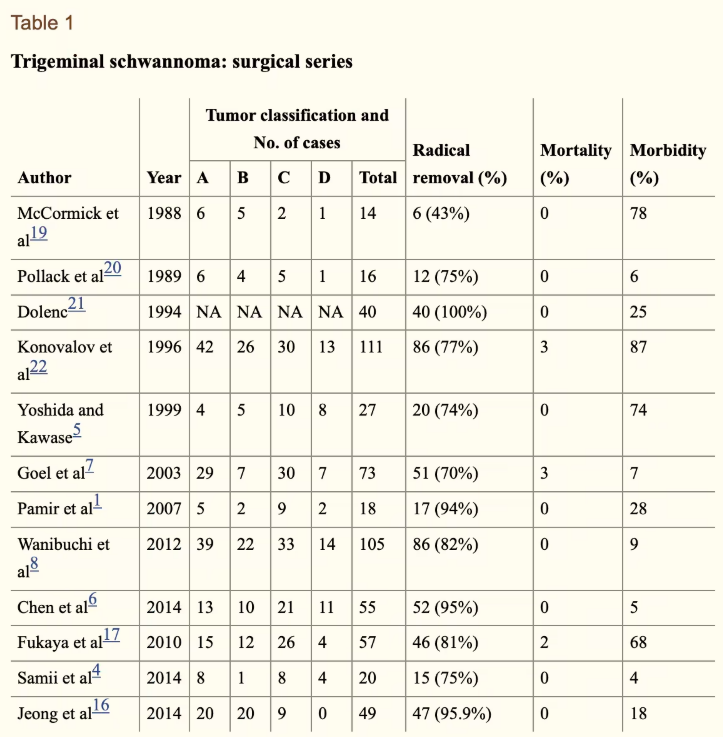
Outcomes of surgical resection have been reported in several series. Some authors report improvement of preoperative paresthesia in the majority of cases, though symptoms that arise following surgical resection frequently persist or worsen. Goel et al. reported improvement of preoperative trigeminal sensory deficits in 40% of patients, with deterioration in 27%. Wanibuchi et al. noted improvement in 16%, no change in 73%, and deterioration in 12%, with new-onset hypoesthesia in additional patients. Chen et al. reported that facial paresthesia remained unchanged in 72% of patients, with improvement in 28%. Other common symptoms are those related to cranial nerve involvement adjacent to the cavernous sinus. Wanibuchi et al. reported diplopia in 20% of patients (86% attributable to abducens nerve deficits and 14% to oculomotor nerve deficits). Al-Mefty et al. noted diplopia in 52% (40% attributable to abducens nerve deficits). Chen et al. reported diplopia in 18% of patients (80% attributable to abducens nerve deficits and 20% to oculomotor nerve deficits), with postoperative improvement in 70%. In a recent study of 20 patients, Samii et al. reported complete resolution of facial pain in all patients, with resolution of cerebellar ataxia in three of four affected patients. Jeong et al. noted that in 51% of cases, trigeminal symptoms either improved or remained unchanged, while the majority of patients with facial paresthesia experienced deterioration. Fukaya et al. studied 57 patients who underwent surgical resection of trigeminal schwannomas: among 45 patients who underwent skull base surgery, gross total resection was achieved in 42 (93%), while 39 of all 57 patients (68%) experienced complications including cranial neuropathy, cerebral contusion, or cerebrospinal fluid leakage. Sharma et al. evaluated 68 surgically treated trigeminal schwannoma cases and reported a gross total resection rate of 76%, a mortality rate of 2%, and a recurrence rate of 15%.
Treatment Modality: Stereotactic Radiosurgery
Although advances in microsurgical technique have substantially reduced perioperative morbidity associated with trigeminal schwannoma surgery, the risk of complications such as cranial neuropathy and cerebrospinal fluid leakage continues to pose a challenge to achieving complete tumor resection. These tumors frequently progress following subtotal resection. Given the risks associated with reoperation, stereotactic radiosurgery (SRS) represents a reasonable alternative for such patients and has been employed as both a primary and adjuvant treatment modality for trigeminal schwannomas. Radiosurgery offers the advantage of high tumor control rates with a low incidence of radiation-related complications.
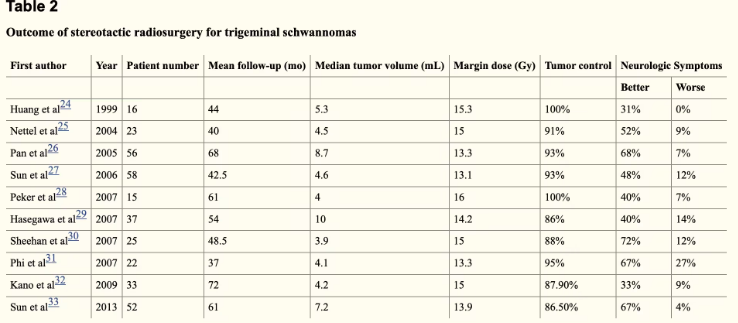
Several reports have highlighted the role of radiosurgery in the multimodal management of these tumors. Table 2 summarizes the outcomes of recent radiosurgical series. Tumor control rates of 79% to 93% have been reported in patients with a mean tumor volume of 4.2 to 8.7 mL, over mean follow-up periods of 4 to 8 years. SRS is associated with a low risk of new neurological deficits. The majority of radiosurgical series report minimal adverse radiation effects beyond facial hypoesthesia or facial pain related to the fifth cranial nerve. In a recent study, Hasegawa et al. demonstrated that morbidity attributable to adverse radiation effects was limited to 10% of patients, manifesting as facial hypoesthesia or facial pain.
Conclusions
Observation, surgical resection, and radiosurgery constitute the therapeutic foundation for the management of trigeminal schwannomas. As in other areas of medicine, the "one-size-fits-all" approach is increasingly giving way to individualized treatment strategies based on patient- and tumor-specific characteristics. Correspondingly, management by a single surgeon has been supplanted by management within a dedicated skull base surgical team capable of offering both transcranial and transnasal approaches, as well as the full spectrum of radiosurgical and microsurgical strategies.
Patients presenting with trigeminal schwannomas require multimodal consultation from a skull base surgical team with expertise in transcranial and transnasal approaches and in both radiosurgical and microsurgical strategies. Neurological symptom improvement, cranial nerve function preservation, and mass effect control are the primary treatment objectives for trigeminal schwannomas.
Gross total surgical resection is the preferred treatment modality but is not feasible in all cases. Radiosurgery serves as the primary treatment for small-to-medium tumors and may be employed for postoperative residual tumor or recurrence. For larger trigeminal schwannomas, a planned strategy of surgical resection followed by SRS for residual tumor is an appropriate option.
For patients with extradural tumors or tumors isolated to Meckel's cave, neuroendoscopic resection is the preferred approach. Detailed analysis of the tumor and its surrounding environment based on high-quality imaging can help more accurately predict the expected outcomes of each treatment modality. A dedicated skull base team should be capable of providing precise individualized counseling to guide the selection of the optimal treatment strategy for each patient.
Reference: J Neurol Surg B Skull Base. 2016 Aug; 77(4): 371–378. Published online 2016 Apr 22. doi: 10.1055/s-0036-1581138
Reference: https://www.incsg.com/sanchaqiaoliu/214.html