2026-06-08
Introduction: A 54-year-old American brain tumor patient recently underwent successful surgical resection of a trigeminal schwannoma located adjacent to the brainstem at the University of Utah School of Medicine. Given the patient's advanced age, the large tumor volume, and the lesion's intimate anatomical relationship with the brainstem and multiple cranial nerves, numerous major hospitals across the United States had declined to offer surgical treatment, citing prohibitively high intraoperative mortality and surgical risk. Under the collaborative efforts of Professor William T. Couldwell and his surgical team at the University of Utah School of Medicine, the operation was completed over the course of several hours. The procedure proceeded without complication, resulting in no adverse effects or neurological injury; postoperative MRI confirmed complete resection.
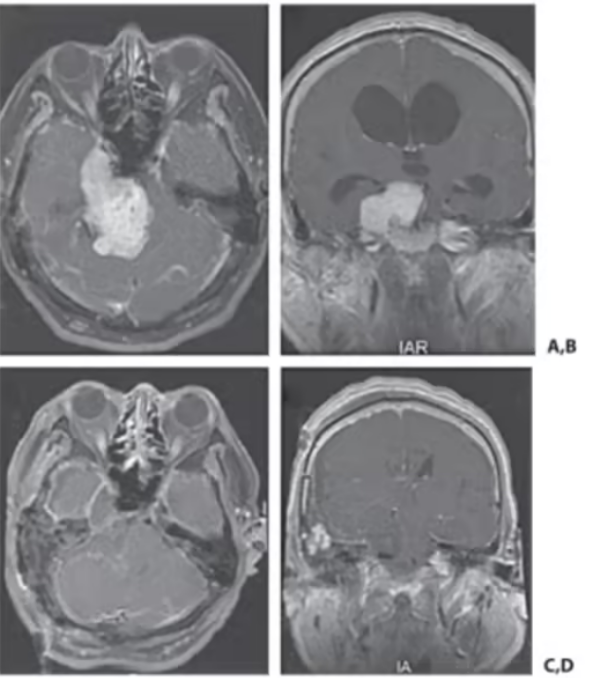
(a, b) Preoperative MRI demonstrating a large trigeminal schwannoma with brainstem compression; (c, d) Postoperative MRI demonstrating complete resection.
A Patient Turned Away at Every Door
The patient had recently been experiencing gait instability and loss of balance, with episodes of sudden-onset vertigo followed by unsteady walking that would resolve spontaneously between attacks. Initially attributing these symptoms to the normal effects of aging, the patient did not seek immediate medical attention. However, the symptoms rapidly worsened over a short period of time, and the patient ultimately sustained a fall down a staircase. Subsequent MRI at a local hospital revealed a large trigeminal schwannoma within the cranium, which had been exerting severe compression on the brainstem — accounting for the rapid symptom progression. While trigeminal schwannomas are not inherently difficult to treat, the brainstem compression in this case multiplied the operative difficulty and risk several-fold. The patient consulted multiple major hospitals, all of which indicated that treatment would be exceedingly difficult to provide.
Traveling Far in Search of Hope
The patient subsequently traveled a great distance to the state of Utah, arriving at the renowned University of Utah School of Medicine. Professor William T. Couldwell, Chairman of the Department of Neurosurgery at the University of Utah, personally evaluated the patient and expressed confidence in his ability to perform a successful operation.
Professor Couldwell noted that schwannomas are among the more common benign skull base tumors, arising from the sheaths of cranial nerves along the cerebellum and brainstem. The most frequently encountered types are the vestibular schwannoma of the eighth cranial nerve (also known as acoustic neuroma) and the trigeminal schwannoma of the fifth cranial nerve. Trigeminal schwannomas are the second most common intracranial schwannomas after vestibular schwannomas, accounting for 0.07% to 0.36% of all intracranial tumors and 0.8% to 8% of all intracranial schwannomas. While trigeminal schwannomas are not inherently difficult to treat, those exerting brainstem compression by virtue of their parabrainstem location do present substantially greater surgical challenge.
Complete Resection Achieved via the Combined Transpetrosal Approach
For this patient's large trigeminal schwannoma adjacent to the brainstem, Professor Couldwell conducted discussions with colleagues and formulated an individualized treatment plan. It was ultimately determined that the correct combined transpetrosal approach would enable complete tumor resection. Under the joint efforts of Professor Couldwell and his surgical team, the tumor was successfully removed over the course of several hours, with postoperative MRI confirming complete resection.
Professor Couldwell's Analysis: The Future of Skull Base Tumor Surgery
Regarding skull base tumor surgery, Professor Couldwell observed that skull base tumors are frequently in intimate association with the surrounding neurovascular structures, rendering complete resection technically demanding. Because skull base tumors can extend into adjacent compartments, both intracranial and extracranial structures may be involved. A multidisciplinary approach is therefore essential for optimal surgical management.
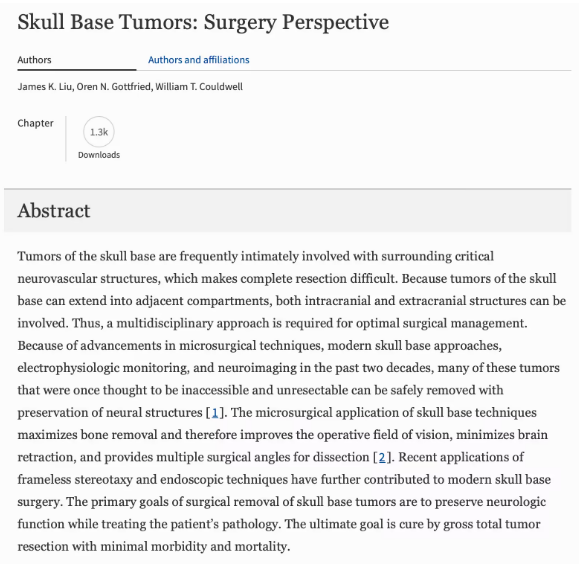
Owing to advances over the past two decades in microsurgical technique, modern skull base approaches, electrophysiological monitoring, and neuroimaging, many tumors once considered inaccessible or unresectable can now be safely removed with preservation of neurological function. The application of skull base techniques in microsurgery maximizes the operative field, minimizes brain retraction, and provides multiple surgical angles for dissection. In recent years, the integration of frameless stereotaxy and endoscopic techniques has further advanced the field of modern skull base surgery. The primary objective of skull base tumor resection is to address the patient's pathology while preserving neurological function. The ultimate goal is curative gross total resection achieved with the lowest possible morbidity and mortality.
Finally, INC International Neurosurgery wishes to remind patients that brain tumors are complex and challenging conditions. Patients are advised to seek care at qualified medical institutions and to consult neurosurgical specialists for diagnosis and treatment. With current medical standards, patients who receive scientifically sound and appropriate treatment — even those diagnosed with brain tumors — can achieve satisfactory outcomes.
Case excerpted from the published work of Professor William T. Couldwell: https://link.springer.com/chapter/10.1007%2F978-0-387-71070-9_38
Reference: https://www.incsg.com/sanchaqiaoliu/209.html