2026-06-08
IIntroduction: The human brain gives rise to 12 pairs of cranial nerves. The trigeminal nerve, designated the fifth cranial nerve, derives its name from its three branches: the ophthalmic nerve (V1), the maxillary nerve (V2), and the mandibular nerve (V3). After emerging from the brainstem, the trigeminal nerve divides into these three branches at the Gasserian ganglion (semilunar ganglion) within the petrous portion of the temporal bone. The branches then pass through foramina at the skull base to enter the orbit, the pterygopalatine fossa, and the infratemporal fossa, respectively, where they ramify further to innervate the skin of the face and the mucosa of the nasal and oral cavities. The trigeminal nerve is primarily responsible for superficial sensation in its distribution territories; its motor branch governs a portion of the masticatory muscles, subserving mastication and occlusion.
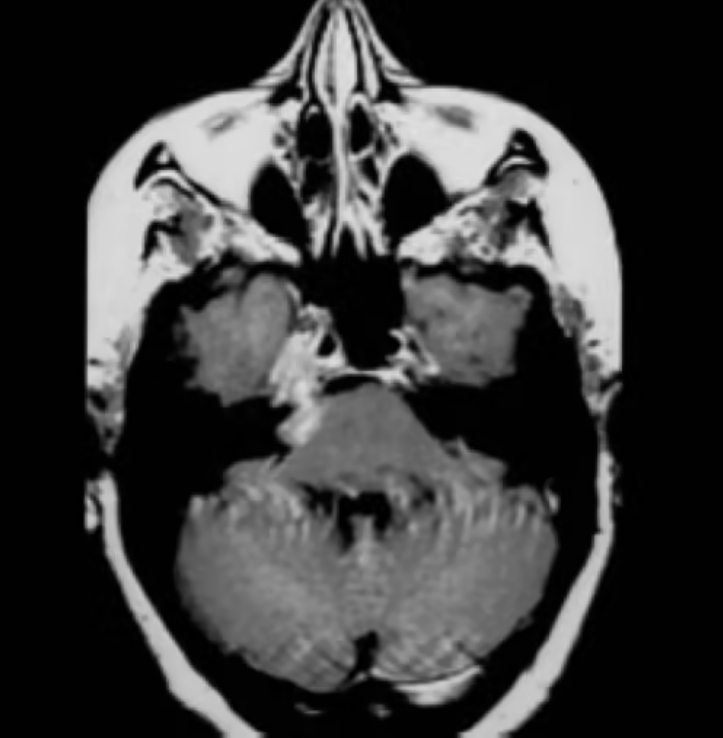
What Is a Trigeminal Schwannoma?
A trigeminal schwannoma is, as the name implies, a tumor arising from the trigeminal nerve. What, then, is a schwannoma? If one imagines a nerve as an electrical cable, the nerve fibers within correspond to the copper wire at the core, while the surrounding nerve sheath corresponds to the insulating jacket. A schwannoma is a tumor that originates from this peripheral nerve sheath encasing the nerve fibers.
The incidence of trigeminal schwannomas is approximately 3%–4% that of vestibular schwannomas (acoustic neuromas). Most tumors arise from the Gasserian ganglion in the middle cranial fossa and present as middle fossa lesions; others originate from the postganglionic rootlets and present as posterior fossa lesions, while still others straddle the middle and posterior fossae to form a dumbbell-shaped configuration. The symptomatic period of trigeminal schwannomas is longer than that of vestibular schwannomas, typically exceeding one year, and in one-third of patients extending to 10–14 years. The earliest symptoms are usually unilateral paroxysmal facial pain or facial numbness, followed by progressive weakness and atrophy of the masticatory muscles; the condition is frequently misdiagnosed as a vestibular schwannoma.
What Makes Surgery for Trigeminal Schwannoma Challenging?
The diagnosis of trigeminal schwannoma is established primarily on the basis of clinical signs of trigeminal nerve dysfunction and characteristic findings on neuroimaging. The principal treatment is surgical resection; however, owing to the deeply situated location of the tumor and the complexity of the adjacent neurovascular structures, the surgery carries considerable difficulty and risk. Failure to achieve an adequate extent of resection may result in numerous complications, including facial nerve palsy, cerebrospinal fluid leakage, intracranial hematoma, lower cranial nerve palsy, and meningitis.
With advances in skull base microanatomy and microsurgical technique, an increasing variety of surgical approaches has become available, the rate of gross total resection has steadily improved, and surgical morbidity has declined accordingly. Professor William T. Couldwell — a member of the INC International Neurosurgical Advisory Group (WANG) and current President of the World Academy of Neurological Surgery — has emphasized that when a tumor maintains a displacement and compression relationship with the brainstem, cranial nerves, and cavernous sinus, sharp dissection under direct microscopic visualization is generally feasible; inability to resect a given portion is most often attributable to inadequate surgical exposure rather than true unresectability, and one must not sacrifice critical structures in the pursuit of blind tumor removal. Professor Couldwell and several other internationally recognized neurosurgical authorities share the view that, in patients without preoperative cranial nerve deficits, aggressive gross total resection should not be pursued at the expense of functional integrity; preservation of neurological function must remain the primary objective, with adjuvant radiotherapy employed postoperatively to control or eradicate residual tumor. In the illustrative case presented here, the onset of bradycardia intraoperatively prompted a modification of the resection strategy, ultimately permitting complete tumor removal.
The Critical Importance of the Initial Treatment Decision
The choice of initial treatment for trigeminal schwannoma is of paramount importance, as an ill-considered treatment strategy will not only fail to alleviate the patient's condition but will also substantially increase the complexity of subsequent management. Treatment planning is guided primarily by the patient's age, the nature and severity of symptoms, and tumor size.
For small tumors (generally less than 2 cm in maximum diameter) presenting with facial numbness or mild-to-moderate pain, and for elderly patients, stereotactic radiosurgery may be considered.
For large trigeminal schwannomas, surgery remains technically challenging — a consequence of the anatomical characteristics of the trigeminal nerve and its course through the skull base. Appropriate surgical approaches include anterior, lateral, posterior, transdural, extradural, and interdural routes; the selection of operative technique is complex and must be individualized according to tumor size, location, and other relevant factors. Accordingly, these cases demand both advanced surgical infrastructure and a high level of technical expertise from the operating neurosurgeon.
INC (International Neurosurgeon's Circle) is an international neurosurgical consortium. Its International Neurosurgical Advisory Group (WANG) comprises more than ten preeminent neurosurgical authorities — including Professor William T. Couldwell — who hold membership in the World Federation of Neurosurgical Societies (WFNS) and various international neurosurgical academic organizations, serve as editors-in-chief of leading international neurosurgical journals, and have had surgical techniques and anatomical structures named after them in neurosurgical textbooks. While dedicated to fostering international academic and technical exchange in neurosurgery, INC also provides patients in China who are affected by brain tumors — including ependymomas, meningiomas, and gliomas — with access to internationally oriented consultations and comprehensive surgical planning from the advisory group's international faculty. Consultations with international neurosurgical faculty members are available by calling the INC International Medical Hotline at 400-029-0925 or by following the official WeChat public account "INC International Neuroscience."
Reference: https://www.incsg.com/sanchaqiaoliu/202.html